A 2024 Bain & Company survey found that roughly 80% of U.S. consumers relied on zero-click search results for at least 40% of searches, and generative AI is pushing more discovery into summarized answers rather than link lists alone. In that environment, law firm reviews matter, but not in the simple way the phrase “ChatGPT recommendation” suggests. Your review profile can influence how AI systems surface, describe, and compare your firm, yet the effect is usually indirect and depends on the wider set of signals attached to your online presence.
What “ChatGPT Recommendation” Actually Means for a Law Firm
When a prospect asks ChatGPT for “the best personal injury lawyer in Phoenix” or “estate planning attorneys near me,” the output can take several forms. Sometimes the system gives a general explanation and avoids naming firms. Sometimes it lists firms pulled from live web sources. Sometimes it summarizes categories such as “firms known for strong client communication” without making a formal endorsement. In search-connected AI products, the result may also include citations, maps, business listings, or links to directories.
That distinction matters because “recommendation” is not a single behavior. A direct endorsement is different from a conversational suggestion, and both differ from appearing in an AI-generated local pack or a cited comparison answer. In regulated services such as legal, AI systems often use more cautious language and may prefer “here are some options to evaluate” over “you should hire this firm.”
Your core question is narrower and more practical: do law firm reviews make your firm more likely to appear, or appear favorably, in AI-assisted discovery experiences? Evidence suggests that reviews can contribute to visibility and description quality, but only as one input among many. The mechanism is less like a star-rating switch and more like a trust layer that supports entity recognition, local prominence, and topical corroboration.
Finding: “ChatGPT recommendation” usually means AI-assisted visibility or favorable description, not a simple one-step endorsement driven by reviews alone.
How ChatGPT Gets Information Before It Mentions Any Law Firm
OpenAI documentation explains that ChatGPT responses may draw from pretrained knowledge, user-provided context, and, in some product configurations, web browsing or connected search results (OpenAI). Microsoft and Google describe similar hybrid systems in which generative answers may be grounded in live retrieval, index data, and ranking systems rather than only static model memory (Microsoft, Google).
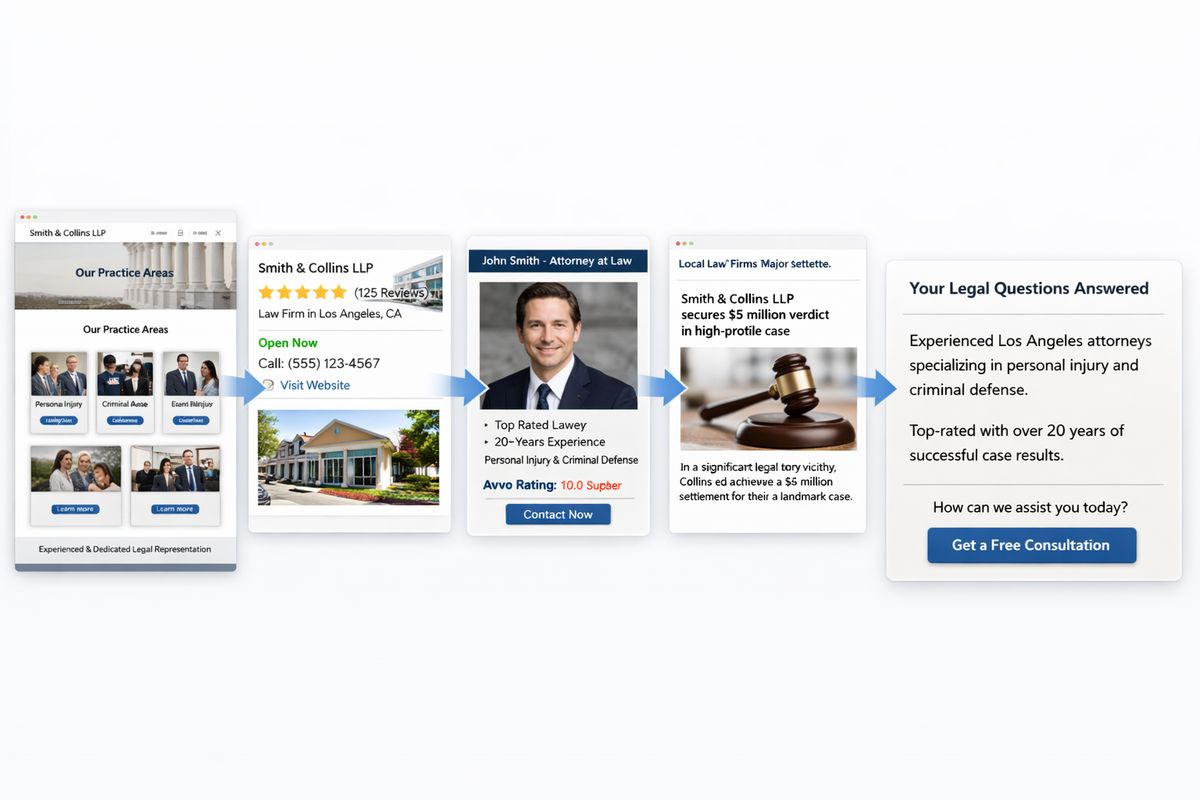
For a law firm, that means your mentions can come from several classes of source. Your website supplies first-party information such as services, locations, attorneys, and FAQs. Business listings supply local signals such as categories, addresses, and review counts. Review platforms add sentiment and client language. Legal directories add structured profile data, awards, admissions, and practice-area labels. News coverage, bar profiles, and speaking pages can add authority and corroboration.
The catch is that no public source provides a complete formula for how every AI answer is assembled for legal queries. Public documentation describes categories of inputs and safety constraints, but not a law-firm-specific ranking formula. So the available evidence supports inference rather than certainty.
If your firm is evaluating how AI-assisted legal discovery differs from traditional search, this is the starting point: AI answers are usually assembled from the same public web environment that already shapes search visibility, but with an added summarization layer.
Finding: ChatGPT-related law firm mentions can come from training data, live retrieval, listings, directories, and websites, but no public source discloses a full legal recommendation formula.
Training Data, Retrieval, and Connected Search Results
OpenAI states that some ChatGPT experiences can browse the web and provide links to sources, while baseline model behavior also reflects patterns learned during training (OpenAI Help Center). Google’s AI Overviews and Microsoft’s Copilot similarly rely on retrieval at query time to ground answers in current information (Google, Microsoft).
That difference changes how reviews may matter. Training data can encode that a firm, directory, or platform exists, especially if the source has broad web visibility. Retrieval-based systems, by contrast, can access current reviews, updated profiles, recent complaints, newer location pages, and fresh rankings. In practical terms, recent reviews are far more likely to shape a live AI summary than a static model response generated without current retrieval.
For law firms, retrieval-based behavior matters more because legal search often depends on location, jurisdiction, and current reputation. A stale answer is less useful when a user asks for firms “near me” or “with strong reviews this year.” That is one reason understanding how AI systems choose legal sources matters more than treating ChatGPT as a closed black box.
Limitation: product behavior varies by interface, subscription tier, region, and whether browsing is enabled, so the same prompt may not produce the same sourcing behavior in every environment.
Finding: Reviews are more likely to influence AI outputs when the system retrieves live web information than when it relies only on pretrained knowledge.
Why Legal Directories and Review Platforms Can Become AI Inputs
Google Business Profiles, Avvo, Lawyers.com, Yelp, Best Lawyers, and Super Lawyers all publish structured information that machines can parse: names, locations, categories, ratings, profile text, awards, and sometimes review excerpts. Structure matters because AI systems do not “trust” all text equally. Pages that clearly identify a law firm, practice area, city, attorney, and review content are easier to retrieve and summarize than scattered mentions on low-quality pages.
Authority matters too. A directory with strong domain visibility, consistent profile templates, and crawlable content may be easier for search systems to understand than a smaller site with the same number of reviews. A firm with 25 reviews on a highly visible directory may be more retrievable than a firm with 60 reviews on a weak platform that is rarely surfaced in search results.
Crawlability adds another layer. If review content is blocked, heavily scripted, truncated, or hidden behind interaction walls, AI retrieval may not access much of it. In that case, the platform’s existence still helps with entity validation, but the review text itself may contribute less.
Finding: Review platforms become useful AI inputs when authority, structure, and crawlability make your review data easy to retrieve and summarize.
Do Law Firm Reviews Help ChatGPT Recommend You? The Short Answer
Yes, but indirectly.
Reviews appear to help by strengthening the signals that AI systems encounter across search, local listings, and directory pages. Volume can indicate prominence. Recency can indicate current activity. Detailed language can indicate service quality, matter type, and location relevance. Strong reviews on visible platforms can reinforce that your firm is real, active, and trusted in a specific market.
But reviews are not a standalone ranking lever for ChatGPT. No OpenAI documentation states that star ratings or review count act as a direct factor in firm selection. A firm with excellent reviews can still be absent from AI answers if core entity signals are weak, the website is thin, or legal directories lack depth. The reverse also occurs. Some firms are named because strong directory authority, press mentions, attorney reputation, or highly relevant service pages give AI systems enough confidence even when public review volume is limited.
That counter-finding matters most in sophisticated practice areas. A boutique appellate or antitrust firm may appear in AI-generated comparisons because legal publications, attorney bios, and case history are highly visible, even if the public review footprint is small.
Finding: Law firm reviews appear to help AI visibility indirectly, but reviews alone do not guarantee inclusion or favorable mention.
Which Review Signals Are Most Likely to Matter
Google’s local search documentation says local results are based on relevance, distance, and prominence, and prominence includes information from across the web such as links, articles, and directories (Google Business Profile Help). Reviews fit that framework because they add both prominence and descriptive relevance, especially when review text mentions location, services, and quality.
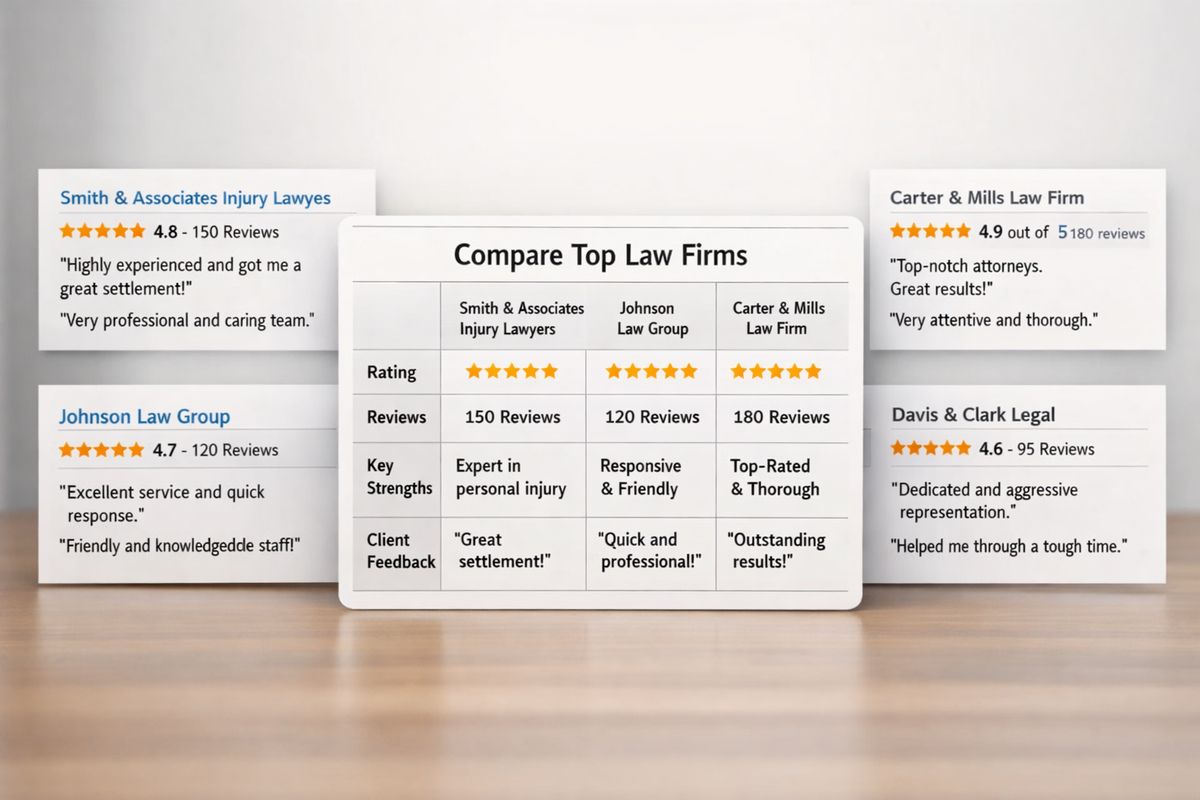
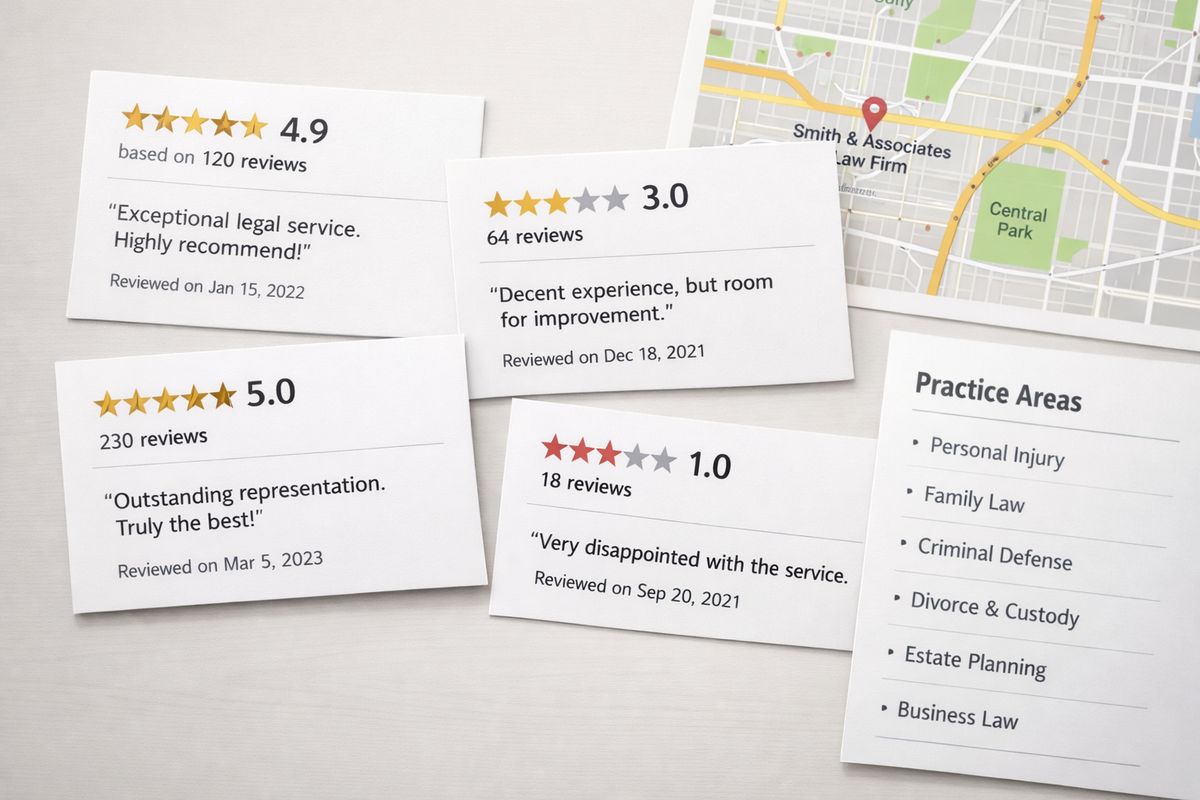
For AI-assisted discovery, the most plausible review signals are average rating, total review count, recency, specificity of language, practice-area relevance, geographic relevance, reviewer credibility, and consistency across platforms. None is likely to act alone. Instead, each one helps increase confidence when your firm is summarized against a specific query.
Average rating is the simplest signal, but it is also the easiest to misread. A 4.9 rating with 12 reviews may carry less practical weight than a 4.7 rating with 180 recent reviews in a competitive metro area. Total review count can suggest market presence, but generic praise contributes less usable information than reviews that mention “rear-end collision,” “child custody hearing,” or “Spanish-speaking staff in Mesa.”
Reviewer credibility also matters indirectly. Platforms with verified profiles, contribution histories, and anti-spam systems tend to produce more trusted signals than anonymous low-friction review pages. Consistency matters as well. If your firm has strong ratings on Google, Avvo, and Lawyers.com, with aligned attorney names and office locations, that pattern is easier for AI systems to treat as corroborated.
Finding: The review signals most likely to matter are the ones that reinforce trust, location, and practice relevance across multiple visible sources.
Review Volume vs. Review Quality
A 2023 BrightLocal Local Consumer Review Survey found that consumers increasingly evaluate both star rating and written content, with recency and detail shaping trust more than raw quantity alone. That does not answer the ChatGPT question directly, but it does show what underlying platforms reward and what users respond to before conversion.
For AI systems, detailed reviews offer more semantic material than generic praise. “Excellent attorney, highly recommend” supplies almost no context. “Helped with a truck accident case in Tucson, returned calls within a day, explained medical lien issues clearly” supplies practice area, location, responsiveness, and subject-matter clues. That kind of language can support summarization in a way star counts alone cannot.
Volume still matters because it can strengthen prominence and reduce volatility. A single negative review can distort perception when your total count is low. A larger review base creates a more stable signal set. But once a baseline level of visibility exists, a smaller number of strong, specific, recent reviews may contribute more useful AI-readable information than a large archive of vague praise.
Limitation: no published study isolates the effect of review text specificity on ChatGPT recommendations for law firms specifically.
Finding: Review quality, especially specificity and recency, likely contributes more AI-usable context than sheer volume once basic prominence is established.
Recency and Ongoing Trust Signals
BrightLocal’s 2023 survey reported that 85% of consumers consider reviews older than three months less relevant in at least some situations, and 40% pay attention only to reviews written within the past two weeks to two months (BrightLocal). That is a consumer-trust finding, but it also aligns with how search systems reward freshness in many local contexts.
For legal services, recency can function as a proxy for current operating quality. Staffing changes, attorney departures, office moves, and response-time shifts all affect user experience. Fresh reviews can signal that your firm is active and still delivering the attributes older reviews describe. AI summaries grounded in current retrieval may therefore lean on recent review language when available.
Historical totals still count toward prominence, especially on established profiles. But a review profile that stopped growing two years ago may look less trustworthy than one with a smaller total and a steady stream of current feedback. In local, high-trust services, stale praise loses explanatory power.
Finding: Recent reviews tend to carry more practical value than old review totals because they reinforce current trust and active market presence.
Practice Area and Location Match
Queries for lawyers are often narrow. A prospect rarely asks for “a good law firm” in general. More often the prompt is “best divorce lawyer in Naperville,” “immigration attorney near me,” or “Phoenix car accident lawyer with good communication.” Reviews that mention the matter type, city, neighborhood, court, or attorney specialty align more closely with those prompts.
Google’s local ranking framework rewards relevance in addition to distance and prominence (Google). AI systems built on public search and retrieval signals inherit that logic because they still need matching evidence. A review that mentions “probate in Maricopa County” or “DUI case in Scottsdale” gives a system specific contextual hooks. General praise does not.
This does not mean clients should be coached to use keywords in reviews. That creates ethical and authenticity problems. It means naturally specific reviews are more useful than generic ones, especially when your target market searches by both service and location.
Finding: Reviews that naturally mention matter type and geography are more likely to support AI visibility than broad firm-level compliments.
What Existing Evidence Says About Reviews and AI-Era Visibility
Google’s published local guidance and annual local SEO research provide the strongest external evidence, even though neither source measures ChatGPT directly. A 2023 BrightLocal survey found that 87% of consumers used Google to evaluate local businesses in the prior year, reinforcing how heavily local discovery still depends on public review ecosystems. For law firms, that matters because AI-generated recommendations often sit downstream from the same ecosystem of profiles, directories, and visible web sources.
The evidence base falls into three buckets. Search ranking research examines how reviews correlate with local visibility. Consumer behavior research examines how reviews affect clicks and trust. Legal marketing benchmarks examine how directory profiles and reputation influence engagement within legal-specific channels. None of these alone proves how ChatGPT ranks firms. Together, though, the pattern is fairly clear: reviews influence the discoverability environment from which AI systems retrieve.
A limitation remains. AI answer interfaces are changing faster than legal-industry research cycles. Much of the best available evidence still comes from local SEO and directory performance, not direct law-firm testing inside every AI product.
Finding: Existing evidence supports reviews as an indirect contributor to AI-era visibility, mainly through the broader local and search ecosystem rather than a disclosed ChatGPT factor.
What Google Says About Prominence and Reviews
Google states that local ranking is based on relevance, distance, and prominence, and notes that prominence reflects information Google has about a business from across the web, including links, articles, and directories (Google). Reviews are not listed as the only factor, but Google Business Profile documentation and platform behavior make clear that review quality, quantity, and responsiveness affect local visibility and user interaction.
For your law firm, the practical point is not that ChatGPT “uses Google reviews directly” in every case. The point is that public web prominence, including reviews, already shapes which sources are visible and trusted. If AI products retrieve from the open web, a stronger local prominence profile gives your firm more opportunities to be seen, cited, or summarized.
There is also a limitation. Google’s ranking guidance is broad and non-quantitative. It does not disclose the precise weight of reviews for legal categories, and prominence includes many non-review signals.
Finding: Google treats reviews as part of local prominence, which makes them relevant to AI discovery even without a direct ChatGPT review factor.
What Local SEO Studies Indicate
Whitespark’s annual local search ranking factor studies consistently place review signals among meaningful contributors to local pack performance, alongside Google Business Profile factors, on-page signals, and links (Whitespark). These studies rely on expert surveys rather than controlled experiments, so the findings are directional rather than definitive. Still, they are useful because they aggregate practitioner observations across thousands of local campaigns.
BrightLocal’s consumer research adds the behavioral layer. Star rating, review count, and recency all influence click decisions, and owner responses can affect trust perception (BrightLocal). That means reviews influence both ranking-adjacent visibility and downstream conversion behavior. For AI systems that try to summarize “highly rated” or “well-reviewed” options, those same patterns are likely to matter.
Correlation is not causation. Review-rich firms may also invest more in website quality, citations, and local SEO. But correlation still matters when AI retrieval chooses among publicly visible sources.
Finding: Local SEO studies indicate that reviews are meaningful visibility signals, though the relationship is correlational and mixed with other local ranking factors.
What Legal Marketing Benchmarks Indicate
Legal-specific public datasets are thinner than local SEO research, but legal directories themselves provide strong clues. Lawyers.com highlights more than one million lawyer reviews and centers detailed profiles in its attorney discovery experience (Lawyers.com). Avvo and similar platforms also foreground ratings, reviews, practice areas, and attorney credentials because those attributes affect profile engagement and selection behavior.
In legal marketing practice, review-rich profiles tend to perform better in consumer-facing categories because prospects compare nearby firms using trust shortcuts. Legal-specific performance evidence often appears in agency benchmarks or private datasets rather than peer-reviewed studies, which limits how far the evidence can be generalized. Sample sizes are not always disclosed, and methodology can vary.
That limitation matters. Public legal marketing evidence is suggestive, not conclusive. But the direction is consistent: for consumer law categories, review content and directory completeness affect profile attractiveness and conversion, which increases the odds that visible profiles are also the ones AI systems encounter.
Finding: Legal marketing benchmarks are less standardized than local SEO research, but available evidence suggests reviews matter most for consumer-facing firm profiles and directory engagement.
Where Reviews Fit in the Larger AI Trust Stack
Reviews sit inside a broader trust stack. They do not replace authority, and they do not create a complete entity on their own. AI systems still need to understand who you are, what you do, where you practice, and why public sources consistently describe your firm in similar terms.
That wider stack includes your website’s practice pages, attorney bios, office location details, schema markup, local citations, bar admissions, professional awards, media mentions, case-related content, and directory consistency. Reviews help validate that stack from a third-party perspective. In effect, they tell a system that the claims attached to your firm are not only self-published.
If your firm is trying to improve visibility across AI-oriented legal search environments, reviews should be treated as corroboration, not isolation. The strongest pattern is consistency across sources, not excellence in one source and weakness everywhere else.
Finding: Reviews function best as one layer in a larger AI trust stack built from authority, relevance, and entity consistency.
Reviews vs. Firm Website Content
Your website gives AI systems the most controlled version of your identity. Practice-area pages define services. Attorney bios define credentials. FAQs define client questions. Case-result summaries and local pages define context. Structured data can make those elements easier to parse.
Reviews do something different. They provide third-party corroboration. If your site says you handle catastrophic injury litigation in Tampa and your reviews independently mention truck accidents, communication, and trial preparation in Tampa, your topical and geographic identity becomes easier to trust. If your site claims broad strengths that never appear in reviews or directories, confidence is lower.
For that reason, clear service-page architecture often matters just as much as review generation. AI cannot summarize strengths it cannot verify somewhere structured and crawlable.
Finding: Your website defines your services, while reviews validate them from an outside perspective, and both are stronger when they agree.
Reviews vs. Legal Directory Authority
A profile on a strong legal directory can outperform a weak standalone review footprint because directories bundle authority, structure, and topic relevance. A complete Avvo or Lawyers.com profile may contain practice areas, office data, admissions, awards, peer information, and review content in one crawlable page. That is efficient for both search and AI retrieval.
By contrast, accumulating reviews on obscure platforms may add little if those pages have low visibility and poor structure. Platform quality often matters more than platform count. A small number of strong presences on high-visibility legal and local platforms generally creates a better retrieval footprint than scattered profiles across ten weak sites.
This is also why understanding why some firms appear in AI-generated legal results requires looking beyond reviews alone and toward the authority of the pages carrying those reviews.
Finding: Strong legal directories can carry more AI visibility value than a larger number of reviews on low-authority platforms.
Reviews vs. Traditional Backlinks and Mentions
Reviews and backlinks solve different problems. Reviews mainly support trust, sentiment, and local relevance. Backlinks and earned mentions support authority and prominence. A news citation from a local paper, a state bar profile, or a law school speaking page tells search systems that your firm is notable. A review tells them that clients describe your services in specific ways.
Neither replaces the other. A firm with excellent reviews but no authoritative mentions may look locally liked yet broadly weak. A firm with strong press and backlinks but no review footprint may look prestigious but thin in consumer validation. The best-performing firms usually have both.
Finding: Reviews support trust and corroboration, while backlinks and mentions support authority, and AI visibility benefits from both.

When Reviews Are Most Likely to Influence AI Recommendations
Reviews are most likely to influence AI outputs when the prompt itself implies comparison, trust, or local consumer choice. Queries containing “best,” “top-rated,” “near me,” “most reviewed,” or a city plus practice area naturally push retrieval systems toward review-rich business listings and directories.
That effect is strongest in commoditized or comparison-heavy legal markets, where multiple firms offer the same service within the same geography. If five nearby personal injury firms all have competent websites, the one with stronger review signals may have a clearer edge in public local platforms and therefore more opportunities to be summarized in AI outputs.
The effect is weaker when prompts ask for legal analysis rather than provider comparison. A query like “what is the statute of limitations for wrongful death in Arizona” favors informational authority. A query like “who are highly rated wrongful death lawyers in Phoenix” favors trust and local prominence.
Finding: Reviews matter most in AI prompts that imply local comparison, quality judgment, or consumer trust shortcuts.
Local Consumer Practice Areas
Personal injury, family law, criminal defense, estate planning, immigration, and bankruptcy tend to be more review-sensitive because prospects often compare multiple nearby firms quickly. These categories involve personal stakes, uneven information, and high dependence on trust cues. Reviews become a practical shortcut.
Google Business Profiles and legal directories are also heavily used in these categories, which raises the chance that review-rich profiles will be retrieved by AI systems. Narrative review content can further help because clients naturally mention responsiveness, clarity, language support, and outcome-related context in these fields.
If your firm serves these practice areas, local search fundamentals for AI visibility carry more weight because your review profile is closely tied to the platforms AI systems are likely to summarize.
Finding: Consumer-facing local practice areas are the most review-sensitive category for AI-assisted firm discovery.
High-Complexity or Corporate Practice Areas
M&A, securities, antitrust, appellate, complex commercial litigation, and some regulatory specialties operate differently. Prospects in these areas often rely less on public review platforms and more on rankings, referrals, case history, publications, speaking, and attorney credentials. A generalized review profile may do little to influence the decision set.
AI systems responding to prompts about these practices may therefore prioritize legal publications, Am Law coverage, chambers-style rankings, firm thought leadership, and attorney biography content. Review volume can still contribute to legitimacy, but it may not drive mention inclusion in the same way it does for family law or personal injury.
This is the strongest counter-case to the “reviews drive recommendations” idea. In institutional legal buying, non-review authority signals often dominate.
Finding: In high-complexity corporate practice areas, reviews usually matter less than reputation, expertise, and authority signals.
When Reviews Probably Matter Less Than You Expect
A strong review profile cannot compensate for weak core visibility infrastructure. If your office locations are inconsistent across platforms, your website lacks detailed service pages, attorney bios are thin, or legal directories are incomplete, reviews have less to attach to. AI systems can summarize only what they can corroborate.
Reviews also matter less when the system is constrained by safety and neutrality policies. Legal services sit in a sensitive category because poor recommendations can carry serious consequences. Some AI products therefore avoid strong endorsements and default to broader guidance or neutral lists. In those cases, reviews may influence phrasing or inclusion, but not the presence of a direct “recommended” statement.
That is why measuring your actual appearance in AI answers is more useful than assuming review growth will automatically change outputs.
Finding: Reviews lose impact when your entity signals are weak or when AI safety policies limit direct legal recommendations.
Safety Policies and Legal-Service Caution
OpenAI and Google both describe safeguards around high-stakes or sensitive topics, including areas that can affect health, finances, or legal outcomes (OpenAI Safety, Google Search Quality Evaluator Guidelines). Legal advice falls within that caution zone.
In practice, this means AI assistants may hedge. Instead of “hire Firm X,” the output may say “consider looking for firms with strong reviews, relevant experience, and local credentials.” Even when firms are named, the wording may stay comparative and cautious. That reduces the chance that reviews alone produce a clean recommendation event.
The limitation is that safety behavior differs across products and prompt wording. Still, legal-service caution is consistent enough to treat as part of the environment.
Finding: AI caution in legal topics reduces the likelihood that reviews alone will trigger explicit firm recommendations.
Weak Entity Signals Elsewhere in Your Presence
Positive reviews are easy to overvalue when other signals are underdeveloped. Inconsistent name, address, and phone data across listings can fracture your identity. Sparse attorney bios can obscure expertise. Missing schema can limit machine readability. Thin practice-area pages can make relevance difficult to establish.
When those weaknesses exist, AI systems have less confidence in your firm as a well-defined entity. Reviews may still help trust, but trust without clear identity produces weaker retrieval outcomes. In many cases, improving entity clarity yields more impact than adding another dozen generic five-star reviews.
Finding: Weak entity signals across your website and listings can blunt the effect of even a strong review profile.
How ChatGPT May Interpret Review Content, Not Just Ratings
Generative AI is built to summarize language patterns. That means review text can matter not only as sentiment, but as descriptive evidence. If multiple reviews mention “fast communication,” “clear billing,” “bilingual staff,” or “strong courtroom presence,” those repeated phrases can shape how your firm is described in an answer.
This is where ratings and text diverge. A 4.8 average tells a system that sentiment is positive. Review text tells a system what is positive about your firm. In comparative prompts, that difference is useful. A summary that says your firm is “often praised for responsiveness and clear case updates” is built from language patterns, not star counts alone.
There is a limitation. Some review text may be truncated, hidden, filtered, or inaccessible to retrieval systems depending on platform design. AI systems also vary in whether they quote, paraphrase, or ignore review details. So the semantic layer is plausible and often observable, but not uniformly accessible.
Finding: Review text can shape AI-generated firm descriptions because repeated phrases provide semantic evidence that ratings alone cannot.
Phrases That Reinforce Practice-Area Relevance
When reviews repeatedly mention specific matter types, jurisdictions, or legal problems, your topical profile becomes more defined. “Helped with green card interview prep,” “handled my custody modification,” or “resolved a rear-end collision case” gives a system usable associations for future prompts.
These phrases matter because prompts are rarely abstract. A user usually describes a need. Reviews that mirror those needs supply machine-readable alignment between the firm and the problem. This is especially useful when your website and directory profiles also use the same language naturally.
Finding: Review phrases tied to specific legal matters strengthen topical alignment for AI-driven matching.
Phrases That Reinforce Service Experience
Operational descriptors matter too. Clients often describe communication speed, empathy, professionalism, transparency, staff responsiveness, and billing clarity. Those attributes may not define legal expertise, but they strongly influence comparative summaries.
In local consumer categories, AI systems may describe firms partly through service experience because that is what public review text offers most consistently. If your reviews repeatedly mention delayed callbacks or confusion about fees, those patterns can be just as visible as positive themes.
Finding: Repeated service-experience language can influence how AI compares and summarizes your firm, even when legal skill is harder to infer directly.
Common Misconceptions About Law Firm Reviews and AI Visibility
The current discussion around AI search has created several review myths. Most come from taking a real signal and overstating it. Reviews matter, but usually as one part of a broader retrieval environment.
A useful way to evaluate any claim is simple: does a named source support a direct ChatGPT ranking effect, or only a related local search or trust effect? In most cases, the evidence supports the second category.
Finding: Most misconceptions come from confusing reviews’ indirect visibility role with a direct AI ranking formula.
“More 5-Star Reviews Automatically Means More AI Mentions”
Local ranking research suggests reviews contribute to prominence, but no public OpenAI source states that more five-star reviews automatically increase mentions. Quantity can help only when your firm is already visible, relevant, and well-defined across authoritative sources.
A weak site with many reviews may still lose to a stronger entity with fewer reviews. Review count is best understood as a supporting signal, not an automatic inclusion trigger.
Finding: More five-star reviews can help, but only within a wider framework of relevance, authority, and entity strength.
“ChatGPT Uses Only Google Reviews”
AI systems can retrieve from multiple public sources, depending on the product and retrieval layer. Google Business Profiles matter a lot for local discovery, but legal directories, firm websites, bar listings, media, and other review platforms can also shape outputs.
That is why a multi-platform presence matters more than a single-source strategy, especially in legal categories.
Finding: ChatGPT-related firm mentions are not limited to Google reviews and may reflect multiple public sources.
“Old Reviews Keep Working Forever”
Older reviews still contribute to accumulated prominence, but their practical value fades. Consumers care more about recent feedback, and retrieval-based systems often prefer newer information when current quality is relevant.
A profile with no meaningful recent activity can appear stagnant, even if historical ratings remain strong.
Finding: Old reviews retain some value, but recency increasingly shapes trust and current relevance.
“Reviews Replace SEO”
Reviews support discoverability, but they do not replace technical SEO, content depth, local optimization, or authoritative mentions. Without crawlable service pages, structured identity signals, and strong profiles, reviews have limited reach.
This is why what actually works for law firms in AI-oriented optimization extends beyond reputation management alone.
Finding: Reviews strengthen SEO and AI discovery, but they do not substitute for them.
How to Audit Whether Your Reviews Support AI Discovery
A useful review audit does more than count stars. It checks whether your review footprint supports the way AI systems retrieve and summarize firms. That means looking at source quality, review freshness, language patterns, and corroboration across your owned and third-party assets.
Start by identifying where your reviews live, how current they are, what themes repeat, and whether those themes match the matters and locations you want to be known for. Then compare those themes against your website, directory profiles, and branded search presence. The question is not “do you have good reviews.” The question is “do your reviews strengthen a coherent public entity.”
Finding: A useful review audit measures alignment, freshness, and corroboration, not just average rating.
Check Source Coverage Across Key Platforms
Inventory your presence on Google Business Profile, Avvo, Lawyers.com, Yelp, and any market-specific local platforms that appear in your search results. Platform quality matters more than having profiles everywhere. A complete, active presence on a few high-visibility sources is usually more valuable than a thin presence across many weak ones.
Check whether firm name, address, phone, attorneys, categories, and practice areas are consistent. If profiles are incomplete or outdated, even a good review count may not translate into strong retrieval value.
Finding: Review source quality and profile completeness matter more than raw platform count.
Check Whether Review Language Matches Your Target Matters
Look at the actual phrases in your reviews. Do they mention the kinds of matters you want to attract, such as car accidents, custody disputes, employment claims, or probate administration? Do they mention your target cities or regions? Do they describe attributes that matter in those engagements, such as communication, trial readiness, language support, or strategic guidance?
If not, your review profile may be positive but generic. Generic positivity helps trust. Specific language helps retrieval and summarization.
Finding: Reviews support AI discovery best when their language naturally overlaps with your target services and locations.
Check Whether AI Tools Can Corroborate the Same Claims Elsewhere
Compare repeated review themes against attorney bios, FAQs, service pages, case summaries, and directory profiles. If reviews mention bilingual support but your website never states it clearly, the signal is weaker. If reviews praise responsiveness but your profiles are outdated and your contact information is inconsistent, confidence drops.
Corroboration likely increases the chance that AI systems will repeat a claim in a summary. This is also where testing your firm’s actual AI outputs becomes useful, because it shows which public claims the systems can already verify.
Finding: Review themes carry more weight when the same strengths appear consistently across your other public sources.
How to Improve Review Signals Without Creating Compliance Risk
Law firm review generation sits inside ethics, privacy, and platform-policy boundaries. Bar rules vary by jurisdiction, and confidentiality obligations do not disappear when a client posts publicly. Any review strategy should therefore be built around process discipline, not aggressive solicitation.
At a high level, the safest approach is consistent, neutral review requesting after appropriate matter milestones, without incentives where prohibited, without scripting false specifics, and without disclosing confidential information in requests or responses. Public response workflows should also be documented in advance.
Limitation: ethics guidance differs by state bar, and platform policies on review solicitation and removal differ by platform. Jurisdiction-specific verification is necessary before implementation.
Finding: The best review strategy improves volume and quality through consistent process, while staying inside ethics and confidentiality boundaries.
Requesting Reviews Systematically
Review requests work best when timing matches client experience. For many firms, that means after a clear service milestone, at matter close, or after a client expresses satisfaction. Requests should be operationally consistent, channel-appropriate, and easy to complete on the platform that matters most for your practice mix.
A systematic process also creates healthier recency patterns than sporadic outreach. The goal is not a one-time surge. It is a steady, compliant flow that reflects ongoing service activity.
Finding: Systematic, milestone-based review requests usually produce stronger long-term signals than occasional review pushes.
Responding to Reviews Without Breaching Confidentiality
Public responses create risk because even confirming representation can disclose information. Several bar ethics opinions caution against revealing client details in online review responses, even when the client has already posted publicly. A restrained response that avoids facts, avoids argument, and invites an offline conversation is generally safer than a detailed rebuttal.
This matters for AI visibility too. Public disputes can add negative, machine-readable text to your profile pages. A controlled, minimal response often limits escalation and preserves trust.
Finding: Review responses should protect confidentiality first, because public detail can create both ethics risk and negative retrievable content.
Handling Negative Reviews
Negative reviews do not always damage visibility. In some cases, a balanced profile looks more credible than a perfect score with suspiciously uniform praise. The problem is not the existence of criticism. The problem is repeated negative themes that go unanswered operationally.
A useful process distinguishes between valid service complaints, platform-policy violations, and potential non-client or abusive posts. Removal standards differ across platforms, so a firm should document the basis for any dispute and avoid assuming removal is likely. A measured response and internal follow-up often does more good than public defensiveness.
Finding: Negative reviews matter most when the same harmful theme appears repeatedly or is handled publicly in a reactive way.

What a Digital Marketing Agency Should Measure If AI Recommendations Matter to You
If AI recommendations matter to your firm, an agency should measure more than review acquisition. Your actual goal is stronger entity visibility across the public sources AI systems can retrieve and summarize. Reviews are one dataset inside that wider measurement model.
That means tracking changes in branded search, local pack visibility, directory profile impressions, review recency velocity, citation consistency, and actual inclusion in AI-generated answers for defined prompts. Without that broader measurement, review campaigns can look successful while contributing little to discoverability.
Finding: Agency measurement should focus on entity visibility and retrievability, not just review count growth.
Metrics That Matter More Than Raw Review Count
Raw review count is easy to report and easy to overrate. Better metrics include branded search growth, Google Business Profile interaction trends, map-pack appearance for target queries, directory profile completeness, citation consistency, review freshness by platform, and recurring theme coverage in review text.
For AI-specific analysis, prompt inclusion rates across tools and time periods are more informative than a single screenshot. Documented testing matters because AI outputs vary and can drift with product changes.
Finding: The most useful metrics connect reviews to visibility, trust, and actual AI-era discovery outcomes.
Tests an Agency Should Run
An agency serving law firms should run controlled prompt tests across major AI and search interfaces, document dates and locations, compare before-and-after profile changes, and analyze review text themes against target queries. It should also test whether optimizations to profiles, service pages, and attorney bios change the language used in AI summaries.
That process should be repeatable. Anecdotal screenshots are not enough. Method, timing, query set, and retrieval context should be recorded.
Finding: Useful agency testing is comparative, documented, and tied to retrievable public signals rather than isolated anecdotes.
Questions to Ask Before You Hire
A law firm evaluating an agency should ask how review generation is kept compliant with bar rules, which directories are prioritized, how citation consistency is measured, how AI prompt testing is documented, and how success is defined beyond review count. Questions should also cover ownership of profiles, response workflows, and how review themes are mapped to target practice areas.
For a broader vetting process, what to ask before hiring a legal SEO partner provides a useful frame for separating tactical vendors from agencies that understand entity visibility.
Finding: A qualified agency should connect review work to compliance, local search, entity SEO, and measurable AI visibility tests.
A Practical Framework: How Much Weight to Give Reviews in Your Marketing Mix
Reviews deserve a material share of attention, but not the same share for every firm. The right weighting depends on your practice mix, geography, competition, and current visibility gaps. If your local infrastructure is weak, foundational SEO and entity work may deserve priority before aggressive review campaigns. If your local presence is already strong, review recency and review-text quality may produce more incremental value.
A practical way to think about it is sequencing. Reviews are most effective when attached to a clear, crawlable, and authoritative digital presence. Without that base, additional reviews may improve conversion more than discovery. With that base, reviews can improve both.
A counter-finding remains important. In high-value institutional practices, non-review authority signals often dominate. Rankings, referrals, publications, case history, and attorney standing can matter more than public review volume.
Finding: Reviews should receive weight according to your practice model and current visibility bottleneck, not as a fixed percentage for every firm.
If Your Firm Serves Consumers Locally
For consumer-facing firms, review programs usually deserve a larger share of effort because local comparison behavior is central to lead generation. Map visibility, directory engagement, and trust shortcuts all make reviews more economically relevant. In these markets, reviews can influence both whether your firm is seen and whether it is chosen.
That does not remove the need for strong service pages, local citations, and attorney bios. It means review development is more tightly linked to discovery than in enterprise-oriented practices.
Finding: Locally focused consumer firms should usually treat reviews as a major, ongoing visibility asset.
If Your Firm Competes for High-Value Institutional Matters
For institutional and highly specialized practices, reviews still help as a trust layer, but they are less likely to be the deciding discovery factor. Here, attorney reputation, rankings, publications, matter-specific authority, conference speaking, and referral network visibility often carry more weight.
In these segments, review efforts should stay active but proportional. Authority-building usually offers the stronger return.
Finding: Institutional-practice firms should maintain reviews, but heavier investment usually belongs in authority and expertise signals.
FAQ: Law Firm Reviews and ChatGPT Recommendations
Can ChatGPT read Google reviews directly?
Access depends on the product setup, browsing mode, and retrieval path. In some cases, AI tools may summarize information from sources that include Google Business Profile data or other review-rich pages. In other cases, the system may rely on directories, websites, or previously learned information instead of directly pulling review text at that moment.
Do Avvo and Lawyers.com reviews matter for AI visibility?
Yes, potentially. Strong legal directories can matter because they combine authority, structure, and legal relevance in one place. If your profiles on those platforms are complete and visible, the reviews attached to them can become part of the public evidence AI systems retrieve and summarize.
How many reviews does a law firm need before it makes a difference?
No public source provides a universal threshold. The meaningful number depends on your market, practice area, and competitor set. In practice, relative competitiveness matters more than hitting a fixed benchmark, and recent, specific reviews often contribute more than a large but stale total.
Are client testimonials on your website equal to third-party reviews?
No. Testimonials on your site help with conversion and message consistency, but third-party reviews usually carry stronger independence signals because your firm does not fully control the platform. Both help, but they do different jobs.
Can negative reviews hurt how AI describes your firm?
Yes, especially if the same negative theme appears repeatedly and recently across multiple sources. One isolated complaint is less likely to define your profile than a pattern involving communication delays, billing confusion, or poor responsiveness.
Should you prioritize Google reviews over legal directories?
Usually, yes for local consumer discovery, but not exclusively. Google often matters most for map visibility and general local search behavior. Legal directories can matter more for legal-specific authority, structured attorney data, and retrievability in specialized searches.
Finding: Reviews help AI-related discovery most when they are recent, specific, platform-credible, and reinforced by strong firm-wide visibility signals.
Frequently Asked Questions
Do law firm reviews help SEO even if they do not change ChatGPT results?
Yes. Reviews can improve local prominence, click behavior, and trust, all of which support search performance. Those gains can indirectly improve the pool of sources AI systems retrieve from later.
Which review platform matters most for a local law firm?
Google Business Profile often matters most for local consumer discovery because of map visibility and broad usage. In legal categories, Avvo and Lawyers.com can also matter because of structured legal relevance and directory authority.
How often should your firm ask for reviews?
A steady, process-driven cadence is usually better than occasional campaigns. Requests should align with matter milestones, client experience, and applicable ethics guidance in your jurisdiction.
Can your firm respond to every review?
Your firm can respond selectively, but responses should be controlled carefully to avoid confirming representation or revealing confidential information. A restrained, standardized approach is usually safer than detailed public exchanges.
Do reviews matter for every practice area equally?
No. Reviews typically matter more in local consumer-facing practice areas and less in institutional or highly specialized practices where authority and reputation signals dominate.
If AI-driven legal discovery is becoming part of your marketing evaluation, reviews should be treated as one piece of a larger entity visibility system. To assess how your review profile, directory presence, and AI discoverability fit together, schedule a call with Attorney Visibility ai for more information.