
Choosing a law firm marketing agency in 2026 is harder than scanning a list of legal vendors and booking a few calls. The market is crowded, service menus overlap, and agency claims often sound alike. A structured selection process gives a law firm a way to compare options, test fit, and make a decision tied to signed cases rather than sales language.
What this process covers
This process helps a law firm compare, vet, and select a marketing partner with a repeatable method. It sets the same standard for every agency under review.
The goal is simple. The firm should finish with one documented choice, one clear scope, one budget range, and one set of success metrics.

What the firm needs before it starts
Agency outreach should start after the firm has basic inputs in place. Missing inputs lead to weak proposals and vague pricing.
A firm does not need perfect data. It does need enough information to explain what kind of growth it wants and what constraints it has.
Business goals and case targets
The firm should define what types of matters it wants more often. Practice area priorities shape channel choice, messaging, and landing page needs.
Case value matters. A firm pursuing high-value personal injury cases will evaluate risk, timeline, and ad spend in a different way than a firm focused on wills or uncontested family law matters.
Current marketing data
The firm should gather traffic, leads, signed cases, close rate, and cost per lead if available. Intake data belongs in the same file.
This starting point keeps the review factual. It also prevents agencies from treating every account like a blank slate.
Budget and decision rules
The firm should set a monthly marketing budget range before proposals arrive. It should also set approval limits, contract boundaries, and the criteria that will decide the final choice.
This cuts wasted meetings. It also helps agencies build plans that fit the firm’s operating model.
Internal team and point of contact
One person should own the agency relationship. That person does not need to do all the marketing work.
That person does need authority to gather feedback, approve content, and keep meetings moving. Without a clear owner, even a good agency fit can stall.
Step 1: Define the firm’s growth target
A firm cannot judge agency fit without a target. Growth needs a number, a time frame, and a business reason.
- Write down the main growth goal for the next 12 months.
- Set the target in signed cases, not only leads.
- Note the practice areas that matter most.
- Set a realistic time frame for results.
Checkpoint: the firm should be able to explain the goal in two sentences without using general terms like “more visibility” or “better leads.”
Set practice area priorities
Some matters drive profit. Some fill time.
- List all practice areas.
- Mark each one as high, medium, or low priority.
- Identify which matters produce the best revenue or strategic value.
- Remove low-priority work from the core agency brief.
This prevents broad campaigns that dilute budget. It also helps when reviewing practice area page strategy for search and conversion.
Set geography and market scope
Marketing only works where intake can support it. Geography should match attorney licensing, court coverage, and response capacity.
- List target cities, counties, states, or regions.
- Mark primary and secondary markets.
- Note any markets the firm wants to avoid.
- Confirm that intake can answer calls in every target area.
Local competition changes cost and timeline. A campaign in a dense metro area differs from one in a smaller regional market.
Set lead and signed-case goals
A target should convert business intent into simple numbers. This gives agencies a common planning base.
- Set a monthly lead target by practice area.
- Estimate close rate from lead to signed case.
- Convert that figure into a signed-case goal.
- Compare the target against average case value and budget.
Success looks clear at this stage. The firm knows what outcome the agency is being hired to support.
Step 2: Choose the services the firm actually needs
Many firms buy a full stack because every proposal includes one. That approach often creates cost without solving the main constraint.
- Review current weaknesses.
- Match those gaps to specific services.
- Ignore services with no direct role in the target.
- Keep the scope narrow at first.
Review core service options
SEO builds visibility in organic search. Local SEO improves map pack and location-based visibility. PPC buys immediate placement for targeted searches.
Website design affects trust and conversion. Content supports search, authority, and practice area depth. Review management supports local credibility, including signals discussed in how reviews affect AI recommendations. Analytics tracks what happened. Social media and email can help, though they are not core growth channels for every firm.
Match services to the firm’s stage
A newer firm may need website work, local SEO, and paid search before anything else. A mature firm with traffic but weak conversion may need landing pages, intake fixes, and cleaner attribution.
- Check current search visibility.
- Review website quality on mobile and desktop.
- Test intake speed and follow-up.
- Match services to the weakest point in the chain.
This prevents overbuying. It also makes proposals easier to compare.
Separate must-have services from optional add-ons
Agencies often include extra services because they may help later. The firm should separate present needs from future ideas.
- Label each service as required, useful, or optional.
- Keep required services tied to the growth target.
- Remove vague add-ons from the scoring process.
- Ask agencies to price optional work separately.
The result is a cleaner scope. It also exposes where one proposal inflates cost with low-priority work.
Step 3: Build a shortlist of law firm marketing agencies
A shortlist should be tight. Five agencies is enough for most firms.
- Build an initial list of 8 to 12 agencies.
- Remove weak fits based on service focus and industry match.
- Keep 3 to 5 agencies for deeper review.
- Use the same screening rules for all candidates.
Search legal-specific and general agency options
Some agencies only serve law firms. Others serve several industries but have a legal practice group.
A specialist may know intake issues, practice area economics, and bar rule limits faster. A broader agency may bring stronger paid media systems or technical depth. Firms comparing AI-focused vendors should also review what to check before hiring an agency with AI services.
Check agency websites and service pages
An agency website should show clear positioning. It should state who the agency serves, what services it offers, and how work is measured.
- Review the industries served page.
- Read service pages for depth and clarity.
- Look for legal case studies or attorney references.
- Remove agencies with generic claims and no proof.
This early filter saves time. It also removes firms that treat legal marketing as a side offering.
Use directories, referrals, and peer input
Peer input adds signal that websites cannot provide. Bar contacts and vendor directories can surface agencies with long legal track records.
- Ask peers which agencies they used.
- Ask what improved and what failed.
- Check legal vendor directories and review platforms.
- Verify that referrals align with the firm’s practice area and market.
Referrals are useful. They should not replace formal vetting.
Step 4: Verify law firm industry experience
Legal marketing has constraints that many agencies do not understand. Experience matters because the work touches ethics, intake language, and market-specific case economics.
- Ask for legal client examples.
- Ask which practice areas the agency knows well.
- Test understanding of bar advertising limits.
- Confirm familiarity with legal intake workflows.
Review practice area experience
Practice area depth affects keyword strategy, ad copy, content structure, and conversion messaging. Personal injury is not estate planning. Criminal defense is not business law.
- Ask which legal categories the agency has handled.
- Request examples closest to the firm’s practice mix.
- Check whether the agency can explain audience differences.
- Note where experience is broad but shallow.
Check market and competition experience
A firm in Chicago, Atlanta, or Los Angeles faces different search costs and competition than a firm in a smaller city. The agency should understand that reality.
- Ask about work in similar markets.
- Request examples from competitive regions.
- Check if the agency discusses local SERP conditions.
- Confirm that budget assumptions fit the market.
Ask about ethics and compliance awareness
The agency should know how legal advertising rules affect claims, testimonials, disclaimers, and intake language. That knowledge should be operational, not theoretical.
- Ask how the agency reviews compliance issues.
- Ask who flags risky language before launch.
- Ask how testimonial and results content is handled.
- Confirm that the final review path includes the firm.
Step 5: Audit case studies, results, and proof
Agencies should support claims with evidence. Evidence means context, not screenshots of rankings alone.
- Read case studies from start to finish.
- Check what changed, when, and why.
- Look for business outcomes.
- Ignore proof that only shows impressions or traffic growth.
Read case studies for context
A useful case study shows starting conditions, market type, strategy, timeline, and results. Without that context, numbers have little value.
- Identify the client type and market.
- Note the services used.
- Check how long the results took.
- Compare the case to the firm’s own goals.
Ask for metrics that matter
Lead volume helps. Signed cases matter more.
- Ask for qualified leads by source.
- Ask for signed-case impact when available.
- Ask for cost per lead and conversion rate.
- Ask how call quality is judged.
This also matters when agencies discuss future-facing visibility, including how firms measure performance beyond standard search reporting.
Check review quality and client retention
Retention can signal delivery quality. So can detailed reviews from long-term clients.
- Read third-party reviews, not only website testimonials.
- Check whether reviews mention communication and results.
- Ask how long typical law firm clients stay.
- Ask why clients leave.
Step 6: Evaluate strategy, not sales language
A strong agency can explain what it plans to do and why. Weak agencies rely on broad claims or recycled decks.
- Ask each finalist the same strategy questions.
- Compare the logic behind channel choices.
- Check whether recommendations reflect firm economics.
- Remove agencies that cannot explain tradeoffs.
Ask how the agency builds a legal marketing plan
The planning process should include discovery, market review, intake review, channel selection, and KPI design.
- Ask what happens in the first 30 days.
- Ask what data shapes the plan.
- Ask how priorities are set.
- Ask how reporting is built around goals.
Test channel recommendations
A serious recommendation should fit timeline, competition, and case value. Agencies should explain when SEO leads, when PPC leads, and when website or local work comes first.
- Ask why each recommended channel is included.
- Ask what result each channel is expected to drive.
- Ask what is not recommended and why.
- Compare the answers across agencies.
Check how the agency uses AI in 2026
Most agencies now use AI in some part of delivery. The issue is not whether they use it. The issue is where, how, and with what controls.
- Ask where AI is used in content, ads, reporting, and research.
- Ask which tasks still require human review.
- Ask how legal accuracy is checked.
- Ask how AI use changes cost or speed.
This is easier to judge when the firm understands what legal teams should expect from AI-led marketing work.
Step 7: Review the website and conversion approach
Traffic does not create signed cases by itself. The website and intake path do the conversion work.
- Review the firm’s current site with each finalist.
- Ask what blocks conversion now.
- Ask what should change first.
- Compare how concrete each answer is.
Check website UX and speed
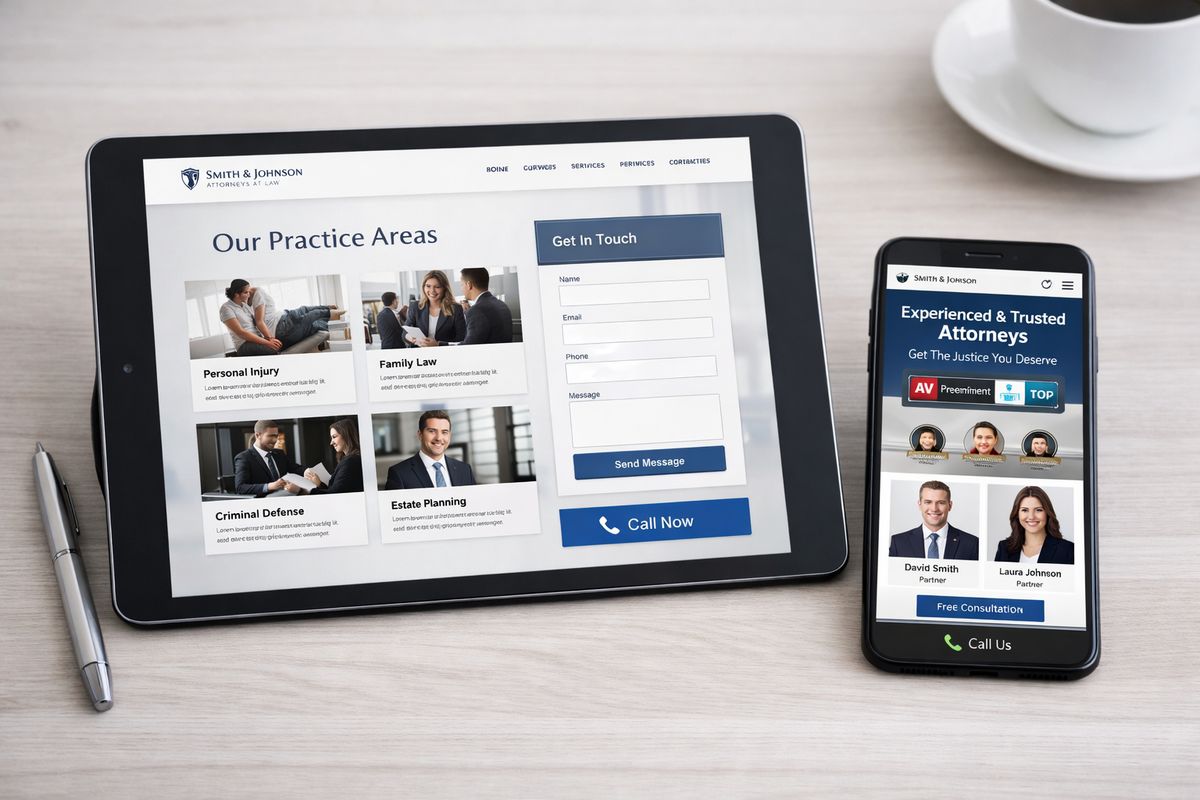
A legal website should load fast, work on mobile, and make trust visible. Navigation should reflect how prospective clients search for help.
- Test mobile speed on key pages.
- Review practice area navigation.
- Check trust signals such as reviews, attorney bios, and outcomes policies.
- Ask what changes would affect conversion most.
Review landing pages and conversion paths
Each paid or organic entry point should have a clear next action. Forms, click-to-call, chat, and scheduling should all reduce friction.
- Ask how landing pages are mapped to intent.
- Ask how forms are kept short.
- Ask how practice area relevance is maintained.
- Ask how underperforming pages are tested.
Ask about intake alignment
Marketing results can be hidden by weak phone handling or slow follow-up. Agencies should ask about intake before claiming a lead problem.
- Ask whether the agency reviews call handling.
- Ask how response time is tracked.
- Ask how marketing and intake data connect.
- Ask who flags lead quality issues.
Step 8: Examine reporting, attribution, and transparency
A firm should know what happened each month without decoding jargon. Reporting must tie spend to outcomes.
- Ask for a sample monthly report.
- Ask which KPIs appear on page one.
- Ask how source attribution works.
- Confirm account access and asset ownership.
Ask what the firm will see each month
Good reports stay simple. They show traffic, leads, spend, conversions, and trend notes.
- Ask for dashboard examples.
- Ask how meetings are structured.
- Ask how often strategy is reviewed.
- Ask how action items are documented.
Review attribution methods
Attribution should include call tracking, form tracking, CRM links if possible, and source-level visibility. A firm should know which channel produced the inquiry.
- Ask how calls are tracked.
- Ask how forms are tracked.
- Ask whether CRM integration is supported.
- Ask how multi-touch journeys are handled.
This matters more as firms compare Google search with newer AI search behavior.
Confirm access and ownership
The firm should own core assets. That includes the website, analytics, ad accounts, and business listings where possible.
- Ask whose email controls each account.
- Ask where logins are stored.
- Ask what happens at termination.
- Get ownership terms in writing.
Step 9: Compare pricing, contracts, and scope
Price needs context. A lower fee with vague scope is not a lower-risk option.
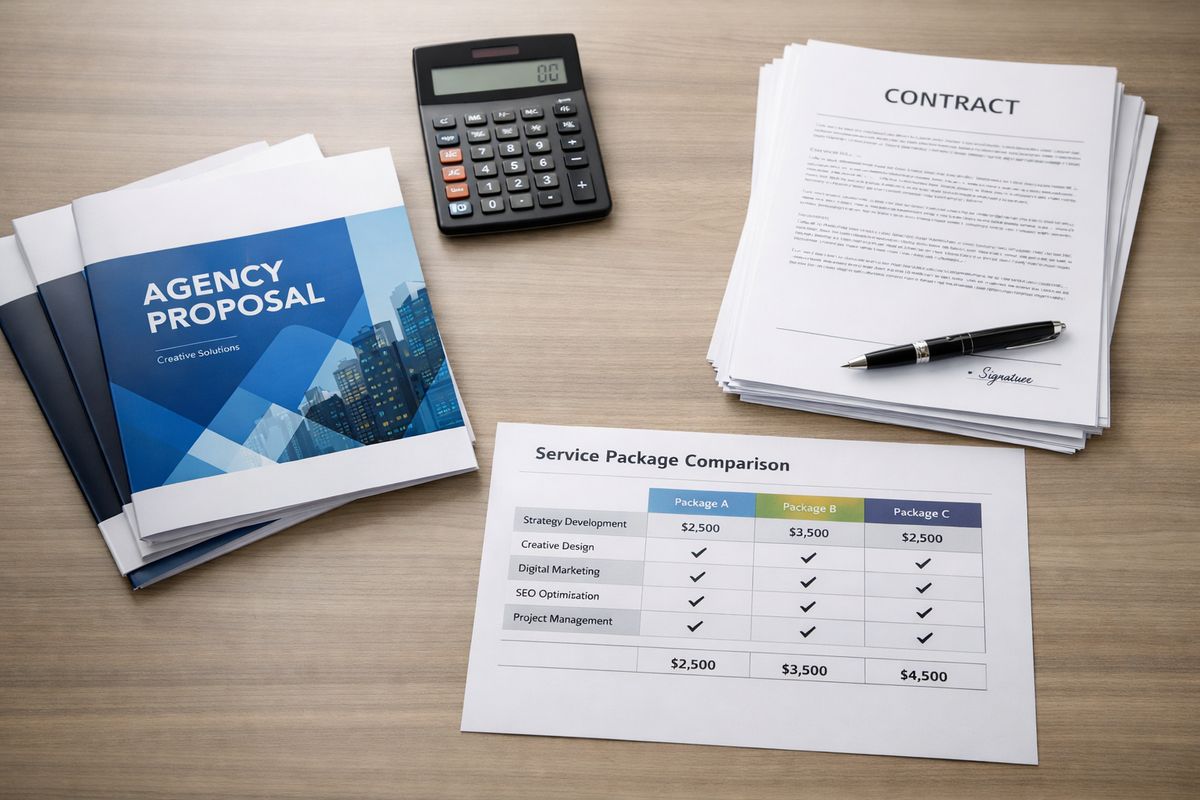
- Put all proposals into one comparison sheet.
- Separate fees from ad spend.
- Normalize scope where possible.
- Compare cost against expected output and risk.
Break down fee structure
Agencies may charge retainers, setup fees, ad management percentages, project fees, or performance-based components. These need separate lines.
- List every recurring fee.
- List every one-time fee.
- Note what media spend is included or excluded.
- Flag any unclear pricing terms.
Review deliverables and timelines
Scope should state what work happens each month. It should also state what the agency expects to improve first and when.
- Ask for monthly deliverables in writing.
- Ask what is produced by channel.
- Ask what the first milestones are.
- Ask what results are realistic in 30, 60, and 90 days.
Check contract length and exit terms
Contract terms shape risk. Exit rights matter as much as launch promises.
- Read the initial term.
- Read the renewal rule.
- Read the notice period.
- Read the termination clause.
Step 10: Interview finalists and ask direct questions
Final interviews should follow one script. That keeps scoring fair.
- Schedule calls with the top 2 or 3 agencies.
- Use the same question list for each call.
- Record notes in one shared sheet.
- Score answers after each meeting.
Ask who will do the work
The selling team is not always the delivery team. The firm should know who owns execution.
- Ask who the day-to-day lead will be.
- Ask what work stays in-house.
- Ask what work goes to contractors.
- Ask who approves strategy changes.
Ask how the agency handles underperformance
Every campaign hits friction. The response to weak performance shows discipline.
- Ask what happens if leads fall short.
- Ask how tests are prioritized.
- Ask how issues are escalated.
- Ask when strategy changes are made.
Ask for a sample 90-day plan
A short launch plan exposes execution style. It should be plain, specific, and time bound.
- Ask for first actions by week.
- Ask for setup tasks and dependencies.
- Ask for initial benchmarks.
- Ask what success should look like by day 90.
Step 11: Score agencies and make the selection
A structured score reduces bias. It also helps internal teams defend the decision later.
- Build one scorecard for all finalists.
- Weight criteria before the final review.
- Score independently if multiple stakeholders are involved.
- Compare totals and written notes together.
Use a weighted scorecard
Common categories include legal experience, strategy quality, reporting, website and conversion skill, pricing clarity, and contract terms.
- Assign a weight to each category.
- Score each agency on the same scale.
- Multiply score by weight.
- Total the results in one sheet.
Compare fit, not only rank
The top score is not always the best working fit. Communication style, response speed, and operational discipline matter.
- Review score totals.
- Review stakeholder notes.
- Check if the team can work with the agency’s process.
- Choose the best fit within the acceptable score range.
Select the agency and confirm next steps
The final step should close open questions before signature. The scope should be final.
- Confirm pricing and deliverables.
- Confirm timeline and kickoff date.
- Confirm ownership of accounts and assets.
- Approve the agreement and onboarding plan.
Common mistakes to avoid
Many agency searches fail for predictable reasons. Most of them start before the contract is signed.
Choosing on price alone
Low fees can hide low output, shallow expertise, or weak account support. The firm may spend less and get less.
A fair comparison looks at cost, scope, strategy, and contract risk together.
Trusting vanity metrics
Traffic, impressions, and rankings can help explain progress. They do not prove business value on their own.
The agency should connect visibility metrics to consultations, qualified leads, and signed cases.
Ignoring intake and follow-up
Many firms blame the channel when the issue sits inside intake. Missed calls, slow callbacks, and weak screening distort results.
Marketing and intake should be reviewed as one system. This also affects newer discovery paths such as visibility in AI-driven search experiences.
Signing long contracts without clear scope
A long term with vague deliverables creates weak leverage. The firm may be locked into activity that cannot be audited.
Scope should define what work happens, how often it happens, and what assets the firm keeps.
Troubleshoot agency evaluation problems
Some searches stall because the comparisons stay uneven. These fixes keep the review moving.
If every proposal looks different
Standardize the inputs. Give each agency the same goals, budget range, practice area priorities, and KPI request.
That makes proposals easier to compare. It also exposes which agency thinks most clearly within the same frame.
If agencies refuse to share specifics
Request anonymized examples, sample reports, and process details. Confidentiality is valid. Vagueness is not.
If an agency cannot explain how it works, the firm should treat that as a risk signal.
If the firm cannot tell which channel matters most
Start with economics and timing. High-value cases in competitive markets often justify PPC sooner. Lower urgency markets may support an SEO-first model.
The decision should follow market conditions, case value, and the firm’s patience for ramp time.
If internal stakeholders disagree
Use the scorecard and the target metrics. Shared criteria lower opinion-based conflict.
A disagreement often shrinks once the team compares the same facts in the same format.
Expected outcome after selection
At the end of this process, the firm should have one selected agency, one signed scope, one reporting plan, and one launch timeline. The decision should be documented.
The firm should also know how success will be judged. That includes lead goals, signed-case targets, reporting cadence, and exit terms.
Next steps after hiring the agency
The first 30 days should cover onboarding, access, tracking setup, intake review, and priority fixes. The first 60 days should produce launch activity and early benchmarks.
By day 90, the firm should have baseline reporting, channel adjustments, and a working view of lead quality. Schedule a call with Attorney Visibility ai for more information on evaluating agencies, AI search visibility, and legal marketing fit.
Frequently Asked Questions
How many law firm marketing agencies should a firm compare?
Most firms should compare 3 to 5 agencies in depth. Fewer can limit perspective. More can slow the process and dilute review quality.
How much should a law firm expect to pay a marketing agency in 2026?
The answer depends on services, market competition, and ad spend. A firm should compare total monthly cost, scope, and contract risk rather than judging the retainer alone.
Should a law firm hire a legal-only agency or a general digital agency?
Either model can work. A legal-only agency may understand ethics rules and intake patterns faster. A general agency may fit if it has strong legal case studies and clear legal process knowledge.
What metrics matter most when comparing agencies?
Qualified leads, signed cases, cost per lead, conversion rate, and call quality matter most. Rankings and traffic help explain movement, but they should not drive the final choice by themselves.
How long should a law firm commit to an agency contract?
The firm should commit only after reading scope, deliverables, and exit terms. A longer term can be acceptable if ownership, reporting, and termination rights are clear.
What should a firm do if an agency promises fast results?
The firm should ask which channel will produce the result, what the timeline means, and what proof supports the claim. Specific answers can be tested. Broad promises cannot.