
ChatGPT optimization is the work of making your law firm more likely to show up accurately and persuasively inside AI-generated answers. The hard part is not doing the work, it is knowing if it is actually paying off. If you are trying to sort signal from hype, here is how to measure it in a way that ties back to real cases, not vanity charts.
What ChatGPT Optimization Actually Means
ChatGPT optimization means improving the chances that your firm, your lawyers, and your practice areas appear in AI answers with the right facts attached. In plain English, you want an AI tool to understand who you help, where you help, and why your firm belongs in the answer when someone asks a legal question.
That overlaps with SEO, local visibility, review management, legal directories, citations, and reputation building. But it is not the same as ranking in Google. A page can rank well and still be ignored in AI summaries. On the flip side, a firm can get mentioned in AI answers because its reviews, directory profiles, attorney bios, and third-party mentions create a clear public picture.
Here’s the thing: ChatGPT optimization is less like trying to win one blue link and more like building a reliable case file. AI tools pull clues from many places, then stitch them into an answer.
The Real Question: What Does “Working” Look Like for a Law Firm?
For a law firm, “working” does not just mean more traffic. It means your firm starts appearing in the right AI-generated answers, your information is correct when it appears, and that visibility nudges real prospects toward contacting you.
A mention alone is not enough. If ChatGPT names your firm but gets your office wrong, mixes up practice areas, or leaves out what makes you different, that mention can do more harm than good. The real goal is useful visibility that leads to better-fit consultations.
If you need a cleaner frame for this shift, it helps to understand how AI search differs from traditional search behavior. The measurement changes because the path to a lead changes.
Visibility, Accuracy, and Business Impact
The simplest way to measure ChatGPT optimization is to break it into three buckets.
First, visibility: does your firm appear at all for prompts that matter? Second, accuracy: are the facts right when your firm is mentioned? Third, business impact: do those mentions lead to branded searches, consultations, or stronger lead quality?
That three-part view keeps you honest. A firm can have visibility without accuracy. It can have visibility and accuracy without impact. And sometimes impact shows up before neat referral data does.
What You Can Measure Directly in ChatGPT
There is no tidy built-in dashboard that tells you exactly how your firm is performing inside ChatGPT. That is the catch. Measurement here starts with disciplined manual testing.
You can still learn a lot by watching four things: presence, placement, consistency, and message control. In other words, does your firm show up, how high does it show up, does that happen repeatedly, and does the answer describe your firm the way you would want a prospective client to understand it?
Brand Mentions in Relevant Prompts
Start by testing prompts that match actual legal intent. Not generic prompts. Real ones. Think “best personal injury lawyer in Phoenix,” “who handles wrongful termination cases in Atlanta,” or “what should I do after a truck accident in downtown Dallas.”
Then check whether your firm appears. If it does, note whether it shows up in the first few recommendations or farther down in the answer. A top-three mention usually matters more than a throwaway mention near the bottom.
Prompt choice matters a lot. A prompt about “best divorce lawyer near me” tests different visibility than a prompt about “how to choose a divorce lawyer after mediation fails.” One is local and competitive. The other is informational with commercial intent hiding underneath.
Accuracy of Firm Information
A mention with bad facts is not a win. Check whether ChatGPT gets your firm name right, lists the correct city, names the right attorneys, and describes the right practice areas.
Also look at the details that shape trust. Does the answer mention your trial experience, bilingual intake, board certifications, or specific case focus if those are part of your public footprint? If ChatGPT keeps flattening your firm into a generic description, you have a message-control problem.
This is where regular testing helps. A simple review process like the one outlined in spot-checking AI answers about your firm can catch issues before prospects do.
Citation and Source Patterns
When ChatGPT provides sources or clearly reflects outside material, pay attention to what keeps showing up. Is it your website, your Google Business Profile, Avvo, Justia, local news, a “best law firms” article, or a review platform?
Those patterns tell you which public assets are actually shaping AI responses. If your site barely appears but directory pages do, that says something. If earned media keeps surfacing, that says something too.
This is one of the clearest ways to move from guessing to diagnosis. You are not just asking, “Did we show up?” You are asking, “What fed the answer?”

The Signals Outside ChatGPT That Tell You Optimization Is Paying Off
ChatGPT optimization is measured partly outside ChatGPT. That sounds odd at first, but it makes sense once you remember how people behave. A prospect might see your firm in an AI answer, then search your name in Google, click your bio page directly, or call from memory later that afternoon.
So if AI visibility improves, nearby signals often improve too.
Branded Search Lift
One of the cleanest signs is a rise in searches for your firm name, attorney names, or close branded variations. Google Search Console can help you see whether more people are typing in your name after content, visibility, or reputation work improves.
This matters because branded search often reflects recognition. Someone saw your firm somewhere, remembered it, and came back to confirm. For many firms, that is more meaningful than a raw traffic spike from a blog post.
If you are still sorting out where to focus between search engines and AI tools, this comparison of where law firms should put attention first helps set expectations.
Referral Traffic and “Dark” Traffic Clues
AI tools do not always hand over neat referral data. Sometimes the visit arrives like cash in a coat pocket, useful but unlabeled.
So watch for indirect clues: direct traffic increases to attorney bio pages, practice area pages, office location pages, and the homepage. If those pages jump after you publish stronger legal content, refresh your profiles, or earn new mentions, that movement may reflect AI-driven discovery.
Timing helps. Suppose your Dallas truck accident page gets updated on June 3, a legal roundup mentions your firm on June 10, and direct visits to that page climb the following two weeks. That is not perfect attribution, but it is a meaningful pattern.
Lead Quality and Intake Notes
Some of the best measurement happens in intake, not analytics. Prospects will tell you more than a dashboard can if you give them a place to say it.
Add simple intake fields and train staff to log phrases such as “found you through ChatGPT,” “an AI tool mentioned your firm,” or “I asked online who handles this kind of case.” Also listen for better-informed leads. If callers already understand your focus, location, or process, your public information is doing its job before the first conversation starts.
A Simple Measurement Framework You Can Actually Use
You do not need a science project. You need a monthly process that is repeatable and boring in the best way.
Use a baseline, a fixed prompt set, and a scorecard. That alone will put you ahead of most firms that say they are tracking AI visibility but are really just checking once in a while and going on vibes.
Start With a Baseline Before You Change Anything
Before updating pages, chasing reviews, or revising bios, document where things stand now. Run your prompt set. Save screenshots. Record whether your firm appears, where it appears, whether facts are correct, and what source patterns show up.
Then log a few outside metrics for the same period: branded search volume, direct traffic to key pages, consultation volume, and any intake notes tied to AI. If you skip the baseline, every later claim gets fuzzy fast.
Build a Prompt Set Around Real Client Questions
Your prompt set should reflect how potential clients actually ask for help. Use practice area prompts, city prompts, urgency prompts, comparison prompts, and question-style prompts.
A small fixed set works better than a huge messy one. Ten prompts for one practice area and one city is often enough to start. If your firm handles estate planning in Scottsdale, test the same handful every month. If you handle criminal defense in Tampa, use prompts tied to arrests, DUI concerns, and lawyer selection.
A good place to sharpen the page types behind those prompts is understanding what content tends to surface in AI answers.
Score Results the Same Way Every Time
Use a simple scoring model. Was your firm mentioned or not? Was it in the top three or not? Were the core facts right or wrong? What source type appeared? Did the answer frame your firm in a way that could drive contact?
The trick is consistency. Fancy scoring systems usually collapse after two months because nobody wants to maintain them. A simple monthly scorecard is enough to spot progress and weak points.
Which Inputs Usually Move the Needle
AI answers do not come out of nowhere. Certain public signals tend to influence recommendations and summaries more than others. If those inputs improve, your outputs often improve too.
Reviews, Directories, and Third-Party Mentions
Strong review profiles, legal directories, local citations, and trusted list articles often show up in AI source patterns. That is especially true for local legal queries where reputation and location both matter.
If your firm starts earning better reviews, tighter directory coverage, and mentions in credible legal or local publications, you should expect AI visibility to improve over time. If you want a closer look at this connection, why reviews and awards can shape AI mentions is worth reading.
Clear Practice Area and Attorney Pages
AI tools need plain signals. Clear practice area pages tell the system what you do. Strong attorney bios tell it who does the work. Office pages clarify where you serve clients.
Thin pages blur all of that. Detailed pages with case types, FAQs, service areas, and plain-English explanations make your firm easier to interpret. The same goes for bios, which often carry trust clues that matter more than firms expect. That is why well-built lawyer profiles can influence AI visibility keeps showing up as a practical lever.
Authority Signals and Reputation Clues
Awards, bar memberships, speaking appearances, press mentions, case results where appropriate, and public sentiment all help form a trust picture. No single signal does the whole job. Together, they create context.
Think of it like a legal file spread across ten folders. One note alone does not prove much. Ten consistent notes start to tell a believable story.
Common Reasons Measurement Gets Messy
This is where firms get tripped up. Some overstate success too early. Others miss real progress because they are looking for the wrong kind of proof.
ChatGPT Answers Can Vary by Prompt, Session, and Model
A slight wording change can produce a different answer. A different session can do the same. Even model updates can shift outputs over time.
That does not make measurement useless. It just means your prompt set has to stay fixed, your checks have to be repeated, and your team has to stop treating one screenshot like a final verdict.
Not Every Mention Produces a Click
A prospect can see your firm in ChatGPT, then search your brand later, visit directly, or call after reading reviews elsewhere. No click from ChatGPT does not mean no influence happened.
That is why single-channel reporting misses the full picture. Assisted conversions matter here more than many firms expect.
Local and Practice-Specific Results Take Time
A Tampa family law firm and a national mass tort firm will not see the same pattern. Geography, competition, and practice mix change the timeline.
Local firms often depend heavily on reviews, local citations, and map-related trust signals. Broader firms may lean more on authority, content depth, and media mentions. If you need a better baseline for those local signals, what supports AI visibility in local legal markets lays it out clearly.
What a Good Monthly Report Should Include
A good monthly report should be easy to scan and hard to fake.
Core KPIs
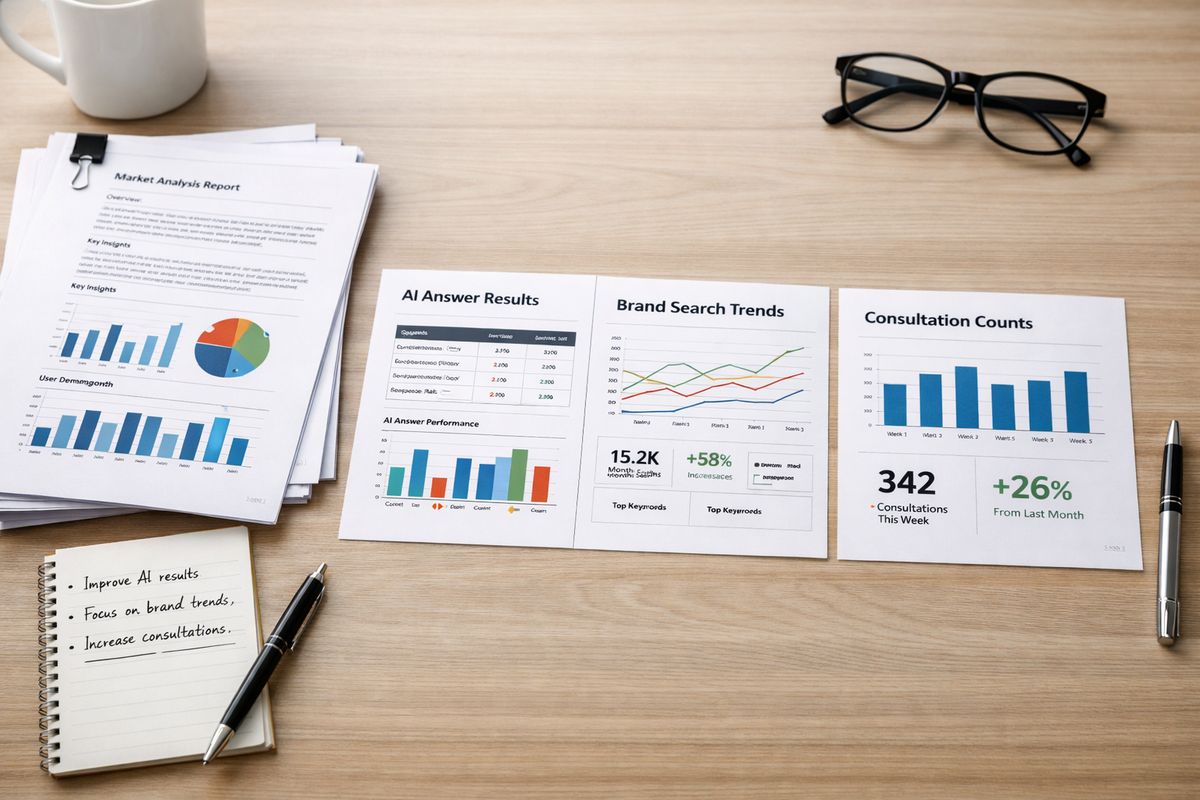
Look for share of mention across the prompt set, accuracy rate, source patterns, branded search trend, direct traffic to key pages, lead volume, and lead quality notes. Those metrics tell a connected story instead of isolated fragments.
Wins, Losses, and What Changed
The report should explain why movement happened. Maybe attorney bios were expanded. Maybe a location page was added. Maybe review velocity improved. Maybe nothing changed, and performance stayed flat.
That honesty matters. If a report cannot connect actions to outcomes, it is decoration.
Next Tests to Run
Each report should end with a short test plan. Improve one practice area page. Clean up inconsistent citations. Earn a placement in a respected legal roundup. Update an attorney bio with clearer case focus.
Small tests beat vague talk about “more AI visibility” every time.
How to Tell If an Agency Is Measuring the Right Things
Any agency can say “AI optimization.” Fewer can show you exactly how they measure it.
Good Signs
Good signs are simple: baseline tracking, prompt-level testing, screenshots, citation analysis, Search Console reporting, intake tracking, and a clear explanation of how AI visibility connects to consultations.
A solid agency will also explain limits. Nobody honest can promise perfect attribution or stable answers every single time.
Red Flags
Be careful with guarantees of “#1 in ChatGPT.” That is not how this works. Also watch for reports packed with buzzwords, empty impression metrics, no prompt logs, no screenshots, and no discussion of lead quality or factual accuracy.
If an agency only talks about exposure and never talks about signed cases, the measurement is off.
A Practical First Step to Try This Month
Start small. Build a 10-prompt scorecard for one practice area and one city. Check whether your firm appears, whether the facts are right, and whether branded search moves over the next 30 days.
That one exercise can clear up a surprising amount. It is like clearing one corner of a cluttered desk. Once you can see what is sitting there, the rest gets much easier to organize.
If you want help building a scorecard that actually ties AI visibility to consultations, schedule a call with Attorney Visibility ai for more information.
Frequently Asked Questions
How long does ChatGPT optimization take to show results?
Usually longer than a single content update and shorter than a full reputation rebuild. If your firm improves reviews, bios, citations, and practice pages, early visibility shifts can show up within weeks, but stronger patterns often take longer. For a deeper timeline, how long public search signals take to influence AI visibility is a useful reference.
Can you track ChatGPT optimization inside Google Analytics alone?
No. Analytics helps with side effects like direct traffic, branded demand, and page-level visits, but it does not tell you how often your firm appears in AI answers or whether your facts were correct there. You need prompt testing and intake tracking too.
What matters more, rankings in Google or mentions in ChatGPT?
For most law firms, both matter, but for different reasons. Google still drives direct search demand at scale, while ChatGPT can shape discovery and shortlists earlier in the process. The better question is how the two support each other.
Does a mention in ChatGPT guarantee more leads?
No. A mention only matters if it is relevant, accurate, and persuasive enough to push someone closer to contact. That is why lead quality, branded search, and intake notes belong in the measurement framework.
What should you optimize first if your firm never appears?
Start with the basics: clear practice area pages, strong attorney bios, consistent local citations, and better review coverage. Then test again using a fixed prompt set. If your public footprint is vague, AI answers usually stay vague too.
Is ChatGPT optimization worth it for every practice area?
Not equally. Some practice areas generate more AI-assisted research behavior than others. High-consideration, comparison-heavy, and question-heavy legal services often have more upside. If you want to see where the fit tends to be strongest, which legal services tend to benefit most from AI search visibility can help.