Great legal work does not guarantee visibility. A firm can have strong case results, responsive intake, and a polished website, then still disappear when someone nearby asks Google Maps or ChatGPT for a local attorney. That is why law firm local SEO now matters far beyond rankings, and why choosing the right agency has become a much bigger decision than it used to be.
Why local SEO now shapes your AI visibility
A few years ago, local SEO mostly meant trying to show up in the map pack and getting more calls from Google Business Profile. That is still part of it, but the stakes changed. AI tools now summarize businesses, suggest firms, pull location details, and reflect patterns found across the same places search engines already trust.
Here’s the thing: local SEO is no longer separate from AI discovery. If your office information is inconsistent, your reviews look stale, your practice pages are vague, or your Google Business Profile is half-filled, that weakness does not stay confined to Google Maps. It can spill into AI-generated answers too.
That does not mean every AI tool works exactly like Google. It does mean the foundation overlaps. When your firm sends the same clear signals everywhere, such as office location, practice focus, attorney identity, and reputation, you make it easier for both search engines and AI systems to understand who you are and when to mention you. If you want a plain-English breakdown of that overlap, start with how AI visibility and search behavior differ in practice.
What “law firm local SEO” actually covers
In plain English, law firm local SEO is the work that helps your firm appear when someone searches for legal help in a specific place. That can mean “car accident lawyer near me,” “divorce attorney in Phoenix,” or a map search for a probate lawyer five blocks away.
It usually covers three connected surfaces: traditional organic results, Google Maps and the local pack, and the business information layer that AI tools often rely on when describing local options. Your website matters. Your Google Business Profile matters. Your directory listings, reviews, attorney bios, and office details matter too.
Local SEO is less about chasing one magic ranking and more about building a clean, believable local presence. Think of it like keeping your courthouse filing perfect. One wrong page may not ruin everything, but enough small errors create friction, delay, and doubt.
The difference between rankings, map pack presence, and AI mentions
These three are related, but they are not the same thing.
Organic rankings come from your website’s ability to rank in regular search results. Map pack presence depends heavily on local signals such as proximity, Google Business Profile strength, category fit, reviews, and local prominence. AI mentions may draw from both, plus outside citations and brand references, then combine them into a summary or recommendation.
That means your firm can rank well for a practice-area page and still struggle in maps if your location signals are weak. The reverse can happen too. A strong profile in Google Maps may drive calls even when your site is not dominant organically. AI adds another layer: if your firm’s local footprint is confusing, AI systems may skip over you or describe you poorly. That is why the gap between SEO and AI visibility for law firms matters more than most agencies admit.
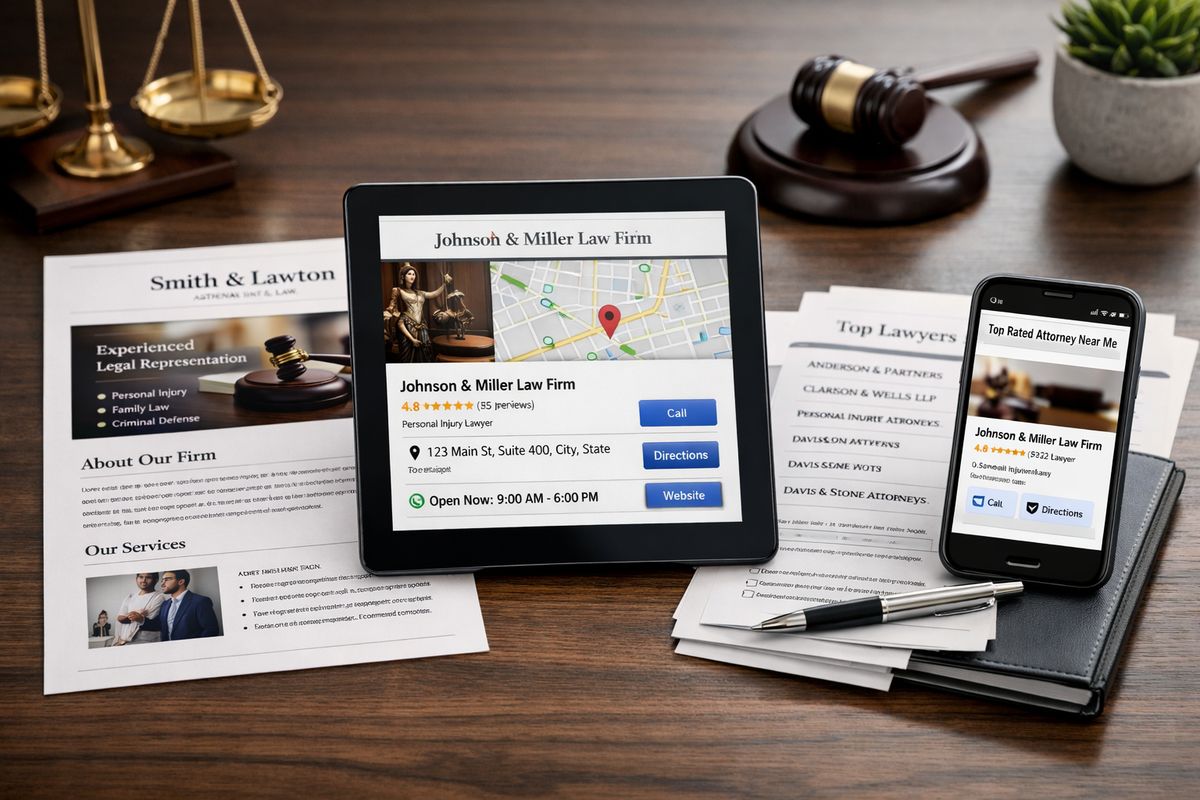
The local signals that matter most before you hire an agency
Before you hire anyone, focus less on broad promises and more on the local signals that actually shape trust. A good agency should be able to explain how it will strengthen those signals, not just talk about content calendars and backlinks in the abstract.
The best test is simple: can the agency show you how your firm becomes easier to verify, easier to understand, and easier to recommend locally? If not, the pitch is probably too generic.
Google Business Profile optimization
For many firms, Google Business Profile is the digital front door. It is often the first thing a potential client sees, especially on mobile, and sometimes the only thing seen before a call happens.
A real optimization process goes far beyond claiming the profile. Your primary and secondary categories need to fit your services. Your service list should reflect actual practice areas. Your description should say what you do and where you do it in normal language. Hours need to be accurate. Photos should feel current and real, not like stock images from 2017. Questions and answers should not sit empty if common concerns keep coming up in intake.
Ongoing activity matters too. Posting updates is not magic, but a maintained profile sends a better trust signal than a forgotten one. If an agency barely mentions Google Business Profile management, that is a red flag.
Reviews, reputation, and response quality
Reviews do two jobs at once. They help people trust you, and they help platforms trust that your business is active, legitimate, and relevant.
Healthy review signals include steady volume, recent feedback, real detail, and thoughtful owner responses. A profile with fifty reviews from three years ago is not as strong as one that gets consistent new reviews from actual clients over time. A profile with ten suspicious five-star reviews posted in one weekend can do more harm than good.
Response quality matters because it shows engagement. Short, copy-paste replies look mechanical. Better responses sound human, acknowledge the client’s experience, and stay within ethical boundaries. If you want to go deeper on this piece, how review patterns shape AI-era trust is worth understanding.
Website location signals and practice-area relevance
Your website needs to make location and service relevance obvious. Not implied. Obvious.
That usually includes office pages, practice-area pages, attorney bios, contact details, embedded maps, and consistent name, address, and phone information. Schema markup can help too, especially when it supports the same facts already visible on the page.
The trick is specificity. A page that says “experienced attorneys serving clients everywhere” does not help much. A page that clearly ties your downtown Denver office to family law, mediation, child custody, and named attorneys gives search engines and AI systems something solid to work with. This is also where strong attorney profile pages can support local trust signals and where clear service pages help AI understand what your firm actually handles.
Citations and directory consistency
Citations are mentions of your firm’s name, address, and phone number across business directories, legal directories, chamber listings, map systems, and other local sources.
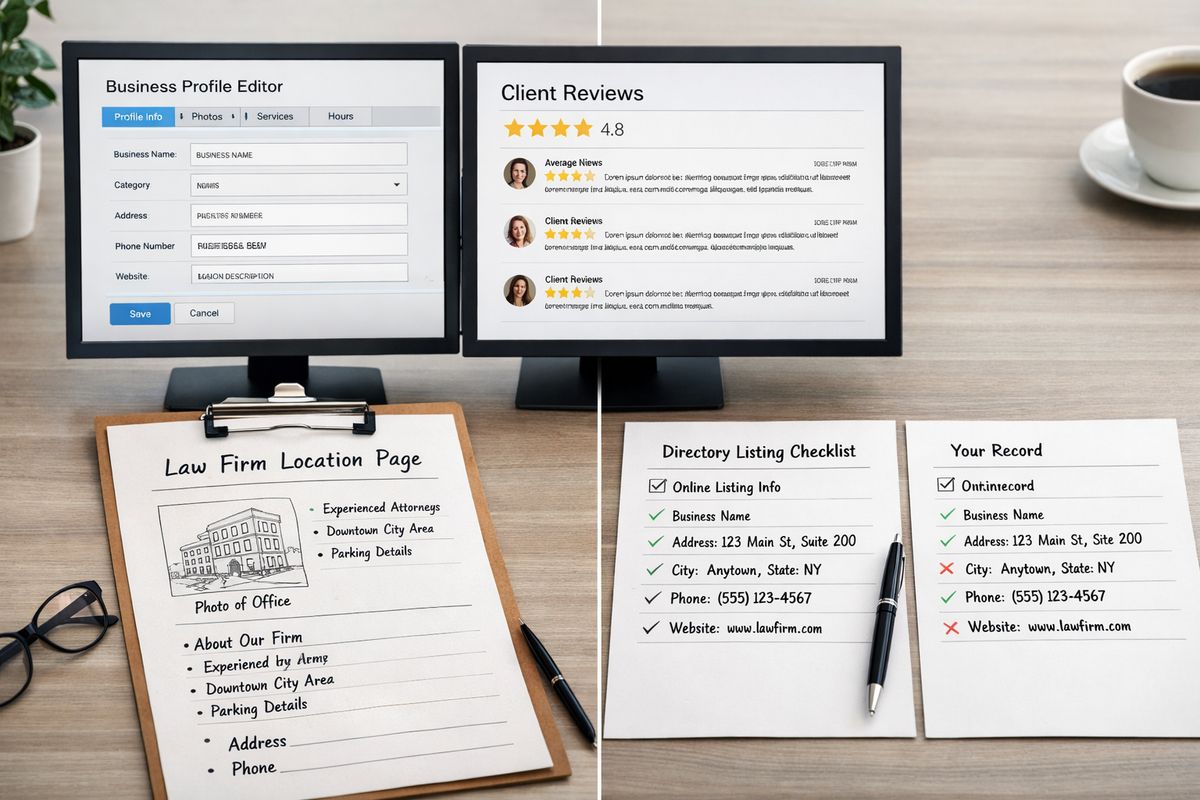
Accuracy matters more than volume. One old suite number on Avvo, a slightly different firm name on Yelp, and a disconnected phone number on a local directory can create a messy picture. Search engines can tolerate some noise, but enough inconsistency weakens confidence.
A good agency should check major legal directories, major local data sources, and any old listings tied to previous offices or phone numbers. Citation cleanup is not glamorous, but it is the kind of work that keeps your local foundation from wobbling.
The biggest local SEO problems law firms run into
A lot of firms feel stuck because the obvious things look fine on the surface. The site exists. The profile exists. Reviews exist. Then visibility still lags.
Usually, the problem is not one giant failure. It is a stack of smaller issues that keep sending mixed signals.
Duplicate listings, wrong addresses, and office confusion
This is one of the most common local SEO problems in legal marketing. A duplicate Google Business Profile. An old suite number from two years ago. A satellite office that was never staffed properly. A virtual office that creates more confusion than value.
A small mismatch can cause a big trust problem, kind of like sending a client to the wrong courthouse entrance on the morning of a hearing. The address may look close enough, but the experience is still bad. Search engines and AI systems react the same way. If office data is messy, visibility gets weaker.
Thin location pages and generic legal content
A location page that only swaps “Chicago” for “Naperville” is not a real local page. It is a template with a city name pasted in.
Useful local pages connect the office, the services, the attorneys, and the geography in a believable way. They mention the actual kinds of cases handled there. They include real office details. They sound like a page built for a person in that city, not for a spreadsheet. That same principle shows up in the kind of content that tends to earn AI visibility, because generic text rarely earns much trust anywhere.
Ignoring proximity and service-area limits
Even excellent local SEO has geographic limits. Proximity still shapes what appears in map results, and one office cannot realistically dominate every suburb in a large metro.
That matters when you evaluate agencies. If an agency promises blanket visibility across an entire region from one office location, the pitch is probably detached from reality. Better agencies set expectations around where growth is likely, where content can expand reach, and where a physical office still makes the biggest difference.
What to look for in a law firm local SEO agency
This is where buying decisions get real. Plenty of agencies can talk about SEO. Fewer can explain local legal visibility in a way that maps to how firms actually get retained.
You are not buying abstract traffic. You are buying better visibility in the places that influence consultations.
Legal category experience that goes beyond generic local SEO
Law firms are not coffee shops or HVAC companies. Legal marketing comes with ethics rules, review sensitivity, higher stakes intake, and much tougher competition in many markets.
A generic local agency may know how to rank a dentist. That does not mean it knows how to structure a personal injury office page, handle review requests in family law, or write around legal nuances without creating compliance headaches. Ask for legal examples, not just “local business” examples.
Clear local strategy, not a vague monthly package
If the proposal sounds like fog, that is a problem.
A real local SEO plan should spell out what gets fixed, what gets built, and what gets measured. That includes Google Business Profile improvements, citation cleanup, office and practice page updates, review strategy, local content priorities, and reporting tied to actual locations. A monthly retainer without a roadmap is just a subscription to uncertainty.
Proof in the right metrics
Traffic is nice. Qualified local leads are better.
Ask to see progress in map pack visibility, Google Business Profile calls, direction requests, local page traffic by city, consultation form submissions, and lead quality by practice area. If every report revolves around raw rankings and total sessions, you are probably not seeing the full picture.
This matters even more if your firm cares about AI visibility. You want signs that your local presence is becoming clearer and more trusted over time, not just a handful of vanity metrics. That is also why measuring if AI-focused visibility work is actually moving should be part of the conversation.
Transparency about timelines and limits
Local SEO is not instant, especially in legal markets. In a smaller city, visible improvement may come faster. In a competitive metro, stronger movement can take months of steady work.
A trustworthy agency says that out loud. It does not promise a number one ranking in 30 days. It does not guarantee map pack domination everywhere. It explains what can improve quickly, what takes longer, and what depends on competition, location, and your starting point.
The service models and price ranges you’ll run into
Shopping for local SEO services can feel a bit like apartment hunting. Photos look great, the listing sounds polished, and then you notice the missing kitchen. Price alone does not tell you much unless you know what is actually included.
Low-cost local SEO vendors
Budget providers often include basic listing setup, light reporting, and maybe a few small website edits each month. That can be enough for a very simple situation, but the catch is what often gets skipped: legal-specific strategy, high-quality local content, serious Google Business Profile management, and review process design.
Cheap SEO often becomes expensive later because cleanup takes time. Undoing bad citations, weak content, or sloppy profile work is rarely fun.
Mid-range agencies for growing firms
This is often the sweet spot for a solo practice or growing firm with one to three offices. You should expect a defined local strategy, regular execution, usable reporting, and someone who can connect maps, reviews, local pages, and lead tracking into one plan.
At this level, the agency should not just “do tasks.” It should help you prioritize. If your biggest gap is review velocity, that should show up in the plan. If your office pages are thin, that should move up the list. Strategy matters here more than volume.
Premium agencies for competitive markets or multi-location firms
Higher investment makes sense when your market is crowded, your practice area is aggressive, or your footprint is complex. Personal injury in a major city is a different animal from estate planning in a smaller town.
Premium service should bring deeper content work, stronger location governance, tighter technical SEO, reputation support, and more advanced reporting by office and practice area. It should also connect local SEO to broader discoverability, including what helps firms appear in AI-driven legal search experiences.
Questions to ask before signing anything
The fastest way to spot a good fit is to ask simple, direct questions and listen for plain answers. If every response sounds recycled, move on.
How will you improve visibility in Google Maps and AI-generated results?
A solid answer should connect the dots between Google Business Profile, reviews, citations, location pages, and consistent entity signals. It should not treat AI as magic dust sprinkled on top of regular SEO.
If the explanation is clear enough that you can repeat it back after the call, that is a good sign.
What will you change in the first 90 days?
You should hear specifics. Listing cleanup. Profile fixes. review process work. Office page updates. Tracking setup. Quick wins tied to obvious gaps.
If the first 90 days sound like “monitoring performance” and “laying the groundwork,” that is too vague.
How do you measure qualified leads, not just rankings?
This question cuts through fluff fast. Good agencies track calls, forms, consultation requests, and location-specific lead sources. Better ones connect those signals back to office pages, maps activity, and practice-area demand.
Who creates the content and who owns the assets?
Do not gloss over this. You need to know who writes local pages, who reviews legal content, who owns the listings, who has Google Business Profile access, and what happens if the relationship ends.
A clean handoff policy is a sign of a healthier vendor relationship.

Common mistakes when buying local SEO for a law firm
Bad local SEO purchases usually come from a few predictable mistakes. The good news is that these are easy to avoid once you know what to watch.
Buying on price alone
The cheapest option often means thin content, weak reporting, outsourced busywork, or barely any strategy at all. You save money up front, then lose time fixing what never should have gone live.
Chasing rankings without fixing trust signals
A firm can invest heavily in keyword rankings while leaving Google Business Profile, reviews, citations, and office pages untouched. That is like polishing the lobby while the front door sticks. Local trust signals need attention too.
Expecting one office to rank everywhere
Strong authority helps, but geography still matters. If your firm has one office, local visibility will be strongest near that office and weaker farther out. A good agency respects that reality instead of pretending otherwise.
Best-fit recommendations by firm type
The right agency setup depends on your footprint, your competition, and how much operational support you need.
Solo or small firm in one city
You usually need focus more than scale. The best fit is often an agency or service plan that can tighten your Google Business Profile, clean up citations, build a steady review process, and improve a handful of strong local practice pages. Fancy extras can wait.
Multi-location regional firm
You need consistency across offices without flattening everything into duplicate content. Look for help with unique office pages, listing governance, review workflows, and reporting that separates one location from another. If every office gets lumped into one blob of reporting, it becomes hard to tell what is working.
Highly competitive practice in a major metro
This setup needs deeper investment. You are not just trying to exist. You are trying to stand out in a crowded field where everyone is buying visibility.
That means stronger local content, better reviews, tighter conversion tracking, clearer attorney positioning, and ongoing optimization across maps and organic search. In these markets, average work disappears.
A simple way to choose your next step
If your local presence already looks strong on the surface, start with an audit that checks for consistency and gaps across your Google Business Profile, office pages, citations, and reviews. If your current agency cannot explain those gaps clearly, compare alternatives. If one weak area jumps out, fix that first instead of trying to overhaul everything at once.
Try one simple check today: look at your Google Business Profile, your office pages, and your latest reviews side by side. If those three do not tell the same story about who you help, where you practice, and why someone should trust you, that is the gap to close first.
Frequently Asked Questions
How long does law firm local SEO take to work?
Some fixes, like Google Business Profile improvements or citation cleanup, can help fairly quickly. Stronger movement in map visibility, local rankings, and lead volume usually takes a few months, especially in competitive legal markets.
Is Google Business Profile really that important for law firms?
Yes. For many firms, it is the first thing a prospective client sees before visiting your website. It shapes calls, map visibility, review trust, and often the local signals that influence broader online discovery.
Can a law firm rank in nearby cities without an office there?
Sometimes, but not equally everywhere. Organic pages can extend reach, especially for nearby markets, but map visibility is still heavily influenced by proximity. One office rarely dominates an entire region in local results.
What should a local SEO agency report each month?
Useful reports should include map pack visibility, Google Business Profile calls and direction requests, local landing page traffic, form submissions, phone leads, and performance by city or office. Generic traffic charts are not enough.
Do reviews affect AI visibility too?
In many cases, yes. Reviews help establish trust, activity, and service relevance across the web. AI systems often reflect patterns from sources that already influence local search, which is why review quality and consistency matter beyond Google alone.
What is the biggest red flag when hiring a local SEO agency?
Guaranteed rankings. Especially fast guarantees. Local legal markets are too competitive and too dependent on geography, competition, and trust signals for honest agencies to promise instant domination.
If you want a clearer read on where your firm stands and what to fix first, schedule a call with Attorney Visibility ai for more information.