
According to Google’s Economic Impact report, people use Search to find local businesses billions of times each month, and legal services sit in one of the highest-stakes categories in that behavior. That is why the best questions to ask SEO agency candidates are not about buzzwords or dashboards, they are about whether your firm will get signed cases or lose six months to the wrong partner.
1. Do You Specialize in SEO for Law Firms Like Yours?
A 2023 Edelman Trust Barometer found that expertise is one of the strongest drivers of trust in professional services. In legal marketing, that matters more than usual because your buyers are not shopping for a T-shirt or a meal. Your prospects are dealing with criminal charges, a divorce, a denied claim, or a catastrophic injury. Search behavior in those moments is specific, urgent, and local.
Legal SEO is different from general local SEO because the economics are different. One qualified personal injury case can justify a serious investment. Ten irrelevant leads can waste intake time and distort reporting. Add bar advertising rules, jurisdiction-specific language, and the need to target actual matter types by city, and generic agency experience stops being useful.
What this means in practice: ask for examples from firms that match your reality. A family law SEO strategy in a suburban market is not the same as a mass tort strategy in multiple states. If an agency cannot explain the difference in intent, conversion path, and competition level, keep moving.
What a strong answer includes
A strong answer names law firms with similar practice areas, similar market conditions, and similar growth goals. It includes measurable outcomes tied to qualified consultations, signed cases, or cost per lead, not just traffic growth. It also explains what changed to get the result, such as rebuilding practice area pages, improving local signals, or tightening intake-focused page structure.
Red flags to watch for
The worst answer is, “You do not need industry specialization because SEO is SEO.” That is false. Another bad sign is vague legal experience with no specifics about market competitiveness, no examples from firms like yours, and no discussion of intake quality. If an agency says it works with everyone and wins everywhere, you are hearing a pitch, not expertise.
2. How Will You Build an SEO Strategy Around Your Practice Areas and Locations?
According to Google’s Search Quality Evaluator Guidelines, relevance and helpfulness are central to search quality, especially in high-stakes categories. For a law firm, relevance starts with matching your services and your markets to the exact searches that produce consultations.
The move that works is a strategy built around practice area intent and geographic intent. That means criminal defense pages for the exact charges you handle, personal injury pages for the exact case types you want, and city or county pages only where your firm has a real reason to rank. It also means your Google Business Profile, internal links, title tags, and intake path all support the same market priorities. If you want a clearer picture of local visibility signals, this breakdown of what actually shapes local search performance for firms is worth reading.
What this means in practice: ask how the agency maps each practice area and each location to search demand, competitiveness, and case value. Keyword counts are not strategy. A list of 500 terms means nothing if the high-intent pages are weak or missing.
Strategy elements that matter for law firms
A serious strategy prioritizes the practice areas that drive revenue, then builds market-by-market targeting around those services. It includes internal linking between related pages, page structures designed to convert phone calls and form fills, and local SEO integration that supports both map visibility and organic rankings. It should also account for the fact that informational content helps capture earlier-stage searches, then channels that traffic into service pages that convert.
3. How Do You Define Success, and Which Metrics Will You Report?
A 2024 HubSpot State of Marketing report found that marketers still struggle to connect channel performance to revenue outcomes. That gap is exactly where law firms get burned by SEO retainers that produce charts instead of cases.
Rankings matter. Traffic matters. But neither one pays your firm unless it turns into qualified inquiries and signed matters. If an agency defines success by impressions, broad ranking counts, or total sessions, you are looking at activity metrics. Your firm needs business metrics: consultation requests, call quality, qualified leads by practice area, signed cases, and cost per acquisition where tracking supports it.
What this means in practice: force the conversation away from vanity metrics. Ask how success ties back to case value and intake quality. If that answer is missing, the reporting framework is broken from day one.
Metrics that matter more than traffic
Branded traffic can rise because of offline awareness. Raw impressions can soar while qualified leads stay flat. Ranking for broad, low-intent terms can look impressive and still produce junk calls. The metrics that matter are visibility for high-intent searches, conversion rate on service pages, lead quality from organic traffic, and closed-loop tracking from intake to signed case. If an agency also talks about emerging visibility in AI-driven discovery, that should connect back to the same business outcomes, not become a separate vanity project. This guide on measuring whether AI visibility is producing anything real captures that standard well.
Reporting cadence and accountability
You should expect a fixed reporting schedule, plain-English analysis, and recommendations tied to the next actions. A dashboard dump is not reporting. A useful monthly review tells you what changed, why it changed, what matters, and what gets done next.

4. Can You Show Case Studies, References, and the Actual Results You Produced?
A 2024 BrightLocal survey found that trust signals shape decision-making heavily in local service categories. In agency selection, proof serves the same role. You are not hiring promises. You are hiring evidence.
Ask for case studies that show before-and-after performance with enough context to judge relevance. You need to know the practice area, the market size, the starting point, the timeline, and the outcome. A ranking screenshot with no business context proves almost nothing. A case study showing stronger non-branded traffic, more consultations from organic search, and better performance on high-value pages tells you far more.
What this means in practice: insist on references from firms that resemble yours in size, geography, or competitive pressure. A national employment firm and a two-office family law firm live in different search environments. You need comparisons that mean something.
What credible proof looks like
Credible proof connects the SEO work to lead growth and conversion improvement, not just keyword movement. It also explains the timeline honestly. SEO gains from technical fixes can happen quickly, but authority growth and local competition take time. If you are also evaluating future-facing channels, look for agencies that understand how search behavior is shifting beyond blue links without pretending Google no longer matters.
5. What Will You Actually Do in the First 90 Days?
A 2023 Project Management Institute report tied stronger outcomes to clear scope, defined milestones, and early alignment. That applies directly to SEO. The first 90 days reveal whether an agency has a real process or just a sales script.
A real agency can explain the opening phase in concrete terms. Expect a technical audit, local listing and Google Business Profile review, practice area and location page assessment, competitor analysis, content prioritization, and analytics or call tracking validation. That is the baseline. Without it, the agency is guessing.
What this means in practice: ask for the sequence. What happens in week two, week four, and month three? If the answer is vague, your campaign will be vague too.
A realistic 90-day plan
The first quarter should focus on diagnosis, fixing obvious technical and local visibility issues, identifying content gaps, and building clean measurement. It should not center on promises of page-one rankings. The simplest version of this is straightforward: establish what is broken, repair what blocks performance, then build the pages and signals that match your revenue priorities.
6. How Do You Handle Content for Legal Topics Without Sacrificing Accuracy?
Google’s Search Quality Evaluator Guidelines place special scrutiny on “Your Money or Your Life” topics, which include legal information. That is not academic theory. It is a direct warning against thin, inaccurate, untrustworthy content in legal search.
Your content has to do three things at once: match search intent, stay legally accurate, and move a prospect toward contact. If any one of those fails, the page underperforms. A page written only for SEO reads like filler. A page written only for legal precision often ignores how people actually search. The agency you hire needs a workflow that covers both.
What this means in practice: ask who writes the content, who edits it, and how attorney review fits before publication. Also ask how the agency handles jurisdiction-specific claims and local language. Firms that want stronger visibility in both Google and AI answer engines should also understand why practice area page depth matters so much.
Questions to ask about content production
A strong answer covers attorney review, source standards, originality, tone, local relevance, and content briefs built around actual search intent. It should also explain how pages are updated when laws, procedures, or firm positioning changes. Legal content cannot sit untouched for two years and stay competitive.
Why generic AI content is a risk
Generic AI content creates three problems fast: factual errors, repetitive phrasing, and zero differentiation. That hurts trust, weakens rankings, and attracts low-quality leads. Search engines are getting better at rewarding genuinely helpful legal content, and prospects are getting faster at spotting junk.
7. How Do You Earn Links and Authority Without Creating Risk?
According to Google’s Spam Policies for Web Search, manipulative link schemes violate search guidelines. In legal SEO, bad link tactics create a double problem: ranking risk and reputation risk.
Authority still matters. Strong backlinks, citations, and trusted mentions help search engines understand that your firm is real, established, and relevant in a market. But the method matters more than the metric. You need direct answers about how links are earned, where citations come from, and what standards guide outreach.
What this means in practice: ask the agency to describe link acquisition in plain English. If the explanation sounds secretive, automated, or guaranteed, walk away.
Safe link-building methods
Safe methods include reputable legal directories, consistent citation building, earned mentions through digital PR, partnerships with local organizations, bar association listings, and thoughtful outreach tied to useful content. Reviews and third-party signals also play a role in how firms are perceived across search environments, including AI-generated answers. This discussion of how review signals influence recommendation visibility connects that idea well.
Red flags on backlinks
Purchased links, private blog networks, “DA 70” packages, and ranking guarantees are obvious warning signs. So is any refusal to explain sourcing methods. If an agency says the process is proprietary and cannot be discussed, the real answer is usually something you do not want tied to your firm.
8. How Will You Approach Technical SEO, Site Health, and Conversion Experience?
Google has repeatedly documented the role of page experience, mobile usability, and site performance in search outcomes through its Core Web Vitals guidance. Fast, usable sites win twice. They rank better, and they convert better.
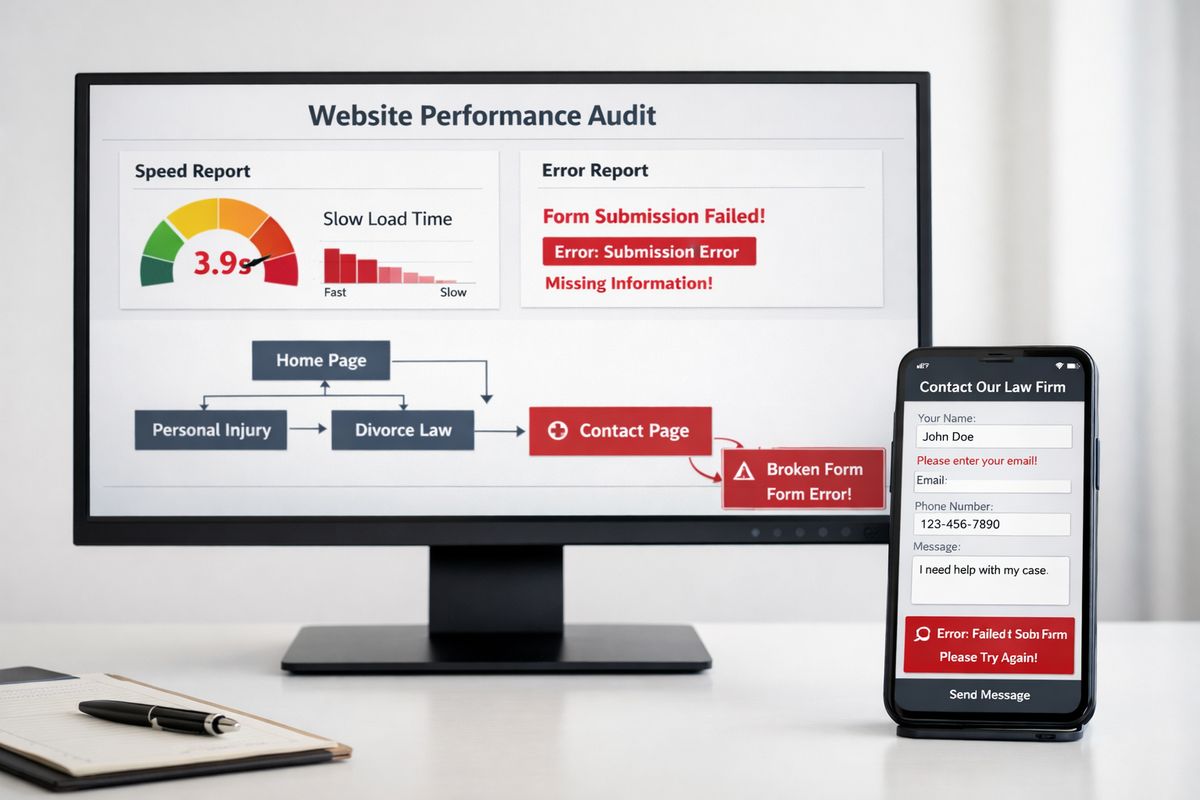
A law firm website has one job after visibility: make contacting your firm easy. That requires clean crawl paths, sensible site structure, mobile-first design, reliable call tracking, and forms that do not break on iPhones. It also requires service and location pages that are indexable, internally connected, and technically distinct.
What this means in practice: ask how the agency audits crawlability, indexation, schema, duplicate location pages, broken events, and page speed. Then ask how those fixes connect to conversion performance. Search traffic that lands on a frustrating site is wasted traffic.
Technical issues that affect law firm performance
Common issues include slow mobile load times, weak internal linking, duplicate local pages with no unique value, broken form tracking, poor call-to-action placement, and missing schema. Firms evaluating agencies for both traditional SEO and newer discovery channels should expect fluency in the overlap between Google optimization and AI search visibility, because the underlying site quality signals often support both.
9. How Do You Stay Compliant With Google Guidelines and Legal Advertising Rules?
Google publishes clear documentation on search quality and spam, and state bars publish rules that govern legal advertising claims, testimonials, and disclosures. Your agency needs to respect both. That is the standard.
Law firms face a compliance burden that many industries do not. A bad SEO tactic can trigger ranking problems. A bad marketing claim can create ethics problems. You need an agency that can explain how it handles review generation, testimonial display, superlative language, office location claims, and transparent optimization methods without getting slippery.
What this means in practice: ask for the agency’s position on compliance before you sign. If the answer is hand-wavy, your risk is already too high.
Compliance topics to address
The conversation should cover reviews, testimonial use, disclaimers, statements about results, office and service area representation, and the exact methods used to optimize your site. You should never accept “trust the process” in a regulated category.
10. What Are Your Contracts, Pricing, Communication, and Exit Terms?
A 2024 Gallup workplace study reinforced a simple truth about business relationships: clear expectations improve retention and performance. In agency hiring, that means the operational details matter just as much as the strategy.
Before money changes hands, you need to know the pricing model, minimum commitment, monthly deliverables, communication cadence, and who owns the content, analytics, and accounts. You also need the exit terms in writing. If the agency relationship ends, your pages, data, call tracking history, and Google assets should remain accessible to your firm.
What this means in practice: ask how separation works before you sign. Strong agencies make scope and separation simple because transparency helps them close the right clients.
Terms to clarify before signing
Clarify setup fees, monthly deliverables, meeting schedule, cancellation notice, access ownership, and whether content and accounts stay under your control. If you are still comparing broader partners, this guide to evaluating legal marketing partners with a sharper filter helps frame the difference between a vendor and a strategic fit.
What to do this week before you sign with any agency
Turn these 10 questions into a one-page scorecard and use the same scorecard on every agency call. Require direct answers, proof, and examples for each item, then compare firms side by side on specialization, strategy, reporting, content quality, technical process, compliance, and contract clarity.
That one step changes the whole buying process. Instead of reacting to the best sales pitch, you evaluate every agency on the factors that actually determine signed cases. If you want a sharper read on law firm SEO, AI visibility, and agency fit, schedule a call with Attorney Visibility ai for more information.
Frequently Asked Questions
How many agencies should you interview before hiring one?
Interview at least three. That gives you enough contrast to spot vague answers, inflated promises, and pricing that does not match deliverables.
How long should a law firm give SEO before judging results?
You should expect meaningful movement within the first 90 days in audits, fixes, reporting, and page improvements. Signed-case impact takes longer, but a real agency shows traction early through better visibility, stronger pages, and cleaner lead tracking.
What is the biggest red flag in an SEO agency pitch?
Guaranteed rankings. Search performance is competitive and dynamic. Strong agencies guarantee work quality, process, communication, and transparency, not page-one positions.
Should your law firm hire a general digital agency or a legal SEO specialist?
Hire the firm that understands legal search intent, intake quality, local competition, and compliance. In practice, that usually means a specialist with real law firm case studies.
What should your law firm own if you hire an SEO agency?
Your website content, analytics access, Google Business Profile access, Search Console, call tracking data, and core accounts should stay under your control or be fully transferable on demand.
Do AI search platforms change what you should ask an SEO agency?
Yes. You should ask how the agency thinks about authority, citations, reviews, structured content, and source visibility beyond Google. But the foundation stays the same: accurate legal content, strong local signals, trustworthy pages, and measurable business results.