
Attorney bios are no longer simple staff pages. In AI search environments, attorney bios function as trust assets that help search systems determine who a lawyer is, what that lawyer handles, and whether the firm deserves to be surfaced in a high-stakes legal result. Based on analysis of legal search behavior and ranking patterns, firms with stronger attorney bios often gain sharper visibility, better lead qualification, and stronger conversion efficiency.
Why Attorney Bios Matter in AI Search Rankings
Attorney bios matter because AI search does not evaluate a law firm the same way traditional search once did. A blue-link result could rank largely on domain strength, backlinks, and general page relevance. AI-generated answers, by contrast, often require identifiable professionals, verifiable expertise, and consistent factual signals before a source is included in a summary, citation set, or recommendation.
That shift changes the business value of the attorney bio. A well-built bio helps a firm communicate attorney identity, jurisdiction, practice focus, and authority in a format that both people and machines can interpret. In legal marketing, that is not a branding detail. It is a visibility and revenue issue.
What the field data shows is straightforward: firms that treat bios as structured search assets tend to create fewer ambiguity signals across their sites. That improves the chances that AI systems can connect a lawyer to a practice area, office, publication, or case result. It also improves what happens after the click, because prospective clients frequently evaluate the lawyer before contacting the firm.

How AI Search Evaluates Law Firm Credibility
AI search increasingly works through retrieval, summarization, and entity matching rather than only keyword matching. In practical terms, the system attempts to identify trusted sources, extract factual information, and assemble an answer that appears authoritative. Law firms are evaluated inside that process, not outside it.
For legal topics, this means a firm’s content must do more than mention a service. It must establish who is providing that service and why that source should be believed. This is one reason firms studying how AI systems select legal sources often find that attorney-level detail plays a larger role than expected.
Why legal queries require stronger trust signals
Legal topics sit in a high-trust category because poor information can create financial, procedural, and personal harm. As a result, AI systems are more likely to apply stricter credibility filters when processing legal questions than when processing low-risk commercial queries.
Attorney identity becomes one of those filters. A named lawyer with stated bar admissions, jurisdictions, and practice concentration sends a stronger signal than a generic service page with vague claims. If the system cannot determine who stands behind the content, citation probability declines. If it can determine that a licensed attorney in a relevant jurisdiction has clear subject focus, confidence improves.
How entity recognition changes visibility
Entity recognition is the mechanism that connects scattered facts into one understandable profile. A lawyer’s name, law firm, office location, practice areas, awards, articles, bar status, and speaking history can all be interpreted as parts of the same entity. That entity model influences whether search systems view the attorney as distinct, credible, and relevant.
Thin or generic bios weaken that process. If ten lawyers at ten firms all appear as “experienced advocates” with almost no distinguishing facts, the machine has little basis for confidence. The recommendation is to treat the bio as the source-of-truth page for the attorney’s professional identity.
What Makes an Attorney Bio Valuable to AI Systems
The most effective attorney bios tend to perform well across four drivers: identity clarity, evidence of expertise, consistency, and freshness. This framing matters because AI systems do not reward biography pages simply for existing. They reward pages that reduce uncertainty.
Driver one: Clear professional identity
A high-value bio begins with a precise statement of who the attorney is. Name, role, office, bar admissions, jurisdictions, and practice areas should be explicit. Marketing language should not replace factual identity.
If a lawyer focuses on catastrophic injury litigation in Illinois and Missouri, the bio should state that plainly. If the attorney handles employment-based immigration for healthcare employers, that should appear near the top. Based on analysis of legal content performance, pages with exact professional descriptions are easier for search systems to parse and easier for prospects to trust.
Driver two: Demonstrated subject-matter expertise
Expertise is strongest when it is evidenced, not asserted. AI systems respond better to representative case types, trial record, transactions completed, publications, certifications, board roles, teaching activity, or speaking engagements than to broad self-description.
This is where many bios underperform. They claim experience but provide no usable proof. A page that notes a lawyer has tried more than 40 jury cases, advises regional hospitals on compliance, or speaks annually on wage-and-hour law offers a far stronger machine-readable signal than a claim of excellence. Firms exploring which content types support AI visibility most effectively often discover that bios are among the most underused sources of authority evidence on the site.
Driver three: Consistent firmwide data
Consistency across digital properties improves machine confidence. The same attorney name, title, office, practice focus, and admissions should align across the website, schema markup, legal directories, media references, and Google Business data.
Inconsistent information creates ambiguity. A lawyer cannot be a partner in one source, an associate in another, and focused on two entirely different practice areas on a third without weakening trust. Based on analysis of local and legal SEO programs, consistency reduces confusion and supports stronger interpretation across both search engines and AI systems. It also reinforces adjacent signals in firmwide local visibility efforts.
Driver four: Freshness and ongoing relevance
Freshness signals that the attorney remains active and current. A bio last updated four years ago suggests neglect. A bio that reflects recent articles, case results, honors, or admissions suggests continuing relevance.
This does not require constant rewriting. It requires disciplined maintenance. Quarterly or biannual updates are often enough to preserve authority signals and keep the page aligned with the attorney’s current role and achievements.
The Five Elements of High-Performing Attorney Bios
https://www.youtube.com/watch?v=hAU17F8EFnw
Once the four drivers are understood, implementation becomes more practical. High-performing attorney bios usually share five page elements that support both ranking eligibility and conversion efficiency.
A strong opening that states practice focus immediately
The opening lines should identify the attorney’s role, core practice area, and client type without delay. This helps users orient quickly, and it helps AI systems extract the main facts without interpreting a long narrative.
For example, an opening that states an attorney “represents employers in labor and employment litigation across Texas, with a focus on wage-and-hour disputes and executive mobility matters” is materially stronger than a general statement about commitment to client success.
Proof-based credentials and experience
Credentials matter, but only when they are specific enough to support authority. Education, clerkships, years in practice, certifications, trial history, transaction volume, or settlement record can all serve this function.
The recommendation is to emphasize measurable proof points. A board certification, a federal clerkship, 18 years in mass tort defense, or counsel on 60 middle-market acquisitions says far more than a long paragraph of praise. Specificity increases both credibility and extraction quality.
Differentiators that support conversion
Differentiation matters because many prospects compare individual lawyers, not merely firms. Former prosecutor experience, in-house counsel background, multilingual capability, industry concentration, or appellate focus can distinguish one attorney meaningfully from another.
These details support conversion because they help a prospect recognize fit. They also support ranking because they create clearer entity attributes. Firms investing in AI-focused visibility programs for legal marketing should treat these differentiators as structured data points, not optional color.
Human detail without weakening professionalism
Selective personal detail can build trust when it supports credibility. Community leadership, nonprofit board service, teaching, or communication style may make an attorney more relatable and memorable. The key is relevance.
What underperforms is biography copy that drifts into hobbies with no professional context. In legal search, authority remains the primary signal. Human detail should complement that authority, not compete with it.
Clear contact and next-step signals
A strong bio should reduce friction between research and inquiry. Office location, consultation pathways, phone contact, and links to related services help move prospects toward action faster.
This is not just a usability concern. It is a time-to-value issue. If a bio confirms fit and provides the next step clearly, the page contributes directly to conversion efficiency. Strong links to service pages also reinforce topical relationships, especially where the attorney bio supports a broader practice ecosystem such as the firm’s service-page strategy for AI search.
Common Attorney Bio Mistakes That Reduce AI Visibility
Many law firm bios fail not because of one major flaw, but because of repeated small omissions that create ambiguity, thinness, or weak differentiation.
Generic copy that could describe any lawyer
Phrases such as “dedicated advocate,” “trusted advisor,” and “aggressive representation” rarely help. They are interchangeable, difficult to verify, and largely useless to machine interpretation.
AI systems need factual distinctions. Generic copy weakens topical precision and makes one attorney look much like every other attorney in the index.
Missing or inconsistent credentials
Omitted admissions, outdated titles, conflicting office information, and mismatched practice areas are common problems. Each one reduces confidence in the page.
In a legal context, inconsistency is expensive. It can suppress visibility, weaken citation probability, and introduce doubt during the prospect’s evaluation process.
Thin pages with no supporting evidence
A bio that includes only a law school, a title, and a phone number does not provide enough depth. It does not establish authority, subject focus, or recent activity.
These pages often underperform in AI search because there is little for the system to extract and validate. The attorney exists, but the expertise profile remains underdeveloped.
Overwritten bios that hide the facts
Some bios contain the opposite problem. They are long, dense, and difficult to scan. Important facts are buried inside narrative language, oversized awards lists, or repetitive keyword use.
The recommendation is to prioritize evidence-led structure. A machine should be able to identify the attorney’s role, practice focus, credentials, and proof signals quickly. A human reader should be able to do the same.
How Attorney Bios Support SEO, Conversion, and Firm Growth
Attorney bios influence more than rankings. They sit at the intersection of discoverability, trust, and lead generation, which is why they should be managed as revenue-facing content assets.
Impact on organic search and AI citations
Strong bios can rank for attorney-name searches, localized practice queries, and long-tail searches tied to specialty matters. They also provide factual material that AI systems can cite in answer generation.
This matters more as search behavior fragments across Google, AI assistants, and conversational interfaces. Firms comparing traditional search performance with emerging AI visibility patterns often find that bios contribute in both environments when structured well.
Impact on lead quality and consultation rates
Observed law firm website behavior shows that prospects frequently review the individual attorney before initiating contact. A detailed bio pre-qualifies the relationship by clarifying fit, experience, and likely case alignment.
That improves lead quality. It can also improve consultation intent because the prospect arrives with greater confidence in the attorney’s relevance to the matter.
Impact on brand authority across the full site
Attorney bios strengthen the credibility of practice pages, articles, case results, and media mentions through internal linking and entity reinforcement. A firm with strong bios sends a clearer sitewide authority signal than a firm whose lawyers are thinly documented.
This is why bios should not be treated as administrative pages. They help validate the rest of the content ecosystem, including efforts to understand which firms appear in AI-generated legal results.
How Law Firms Should Structure Attorney Bios for AI Search
The strongest programs follow a repeatable framework. That improves scalability, accuracy, and long-term maintenance.
Phase one: Standardize the information architecture
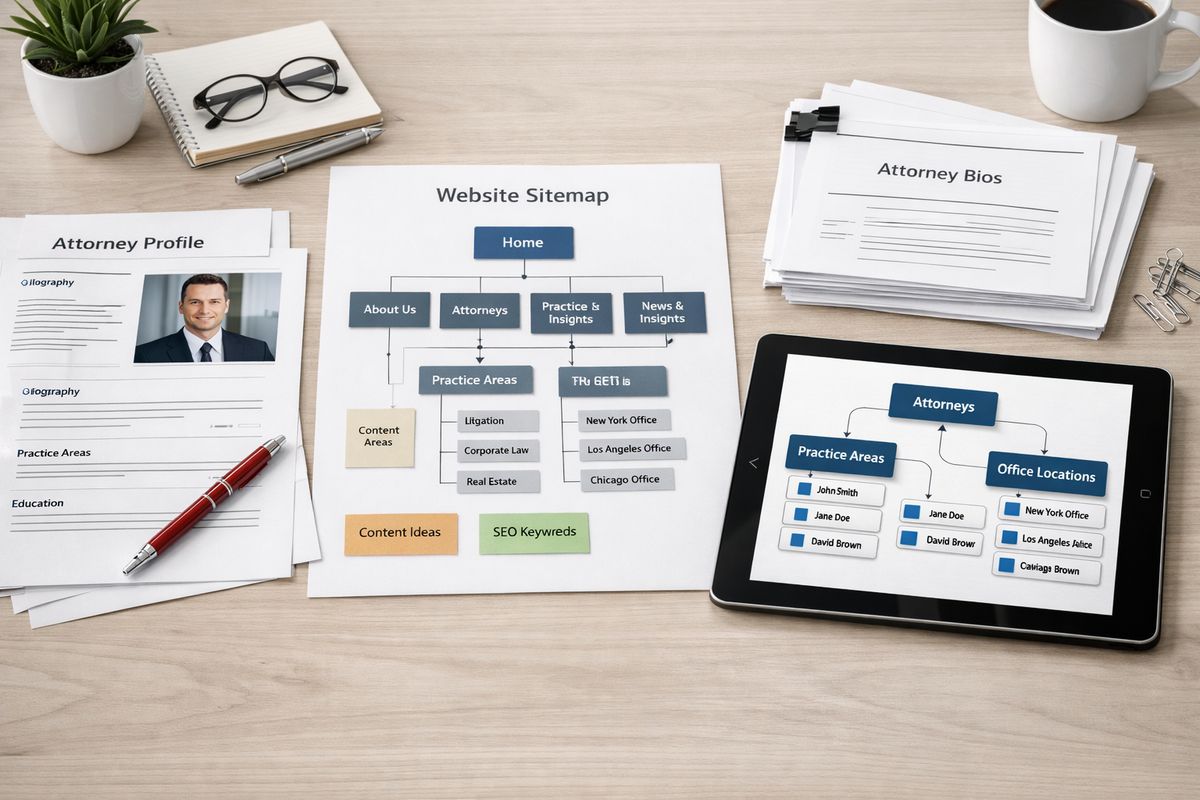
Each attorney page should follow a common structure: summary, admissions, jurisdictions, practice focus, experience, credentials, publications, honors, community activity, and contact information. Standardization improves machine readability and reduces page-to-page inconsistency.
It also improves operational efficiency. Content teams can update pages faster when the structure is fixed.
Phase two: Add structured data and internal linking
Attorney pages should include relevant person-oriented structured data and clear connections to articles, practice areas, offices, verdicts, and media mentions. Technical structure helps search systems interpret relationships across the site.
An agency evaluating this work should understand that the bio is not isolated copy. It is part of a connected entity graph across the full domain.
Phase three: Build an editorial update process
Quarterly or biannual review cycles are usually sufficient for most firms. Updates should capture new matters, speaking engagements, publications, honors, certifications, and admissions changes.
Based on review of legal content programs, regular maintenance preserves ranking value and prevents authority decay over time.
What to Look for in an Agency Managing Attorney Bios
Not every agency that can write website copy can optimize attorney bios for AI search. The distinction matters.
Legal-sector research and subject accuracy
The agency should understand legal practice areas, ethics constraints, bar-related terminology, and the difference between persuasive positioning and unsupported claims. Accuracy is non-negotiable in attorney biography work.
Entity SEO and structured content capability
The agency should be able to connect biography content to schema, local search signals, practice pages, and AI search behavior. A useful starting point is familiarity with how law firms are being discovered in AI-driven search experiences.
Measurement tied to business outcomes
The right metrics include attorney-name rankings, long-tail practice visibility, AI citation presence, engagement quality, consultation conversions, and time-to-value after updates. Firms choosing external support should also evaluate what to ask before selecting a search partner for a legal site.
Recommendation
Law firms should treat attorney bios as revenue-facing search assets, not administrative pages. The recommendation is to audit every bio for identity clarity, evidence of expertise, consistency across digital properties, and technical structure, then place those pages on a recurring update schedule as part of a wider AI search strategy.
Firms that do this well create stronger trust signals for AI systems, reduce friction for prospective clients, and improve the performance of the entire website. For firms evaluating execution support, the practical next step is to schedule a call with Attorney Visibility ai for more information.
Frequently Asked Questions
How long should an attorney bio be?
An effective attorney bio is usually long enough to establish identity, focus, credentials, proof of experience, and contact pathways. In most cases, that means more than a short profile blurb and less than an unstructured essay. Depth matters more than raw length.
Do attorney bios help with local SEO?
Yes. Office location, bar admissions, jurisdictional focus, and consistency across firm pages and external listings all support local relevance. Attorney bios often reinforce geographic and practice-area signals at the same time.
Should every attorney at a firm have a unique bio?
Yes. Unique bios improve differentiation, reduce duplication, and give AI systems clearer entity signals. Reused language across multiple lawyers weakens both trust and visibility.
How often should law firms update attorney bios?
Quarterly or biannual review is a sound standard for most firms. Updates should reflect new matters, publications, awards, admissions, speaking engagements, and title changes.
Are awards and publications worth including in attorney bios?
Yes, if they are relevant and presented with restraint. Awards, publications, certifications, and speaking roles provide evidence of authority. Their value increases when they support the attorney’s actual practice focus rather than inflate the page with unrelated recognition.
Can an agency improve attorney bios without changing the full website?
Yes, but results are strongest when biographies are connected to practice pages, schema, local signals, and the broader content structure. Bio optimization works best as part of a coordinated visibility program rather than as isolated copy editing.