If “optimize for ChatGPT” sounds like one more shiny marketing phrase your firm is supposed to care about, that reaction makes sense. But this one is worth sorting out, because AI tools are already shaping which firms get noticed first, and the real question is not whether to chase a trend, it’s whether your firm is easy to find, understand, and trust when somebody asks for legal help in plain English.
What “Optimize for ChatGPT” Actually Means for a Law Firm
To optimize for ChatGPT, you are not trying to game a secret ranking button inside one tool. You are making your firm easier for AI systems to discover, interpret, trust, and mention. That means your website says what you do clearly, your attorneys are easy to verify, your local footprint is consistent, and your content answers the kinds of questions potential clients actually ask.
Here’s the thing: this is not separate from SEO, reputation, and brand credibility. It sits on top of all of them. If your existing marketing already makes your firm look legitimate and useful, AI visibility becomes much easier to improve. If your digital presence is vague or thin, AI tends to skip past you.
How AI answers are different from search results
Traditional search gives somebody a list of links and asks that person to do the sorting. AI often skips that step and returns a direct answer, a shortlist, or a summary. That changes the game, especially in legal marketing, because many legal searches start as messy questions, not neat keywords.
A person sitting in a car outside a courthouse in Phoenix on a Friday night is not typing perfect SEO phrases. That person is asking something closer to, “What happens after a DUI arrest and do I need a lawyer right away?” AI tools are built for that style of question. If your firm has the kind of content and credibility signals that help answer it, you have a better shot at being surfaced in that conversation.
This is also why the difference between AI-driven discovery and traditional search behavior matters so much for law firms. The format of the answer changes which firms get visibility.
Why this matters for firms that depend on trust
Legal hiring is not an impulse purchase. Before somebody contacts your office, that person wants signs that your firm handles this exact kind of problem, in this exact place, with real competence. AI systems tend to look for the same things: clarity, authority, consistency, and local relevance.
If your practice areas are hard to decode, your bios are thin, or your location details are inconsistent, AI has less to work with. A competitor with cleaner signals may get the mention instead, even if your actual legal work is stronger. That is the part many firms miss. AI visibility is often a packaging problem before it is a performance problem.

Should Your Firm Care Right Now?
Yes, but with a grounded definition of “care.” Your firm does not need to drop everything and buy a trendy add-on tomorrow morning. Your firm does need to pay attention if new clients rely on online research, if your market is competitive, or if your practice depends on trust before the first call.
The practical test is simple. If potential clients are likely to ask broad legal questions online before contacting counsel, then ChatGPT optimization deserves attention now. If your firm already invests in content, local visibility, or authority building, this is a natural extension of work you should already be doing.
The firms most likely to benefit first
Some firms will feel this shift sooner than others. If your office is in a competitive metro market, AI visibility can become a tie-breaker early. If you handle high-consideration matters such as personal injury, criminal defense, family law, estate planning, or immigration, people often research before reaching out, and that research is becoming more conversational.
This also matters more if your firm already publishes useful content or wants to build confidence before consultation. AI tools often influence the shortlist before somebody ever clicks a website. For practice areas where trust takes a few touches to build, being present in those early answers helps.
Firms trying to sort out where this matters most can get a clearer picture by looking at which legal services tend to benefit earliest from AI-driven discovery. Not every practice area moves at the same pace.
When this should not replace core marketing work
The catch is simple: ChatGPT optimization should never replace the basics. If your site is slow, your service pages are thin, your city pages are generic, or your Google Business Profile is neglected, start there.
A firm with weak fundamentals does not need a new layer. It needs a stronger foundation. AI tools still rely heavily on the same signals that strong SEO relies on. Good structure, useful content, local relevance, and authority still do the heavy lifting. If those pieces are missing, no agency pitch about AI is going to save the situation.
How Potential Clients May Use ChatGPT Before Contacting a Lawyer
Most legal clients do not move in a straight line from search to call. The path is messier. Somebody gets worried, asks broad questions, compares options, checks locations, reads reviews, and only then decides whether your firm feels like a fit. AI can influence several of those steps, even if the final contact still happens through Google, Maps, or a direct visit.
Early-stage questions people ask AI
At the beginning, the questions are usually practical and anxious. Do you have a case? What happens next? How long do you have to act? What kind of lawyer handles this? AI tools are often a first stop because asking feels easier than digging through ten different websites.
That is why broad educational content still matters. A clear page explaining a process, a deadline, or a likely next step can feed both search visibility and AI understanding. Legal content that mirrors real intake questions tends to perform better because it matches the way people actually ask for help.
Comparison and shortlisting behavior
Once somebody has a basic sense of the issue, AI may become a pre-filter. Instead of searching for one firm directly, a person may ask for the difference between a general practice attorney and a specialist, whether contingency fees are typical, or what credentials matter in a custody case.
At that stage, AI is helping narrow the field. Your firm may not get the signed case from an AI mention alone, but being included in the mental shortlist matters. That is one reason answer-focused legal content written in natural language has become more valuable. It helps your firm sound usable, not just visible.
Local intent still matters
For legal services, local intent rarely goes away. State law, court procedures, and licensing rules make location part of the decision. Even when somebody starts with a broad AI question, the next question is often local: who handles this in my city, county, or state?
That means your office address, service areas, jurisdiction details, bar admissions, and local pages are not housekeeping. They are part of your visibility engine. Firms that want stronger AI discovery usually need the same local clarity that supports a stronger local search foundation for legal clients.

What ChatGPT and Other AI Tools Look For
AI tools do not “think” like a client, but they do look for patterns that overlap with human trust. The easier your firm is to interpret, the more likely your information can be summarized accurately. The stronger your authority signals, the safer your firm looks as a source.
Clear website structure and plain-English pages
A confusing website is hard on clients and hard on machines. If your navigation buries your practice areas, your pages are filled with vague claims, or your attorney bios are hard to find, AI has trouble understanding what your firm actually does.
Clear structure helps. That means focused service pages, obvious location pages, attorney bios, FAQ content, and readable formatting. A page called “Car Accident Lawyer in Denver” that explains injuries, insurance issues, and next steps is much easier to interpret than a page full of slogans about fighting for justice.
Topical depth and firsthand legal credibility
Surface-level content does not travel far in AI search. Detailed pages about specific case types, common legal processes, and jurisdiction-specific issues tend to do better because they give AI something real to work with.
Credibility matters just as much. Attorney experience, court admissions, bar memberships, speaking engagements, quoted commentary, publications, and specific practice focus all help establish that your firm is not just publishing content, but knows the subject. If you want to understand why some firms keep getting surfaced, it helps to look at the signals AI uses when deciding which legal sources to rely on.
Consistency across the web
Your website is only part of the picture. AI can pull from business listings, legal directories, review sites, social profiles, local chamber pages, news coverage, and other third-party sources. If your phone number is different in three places, your office suite is missing in one directory, and your attorney name appears two different ways, that inconsistency creates friction.
Clients notice that kind of sloppiness. AI systems do too. Consistency is boring work, honestly, but it matters.
Strong trust signals
Law firms have a higher trust threshold than most businesses. Somebody hiring a divorce lawyer, criminal defense attorney, or probate counsel wants reassurance before making contact. AI systems often reflect that by favoring firms with stronger signals of legitimacy.
Reviews, testimonials where allowed, awards, media mentions, podcast appearances, transparent contact details, and clear authorship all help. So do real attorney bios with education, admissions, and focused experience. If your online presence feels thin, anonymous, or generic, trust drops fast.
The Building Blocks of ChatGPT Optimization for Law Firms
If an agency offers ChatGPT optimization, the service should translate into specific work. Not mystery. Not trend language. Actual tasks that improve how your firm is understood and trusted.
Create pages that answer real legal questions
The best starting point is content built around real client language. Service pages, city pages, FAQ hubs, and articles should answer the questions people ask when stress is high and knowledge is low.
A page about DUI defense that explains what happens after an arrest in your state will usually beat a page that repeats broad phrases twenty times. The same goes for family law, injury claims, business disputes, or estate planning. Useful specificity wins. So do strong practice-area pages that make your services easier for AI and clients to understand.
Tighten attorney bio and practice-area pages
Attorney bios do more than introduce your team. They help establish jurisdiction, qualifications, focus, and credibility. If a bio only says that an attorney is passionate about clients, it is wasting valuable real estate.
Your bios should show admissions, focus areas, years of experience where relevant, speaking or publication history, and plain-English descriptions of the work handled. Practice pages should clearly state who you help, what issues you handle, and where you handle them.
Add schema and structured data
Schema is code that labels information for machines. It tells systems what a page represents, who an attorney is, what an office location is, whether a section is an FAQ, and other details that are easy for humans to infer but easier for machines to miss.
For law firms, that can include organization schema, attorney schema, article schema, local business schema, review-related markup where appropriate, and FAQ schema. Schema is not magic, but it helps remove ambiguity. That matters.
Earn citations, mentions, and links that reinforce authority
Off-site authority still counts. If your attorneys are quoted in local media, listed in respected legal directories, involved with bar associations, featured on podcasts, or connected to community sponsorships, those mentions support your credibility.
The point is not link collecting for its own sake. The point is creating a believable footprint that says your firm exists in the real legal world, not only on its own website.
What to Ask a Marketing Agency Before Paying for “ChatGPT Optimization”
https://www.youtube.com/watch?v=bhTo8fDmr5I
This is where a lot of firms get sold a label instead of a service. “AI optimization” sounds advanced, which makes it easy to hide weak deliverables behind impressive language. The fix is simple: ask for specifics.
Ask what work is actually included
A real service should include concrete actions. That may involve technical SEO improvements, content strategy, practice page rewrites, attorney bio upgrades, schema implementation, citation cleanup, authority building, and reporting. If the answer stays fuzzy, that is a problem.
You want deliverables, not vibes. If an agency cannot explain what changes on your site, what changes off your site, and what gets measured after that, the offer is probably too thin.
Ask how success will be measured
Good reporting for this kind of work should connect visibility to business outcomes. Organic traffic trends, branded search lift, stronger rankings for high-intent pages, referral patterns, consultation volume, and lead quality by practice area all matter more than a screenshot showing a one-time mention in an AI chat.
Direct AI attribution is still imperfect, which means any honest agency should say so. But that does not make measurement impossible. It just means you track a mix of leading and lagging indicators. A useful place to start is understanding how firms can tell whether AI-focused visibility work is leading to real marketing gains.
Ask whether the agency understands legal ethics and intake reality
Legal marketing has tighter guardrails than most industries. Disclaimers matter. Jurisdiction limits matter. Testimonial rules matter. Intake quality matters. A flood of bad leads is not a win.
A capable agency should understand the difference between traffic and retained cases. It should also understand that legal content cannot be sloppy. Accuracy is not optional when your website shapes client decisions and may influence AI summaries.
Red Flags and Common Mistakes
Not every firm should buy this service right now, and not every agency selling it knows what it is doing. A few mistakes show up over and over.
Buying “AI optimization” without fixing your site
This is the big one. If your mobile experience is rough, your service pages are generic, your forms are clunky, or your local signals are weak, paying for AI optimization first is like repainting a lobby while the front door sticks shut.
Fix the site. Fix the structure. Fix the local details. Then add the extra layer.
Publishing generic AI-written legal content at scale
Cheap content is tempting, especially when agencies promise volume. But bland legal articles that sound like every other page on the internet do not build trust. Worse, they can blur practice distinctions, flatten local nuance, and create accuracy problems.
Legal content needs specificity, review, and a point of view. It should sound like your firm understands the actual problem, not like a machine stitched together common phrases about it.
Chasing mentions instead of signed cases
Visibility is only useful if it leads to the right consultations. A mention in an AI answer can be nice, but it is not the goal. The goal is qualified leads, stronger trust, and more signed cases in the practice areas that matter to your firm.
If a vendor spends more time showing novelty than talking about intake, conversion, and case quality, step back.
Budget: What This Usually Costs and Where the Value Comes From
There is no single number for this because worthwhile ChatGPT optimization is really a bundle of underlying work. The price depends on how much of that work your firm already has in place, how competitive your market is, and whether you need cleanup, expansion, or both.
If ChatGPT optimization is folded into SEO
In many cases, that is the best version of the service. A strong SEO engagement already covers technical improvements, content strategy, page refinement, local SEO, authority building, and reporting. The AI angle changes priorities and framing, but not the need for those fundamentals.
That also means results are not instant. If somebody promises dramatic gains in two weeks, be skeptical. A healthier expectation looks more like the timeline discussed in what usually has to happen before search improvements start showing up in AI visibility.
If an agency sells it as a standalone service
Standalone can make sense only if the scope is narrow and useful. For example, an audit of your practice pages, bios, schema, and citations could be worthwhile if you already have a strong SEO team and want a focused AI visibility layer.
What should not be standalone is vague monitoring with no implementation behind it. Paying for a monthly PDF about AI mentions, without content, technical, or authority work attached, is usually not money well spent.
Where spending more makes sense
Higher investment can pay off when the upside is large. Competitive metro markets, multi-location firms, high-value case types, and firms with strong intake capacity often see more value from deeper visibility work.
If one additional case can cover a meaningful share of the monthly spend, stronger authority and discoverability become easier to justify. The math is usually clearer in personal injury, criminal defense, high-asset family law, and business litigation than in lower-value, lower-volume work.
A Simple Priority Order for Your Firm
https://www.youtube.com/watch?v=loujaeBy8p0
The easiest way to think about this is in layers. Start with the pages that help somebody decide whether to contact you. Then expand into answer-focused content. Then strengthen authority off-site.
Start with the pages that make hiring decisions easier
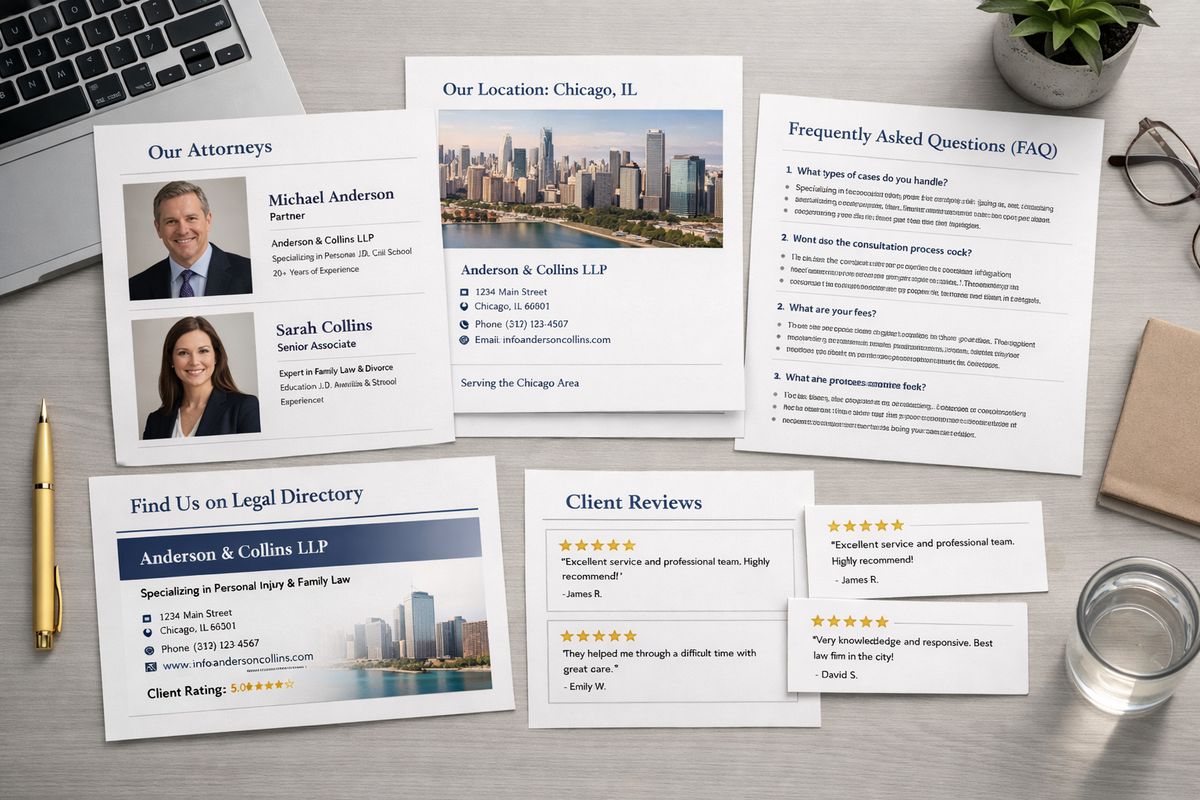
Your highest-value pages are usually your practice-area pages, location pages, attorney bios, reviews, and FAQs. Those pages help whether somebody finds your firm through Google, maps, a referral, or AI.
If your site is thin, start there. Tighten what you already have before publishing fifty new blog posts. A sharp core beats a bloated archive every time.
Then build answer-focused content around real intake questions
Once your core pages are solid, build supporting content around the questions your intake team hears every week. Not theoretical SEO topics, real questions. What happens after an arrest? How is fault decided? What documents should you bring to a probate consultation?
This is where the best content ideas usually come from, straight from the conversations already happening in your office. Firms looking for direction here tend to do better when they focus on the kinds of pages and articles that actually support AI discovery for legal services.
Then strengthen authority off-site
After the website foundation is in shape, work outward. Clean up legal directories, standardize citations, earn local mentions, support review generation, and look for legitimate opportunities to be quoted or featured.
That sequence matters. Off-site authority works better when it points back to a site that already explains your value clearly.
So, Should Your Law Firm Optimize for ChatGPT?
Yes, but only in the practical sense that matters. Your firm should become easier for AI tools to understand and trust by improving the same things that make clients more likely to choose you: clear pages, strong bios, local relevance, useful content, and a believable reputation across the web.
Do not buy magic beans. Do fix the parts of your digital presence that make your firm hard to interpret. Start by auditing one high-value page, your top practice area page is usually the right choice, and see whether it clearly explains who you help, what you handle, where you practice, and why somebody should trust you. If you want a clearer plan, schedule a call with Attorney Visibility ai for more information.
Frequently Asked Questions
Is optimizing for ChatGPT different from regular SEO?
Yes, but not by much. The underlying work overlaps heavily with SEO, local SEO, content quality, and authority building. The difference is that AI tools often summarize information instead of just listing links, so clarity, structure, and trust signals matter even more.
Can ChatGPT send clients directly to your law firm?
Sometimes, but not always in a clean, trackable way. AI can influence awareness, shortlisting, and trust before somebody searches your firm name, checks your reviews, or visits your site through another channel. That indirect influence is often the real value.
What pages should your firm fix first?
Start with practice-area pages, attorney bios, location pages, and FAQ content. Those pages give both clients and AI systems the clearest view of what your firm does, where you do it, and why your team is qualified.
Should your firm publish more AI-generated legal articles?
Not unless every piece is edited for accuracy, specificity, and usefulness. Generic bulk content usually adds noise, not authority. For legal marketing, fewer strong pages beat dozens of bland ones.
How long does ChatGPT optimization take to help?
Usually months, not days. Since most of the work overlaps with SEO, local authority, and content improvement, results depend on how strong your current foundation is and how competitive your market is.
How do you tell if an agency is selling hype?
Ask what work is included, what pages get improved, what technical fixes are made, what authority signals get strengthened, and how results are measured. If the answers stay vague, or focus on novelty instead of consultations and signed cases, that is a red flag.