
If your law firm is trying to choose between SEO vs ChatGPT, the short answer is simple: SEO brings in the people looking for a lawyer, and ChatGPT helps you do some of the work faster. Treating them like interchangeable options is where firms get stuck, and it usually leads to a lot of content with not much to show for it.
SEO vs ChatGPT at a Glance
For most law firms, SEO is the better primary investment. ChatGPT has real value, but mostly as a support tool. If your goal is signed cases, dependable visibility in search still matters more than faster drafting.
That difference matters because these tools solve different problems. SEO is about getting found by potential clients in Google, especially when somebody has an urgent legal issue and needs help nearby. ChatGPT is about speeding up parts of your marketing workflow, such as outlining articles, refining FAQs, or helping turn rough notes into usable drafts.
What SEO means for a law firm
SEO is the work that helps your website show up when somebody searches for terms like “car accident lawyer in Phoenix,” “divorce attorney near me,” or “DUI lawyer open now.” It includes your practice-area pages, local landing pages, Google Business Profile, technical site health, reviews, internal links, and the overall trust your site builds over time.
For a law firm, SEO is not just about traffic. It is about visibility in the exact moments that matter. A person searching for legal help at 9:40 p.m. after an arrest or after getting served papers is not browsing for fun. That person is looking for answers and a lawyer to call.
What ChatGPT means in a law firm marketing workflow
ChatGPT is an AI tool you can use to draft content, brainstorm article ideas, summarize long information, rewrite plain-language explanations, and speed up repetitive marketing tasks. It can help with intake script ideas, email follow-ups, FAQ drafts, title variations, and content refreshes.
But it is not a discovery channel in the same way Google is. People do use AI tools for research, and that trend is real. Still, using ChatGPT does not automatically place your law firm in search results, local map listings, or the top of a local service query.
The short answer: different jobs, different outcomes
Here’s the thing: law firms still need SEO if the goal is dependable search visibility. ChatGPT can make your marketing team faster, but speed is not the same as demand.
SEO brings qualified traffic. ChatGPT helps produce work faster. Those outcomes are connected, but they are not the same.
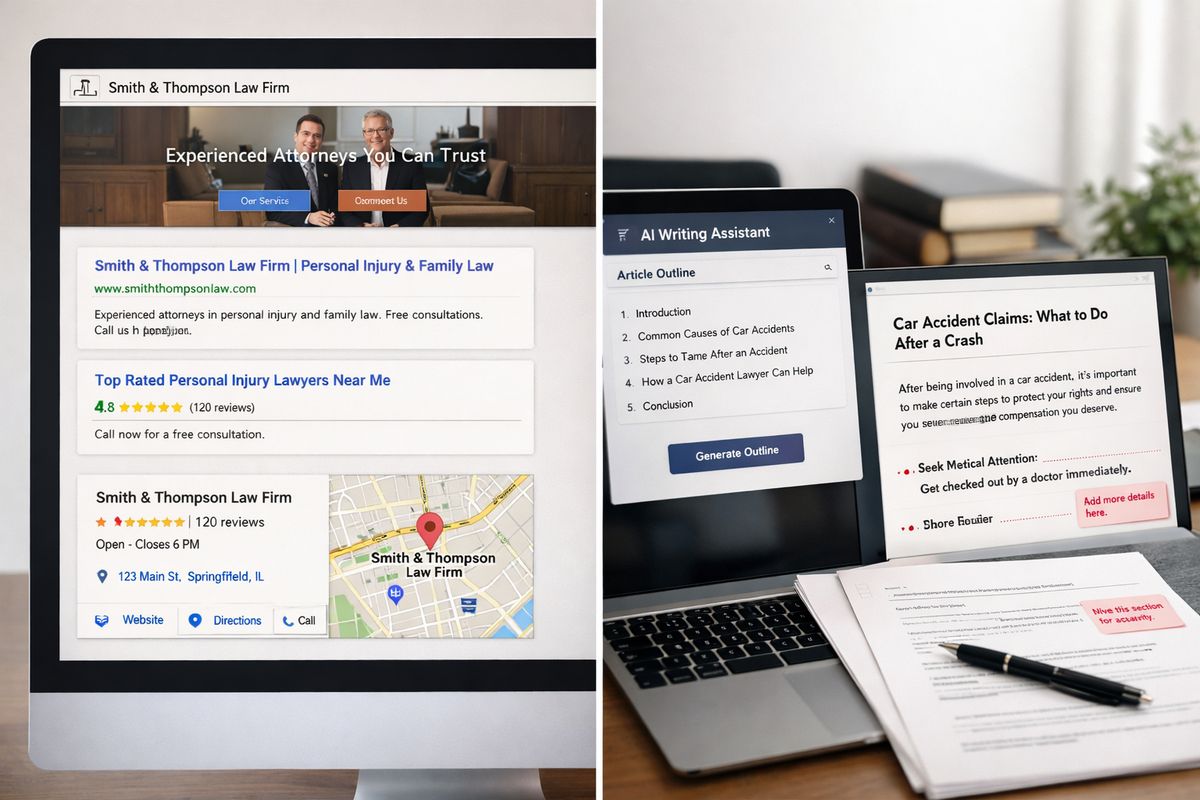
How Potential Clients Actually Find Your Firm
When somebody needs legal help, the path is usually not mysterious. It is practical, urgent, and local. A person gets in a crash, gets arrested, or realizes a custody dispute is about to get ugly, then grabs a phone and starts searching.
SEO meets active search intent
SEO matches that behavior directly. A well-optimized law firm site can appear for practice-area searches, local searches, question-based searches, and “near me” searches that signal real hiring intent. If your firm ranks for “personal injury lawyer Mesa” or shows in the map pack for “estate attorney near me,” you are meeting people where intent is already high.
That is why SEO works so well for legal marketing. You are not trying to create demand from scratch. You are showing up when demand already exists.
ChatGPT supports research, not primary discovery for most firms
ChatGPT can play a role earlier in the process. Somebody may ask broad questions about what happens after a DUI arrest or how child custody gets decided in a certain state. That can shape early research, but it still does not replace the volume, urgency, or local precision of traditional search.
The catch is that AI conversations do not reliably send traffic to your site the way search results do. If you want a clearer picture of that shift, this breakdown of Google and AI discovery behavior helps explain why law firms should not confuse research assistance with actual lead flow.
Traffic Potential and Visibility
Traffic is not just a number on a report. For a law firm, it is future consultations, phone calls, and case opportunities. That is why the difference between search visibility and AI assistance matters so much.
SEO can build compounding visibility
Good SEO compounds. A strong practice-area page can rank for months. A useful FAQ can keep attracting visitors. A well-managed Google Business Profile can keep generating map views and calls. Local pages, blog posts, internal links, and review signals all build on each other.
Think of it like a file cabinet that keeps working after you label it properly once. The setup takes effort, but afterward the right people can keep finding the right drawer.
That is why SEO often becomes more efficient over time. One page leads to another, one ranking supports another, and your site starts building authority in specific legal topics and local markets.
ChatGPT does not give your firm owned search visibility by itself
ChatGPT alone does not put your firm into Google results. It does not create map pack rankings. It does not strengthen your local citations or fix your technical SEO. If it helps draft a page, that page still needs to be reviewed, published, structured correctly, internally linked, and optimized around real search demand.
In other words, AI-generated content only matters when it becomes part of an actual SEO system. If you are trying to understand what content formats matter most in that system, this guide to pages that support AI and search visibility is worth a look.

Lead Quality and Client Intent
A lot of marketing conversations get stuck on traffic volume. For law firms, that is the wrong place to focus. The better question is simple: does this bring in people who are close to hiring counsel?
SEO targets high-intent prospects
SEO shines here because it connects your firm to people with immediate needs. Practice-area pages, city pages, and well-written FAQs often attract visitors who are already deciding who to contact. Somebody searching “truck accident attorney Scottsdale free consultation” is much closer to calling than somebody reading a general AI answer about negligence law.
That is what makes organic search so valuable. Rankings do not just create awareness. Done well, rankings bring in prospects who are ready to act.
ChatGPT helps shape messaging for better conversion
ChatGPT can help on the conversion side. It can improve page clarity, suggest better explanations for legal terms, draft intake email templates, and organize FAQs around the questions clients actually ask. It can even help turn a dense attorney paragraph into something a stressed person can understand at midnight.
The trick is that this helps your site convert better, not generate demand on its own. Better messaging matters, but it still needs traffic coming in first.
Content Creation and Speed
This is where ChatGPT earns real respect. Legal marketing takes a lot of writing, and most attorneys do not want to spend Friday afternoon drafting a 1,200-word page on probate timelines.
SEO content requires strategy, structure, and legal accuracy
Strong SEO content is not just “write an article and post it.” It needs clear page intent, keyword targeting, internal links, local relevance, and legal accuracy. A page about a car accident claim in Arizona should not read like a generic legal textbook. It should reflect the questions, laws, and practical concerns connected to that jurisdiction and case type.
It also needs to be trustworthy. Search engines reward content that actually helps people and aligns with the query. In legal marketing, vague filler is easy to spot.
ChatGPT can speed up drafting and ideation
ChatGPT is useful for getting unstuck. It can generate topic clusters, outline a page, rewrite clunky paragraphs, suggest title options, draft schema ideas, and help refresh older content. If your firm has good source material already, AI can help shape it faster.
Used well, it is like having a fast junior assistant who never gets tired but still needs supervision.
Where AI-written content can go wrong for law firms
The problem starts when speed becomes the goal. AI copy can sound bland, repeat obvious points, flatten your tone, and make factual mistakes. It can also invent citations or present overconfident nonsense as if it were settled law. For legal content, that is a bad trade.
That risk gets even bigger when pages go live without attorney review. If you are using AI in legal marketing, this practical approach to checking AI-generated legal answers shows why review cannot be an afterthought.
Accuracy, Trust, and Ethical Risk
For a law firm, trust is not a nice bonus. It is the whole thing. A site can be beautifully designed and still lose a prospective client in seconds if the content feels thin, generic, or wrong.
SEO rewards trustworthy, well-reviewed content
SEO tends to reward pages that match search intent and show real expertise. That means useful explanations, clearly structured service pages, accurate legal information, and signals that your firm knows the subject matter. Attorney oversight matters because legal content has to reflect real knowledge, not just polished wording.
That is also why bios, case context, and topical depth matter. Search engines are getting better at telling the difference between a real legal resource and a page that just sounds polished.
ChatGPT can hallucinate or oversimplify legal information
A hallucination is when AI states something false as if it were true. No warning. No hesitation. Just a clean sentence that sounds credible and can still be completely wrong.
In legal content, that risk is serious. State law varies. Procedure varies. Deadlines vary. A too-confident but inaccurate explanation about expungement eligibility or custody standards can damage trust fast.
Why human review is non-negotiable
Every AI-assisted legal page should be reviewed for jurisdiction, tone, accuracy, ethics, and actual usefulness. Not just skimmed. Reviewed.
That is how your firm protects reputation and compliance. If you want to understand how AI tools decide what to surface in the first place, this plain-English look at source selection in legal AI answers adds helpful context.
Local SEO vs AI for Geographic Reach
Legal marketing is local in a way many industries are not. A family lawyer in Dallas does not need vague national attention. A criminal defense attorney in Tampa needs visibility in Tampa.
SEO is built for local market visibility
Local SEO is made for that job. Your Google Business Profile, local landing pages, reviews, citations, map pack presence, and city-specific relevance all help your firm appear where nearby clients are actually searching. When somebody wants a lawyer fast, proximity and local credibility matter.
That is why local SEO remains one of the strongest growth channels for law firms. It aligns with how legal services are chosen in real life.
ChatGPT has weak local targeting by itself
ChatGPT can help draft city pages or location-specific FAQs, but it does not create local rankings by itself. It does not strengthen your map visibility or improve your review profile. It supports local marketing work. It does not replace it.
For firms trying to connect local SEO and emerging AI visibility, this explanation of what drives local presence in both places is useful.

Cost, Time, and Resource Demands
Sticker price can be misleading here. ChatGPT looks cheap. SEO looks expensive. But cost without context leads to bad decisions.
SEO takes longer but builds long-term equity
SEO usually takes months, not days. Technical fixes, content creation, local optimization, internal linking, and authority building all need consistent work. But once pages rank and local trust improves, that visibility can keep paying off.
That is the real value. You are building an asset your firm owns.
ChatGPT is cheaper to access but needs oversight
ChatGPT has a low barrier to entry. The subscription cost is small compared with agency retainers or a full content team. But the hidden cost is time spent prompting, editing, reviewing, fact-checking, and publishing. If the output is generic or inaccurate, the savings vanish quickly.
Fast content is only valuable when it is useful and correct.
What “cheap” actually costs if results do not show up
Cheap content that never ranks is not cheap. It costs lost time, missed leads, weaker trust, and a website full of pages nobody wants to read. It can also leave your firm sounding just like every other firm in town, which is the last thing you want in a crowded market.
The false economy is easy to miss. You save on production, then lose on visibility.
SEO Performance vs ChatGPT Output Measurement
If you cannot measure it, you cannot tell whether it is helping your firm grow or just keeping everybody busy.
SEO gives clearer business metrics
SEO has practical business metrics. Rankings. Organic traffic. Map views. Phone calls. Form submissions. Booked consultations. Signed cases. Those numbers connect directly to growth, especially when call tracking and intake reporting are set up properly.
That clarity is one reason law firms keep investing in SEO. It is not perfect, but the path from visibility to lead is usually trackable.
ChatGPT improves efficiency, not market demand
ChatGPT performance is measured differently. Time saved on drafting. Faster content production. Better first drafts. More consistent workflows. Those gains matter, especially for busy firms, but they are indirect unless tied to rankings, conversions, or stronger client communication.
If your firm wants to put structure around that, this framework for tracking AI visibility and output helps separate useful gains from feel-good activity.
Brand Authority and Differentiation
Law firm websites often sound painfully similar. “Dedicated advocacy.” “Personalized representation.” “Results-driven counsel.” By the third homepage, everything starts to blur.
SEO helps your firm own specific topics and searches
SEO gives your firm a chance to stand out by owning specific topics, local questions, and practice-area searches. A focused page on truck rollover claims in Phoenix or custody modifications in Collin County is far more memorable than generic marketing copy. Repeated visibility in those searches builds familiarity, and familiarity builds trust.
That is how authority grows online. Not by sounding bigger, but by being more useful in the exact places prospects are looking.
ChatGPT can flatten your voice if you let it
AI tends to default to safe, generic language. It likes smooth sentences, broad advice, and familiar phrases. That can be helpful for rough drafts, but it can also erase the parts of your firm that actually make you distinct.
Use it as a draft partner, not your brand voice. Your experience, examples, local knowledge, and point of view are the things that make content believable.
Best Fit by Law Firm Size and Growth Stage
The right emphasis depends partly on where your firm is today. But even here, the hierarchy stays pretty clear.
Solo and small firms that need leads now
If your firm needs nearby clients and signed cases, SEO usually deserves priority. You need practice-area visibility, local rankings, and a site that turns searchers into consultations. ChatGPT can still help lighten the load by speeding up outlines, FAQs, and rough drafts, but it should not be the main strategy.
Growing firms that need scale
Growing firms can get more out of ChatGPT because the workflow demands are larger. More pages, more campaigns, more intake touchpoints, more refreshes. AI can support that production, while SEO remains the engine that keeps discoverability moving.
Firms with an agency vs firms doing it in-house
An agency can combine strategy, review, technical SEO, and AI-assisted efficiency in a way that is hard to replicate in-house without strong marketing leadership. Firms handling everything internally often run into the same problem: lots of AI output, very little direction.
If your firm is still sorting out where AI fits, this practical guide to deciding how much attention ChatGPT deserves can help ground the decision.
When to Choose SEO, When to Use ChatGPT, and When to Combine Them
This is the practical decision point. If your firm has limited time or budget, priority matters.
Choose SEO if your goal is qualified traffic and signed cases
Choose SEO when your goal is local visibility, stronger practice-area rankings, and a steadier stream of high-intent leads. If your firm has to pick one place to put marketing focus, this is it. SEO is the option most directly tied to being found by people who need legal help now.
Use ChatGPT if your goal is speed and support
Use ChatGPT when your goal is to move faster. It works well for outlining, repurposing, drafting FAQs, refreshing old pages, and improving internal workflow. It is helpful, efficient, and often worth using. It just is not a substitute for discoverability.
Combine both for the strongest marketing setup
For most law firms, the smartest setup is both. Let SEO set direction, standards, targeting, and growth goals. Let ChatGPT help execute faster inside that system.
That balance is where the real value shows up. If you want a broader picture of that blended approach, this look at what actually helps firms appear in AI-driven results connects the dots well.
Pricing and Return on Investment
Cost only matters in relation to outcomes. A cheaper tool that does not generate clients is not the better deal.
What SEO investment usually covers
SEO investment usually covers technical fixes, on-page optimization, local SEO, content strategy, content production, internal linking, reporting, and authority-building work. You are paying for the infrastructure that helps your firm get discovered and trusted in search.
That is why SEO pricing can vary so much. It is not just content. It is an entire visibility system.
What ChatGPT investment usually covers
ChatGPT usually costs far less in software fees. But the full investment also includes prompt development, attorney review, editing, publishing, and strategy. The tool is affordable. The finished output still takes work.
Which one delivers better ROI for law firms
If your goal is client acquisition, SEO usually delivers the stronger ROI because it is tied to discoverability and lead generation. If your goal is operational efficiency, ChatGPT can deliver ROI by saving time and speeding up production.
For law firms, that usually means this: SEO drives revenue more directly, while ChatGPT helps reduce the effort behind the scenes.
Verdict: Which One Wins for Law Firms?
If your firm has to choose a primary marketing priority, SEO wins. That is the clearest answer.
The winner: SEO
SEO is the stronger primary investment for law firms that want sustainable visibility, qualified leads, and long-term growth. It aligns with how people actually look for legal help, especially in urgent and local situations. It creates an asset your firm owns and can keep improving.
Where ChatGPT still earns a place
ChatGPT still deserves a place in your marketing stack. It can help with brainstorming, drafting, organizing, refreshing, and smoothing out repetitive work. Used carefully, it saves time and helps your team move faster.
Just do not confuse support with strategy.
One smart next step to try
Audit one practice-area page and one local page on your site. Check whether each page targets a real search, explains the issue clearly, reflects your jurisdiction, and gives somebody a reason to contact your firm. Then use ChatGPT to help improve the draft, tighten the FAQ language, or suggest clearer headings before final human review.
Frequently Asked Questions
Is ChatGPT replacing SEO for law firms?
No. ChatGPT can support content creation and research, but it does not replace the visibility SEO creates in Google search results and local map listings. If your goal is getting found by prospective clients, SEO still carries more weight.
Can ChatGPT help a law firm with SEO?
Yes, if you use it the right way. It can help with outlines, draft language, FAQ ideas, content refreshes, and organizing information. It works best when guided by a real SEO strategy and reviewed for legal accuracy.
Which is better for getting more legal leads, SEO or ChatGPT?
SEO is better for lead generation because it helps your firm appear when people actively search for legal help. ChatGPT can improve content quality and workflow speed, but it does not generate demand on its own.
Is AI-written legal content safe to publish?
Not without review. AI can oversimplify law, miss jurisdiction issues, or confidently state something inaccurate. Any legal content created with AI should be checked carefully before it goes live.
Does local SEO matter more than AI visibility for law firms?
For most firms, yes. Legal services are highly local, and nearby prospects often want help fast. Local rankings, reviews, and map visibility usually have a more direct effect on consultations than general AI exposure.
Should your firm invest in both SEO and ChatGPT?
Usually, yes. SEO should guide the strategy because it drives discoverability. ChatGPT should support execution by helping your team move faster and create better drafts. That combination tends to be the most practical setup.
If your firm wants a clearer plan for where SEO ends, where ChatGPT helps, and what kind of strategy actually turns visibility into signed cases, schedule a call with Attorney Visibility ai for more information.