
Practice area pages are the clearest pages a law firm can publish about what it actually does, and in 2026 they matter far beyond traditional SEO. Across legal-marketing analysis and search behavior, these pages now function as the source material AI systems use to identify a firm’s services, geography, and matter fit.
Why Practice Area Pages Matter for AI Search
Law firms evaluating digital agencies are no longer judging practice area pages as routine website copy. According to legal-marketing coverage from firms such as PaperStreet and MileMark Media, service-specific legal pages increasingly act as the primary pages search systems review when matching a firm to a legal need. That shift matters because AI search does not browse a site like a human visitor. It extracts signals.
In plain terms, a practice area page tells a machine and a prospective client the same thing: this firm handles this legal matter, in this place, for these kinds of clients. A homepage cannot carry that entire burden. A blog post usually does not try to. A practice area page does.
That is why these pages now operate as strategic infrastructure. Firms that understand how AI search works for law practices tend to treat service pages as foundational assets, not filler built to satisfy a website checklist.
What Practice Area Pages Are and Why They Carry More Weight in AI Search
Practice area pages are dedicated pages for specific legal services, such as personal injury, divorce, business litigation, estate planning, or criminal defense. They are the pages that answer the commercial question behind a search: who handles this legal problem?
According to legal SEO agencies, AI systems favor these focused pages because they provide stronger topical signals than broad service summaries. A page devoted to medical malpractice says more than a general “services” page ever can. It gives the system a precise subject, related terminology, a likely audience, and a clearer match to user intent.
That specificity is the difference between being vaguely relevant and clearly retrievable. AI systems need clarity because they summarize, compare, and recommend. Ambiguous content gets ignored.
How Practice Area Pages Differ From Attorney Bios, Blog Posts, and Homepages
Each page type on a law firm site serves a different job. The homepage establishes brand identity and broad positioning. Attorney bios establish individual qualifications, bar admissions, and professional credibility. Blog posts capture informational searches and answer narrower questions about laws, deadlines, defenses, or procedure.
Practice area pages do something else. They confirm service capability and commercial intent.
That distinction shows up in results. Agencies regularly report that blog content helps discovery, but service pages do more of the work in qualification and conversion. A person reading about “how long a car accident settlement takes” is often still researching. A person landing on an auto accident lawyer page is much closer to contacting counsel. For firms weighing where AI search differs from standard rankings, that gap matters because answer engines often prefer pages that directly map to a service need.
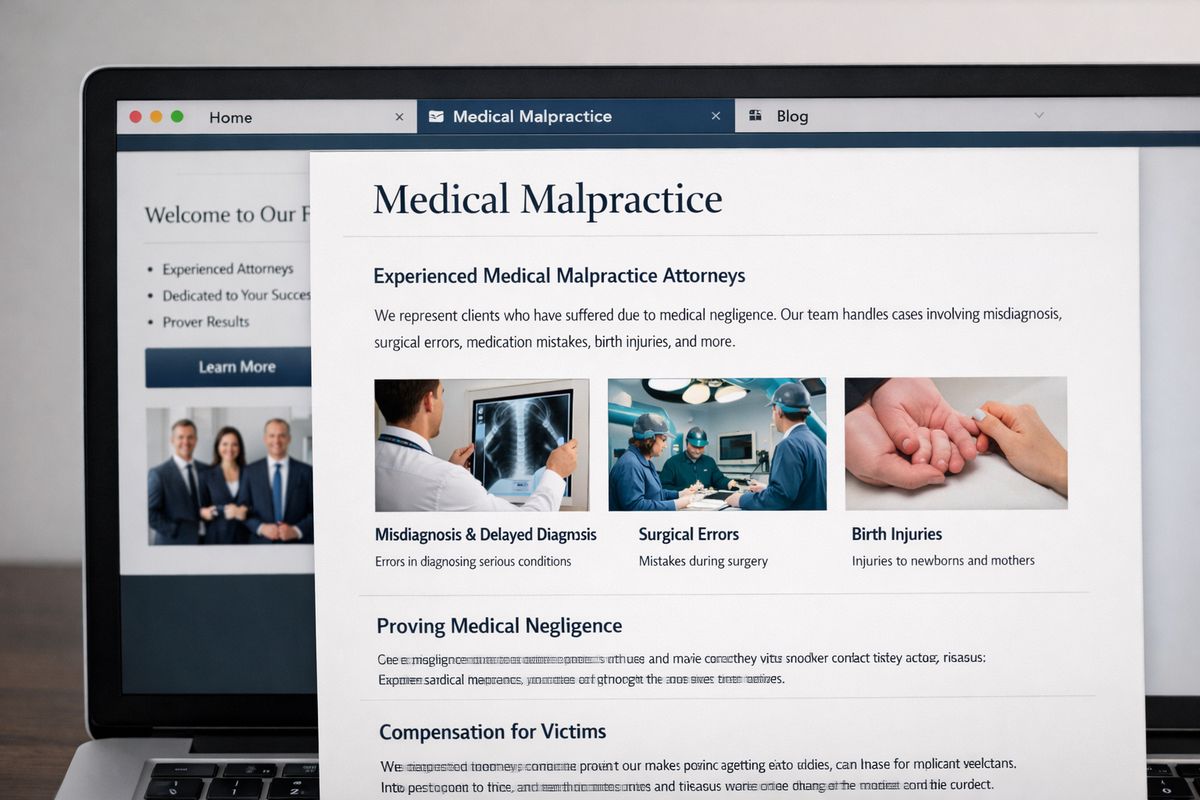
Why AI Search Relies on Clear Service-Level Content
AI search engines and answer engines build responses from pages they can interpret with confidence. In legal marketing, confidence comes from pages that state exactly who handles what, where they handle it, and what type of matter qualifies.
That makes practice area pages unusually valuable. They reduce ambiguity. A system does not need to infer whether a firm handles wrongful death claims from a vague sentence on a homepage or from a single blog article written three years ago. A strong service page states it directly.
There is a balancing point here. AI systems also look at reputation signals, reviews, links, and attorney credentials. But those signals work better when anchored to a page that clearly identifies the service itself.
AI Systems Need Explicit Signals About Topic, Location, and Client Need
A strong practice area page gives AI systems explicit information about the legal issue, case types, jurisdictions served, industries served where relevant, and the path to contact. It also explains the client problem in the language real people use.
That matters because legal searches are messy. One person searches “spinal cord injury lawyer.” Another searches “catastrophic injury attorney after truck wreck.” A third asks an AI tool who handles severe crash cases in Dallas. If the page defines the matter clearly and includes related terms naturally, the system has enough context to connect those phrasing differences to the same service.
Location is equally important. Firms that want stronger visibility in local answer engines need pages that work alongside the local signals AI tools rely on. A service page that says only “serving clients nationwide” tells a machine very little unless the firm truly practices at that scale.
Broad “Practice Areas” Hubs Alone Leave Gaps in AI Understanding
Overview pages still help site architecture. They group services, create navigation paths, and support internal linking. But they are not enough on their own.
According to agency guidance, AI search performs better when each major service has its own URL with substantive copy. An umbrella “Practice Areas” page can say the firm handles family law, criminal defense, and estate planning. It cannot fully explain the intake criteria, legal standards, and location signals for each one without becoming unreadable.
The overview page still has value. It acts like a table of contents. The individual service page is the chapter AI systems actually learn from.
What Strong Practice Area Pages Include
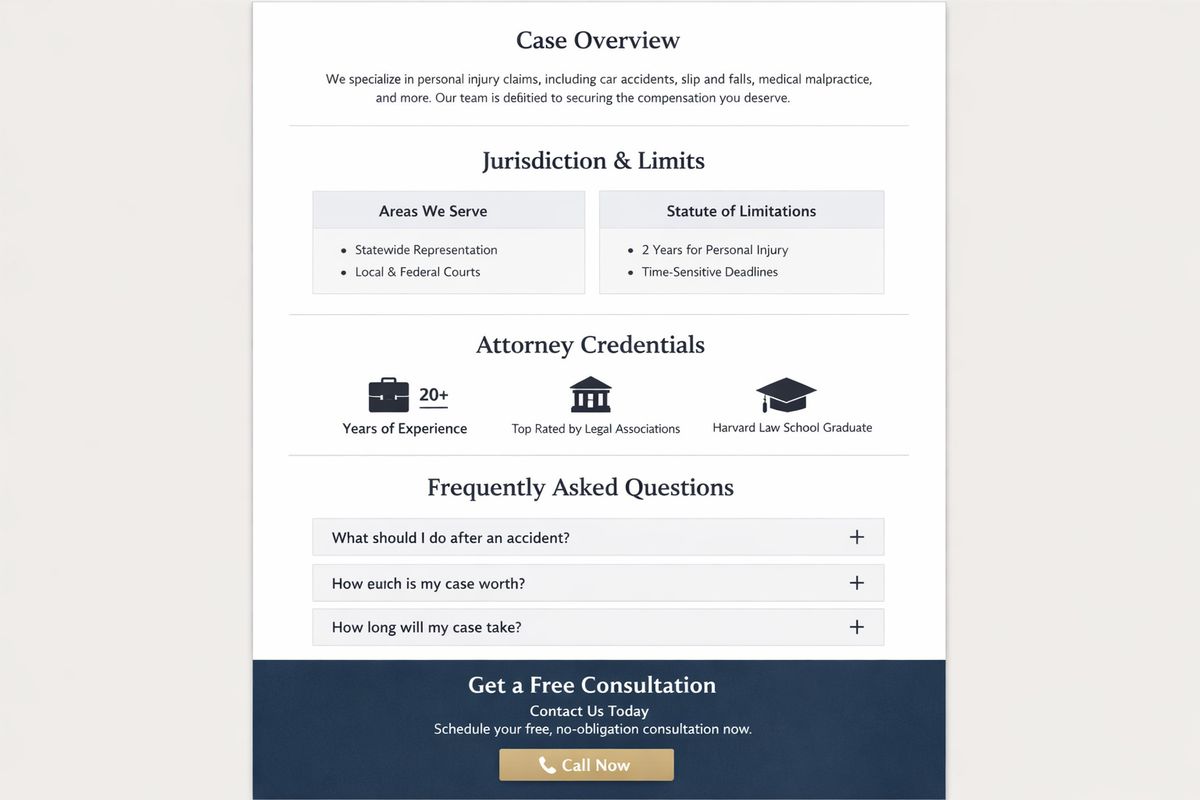
The best practice area pages do not read like generic brochure copy. They define the legal issue, narrow the audience, prove relevant experience, and move the visitor toward contact. They also make extraction easier for search systems.
Clear Definitions of the Legal Matter
Each page should explain the matter in plain language and include common synonyms, related claims, and adjacent case types. A nursing home abuse page, for example, should not assume everyone uses the same phrase. It should also reference neglect, elder abuse, falls, malnutrition, medication errors, or wrongful death if those are part of the firm’s actual caseload.
That improves retrieval because AI systems match concepts, not just exact terms. Firms exploring which content formats tend to surface in AI answers generally find that direct definitions outperform broad marketing language.
Jurisdiction and Service Boundaries
Legal services are bounded by geography and licensing. Good pages say where the firm practices, where attorneys are admitted, and any limits on the matters they accept.
This is not a minor detail. It reduces false matches. If a firm handles employment litigation only in California state and federal courts, the page should say so. If a firm works only with employers and not employees, that belongs on the page as well. Strong qualification begins with clear boundaries.
Evidence of Experience and Credibility
Credibility on a practice area page comes from specifics: attorney names, representative matters, verdicts or settlements where ethics rules permit, court admissions, speaking engagements, publications, and recognitions that can be substantiated.
The balancing view is straightforward. Unsupported claims weaken trust. “Aggressive advocacy” says nothing. “Lead counsel has tried 40 jury cases in state court” says something measurable. For firms assessing trust signals, reputation indicators such as awards and third-party proof support visibility only when they are relevant, attributable, and compliant.
FAQs, Process Explanations, and Next-Step Information
Pages perform better when they answer common questions directly. That includes process explanations, filing deadlines at a high level, what evidence matters, how fees work if the firm offers contingency arrangements, and what happens during an initial consultation.
These sections help both humans and machines. A prospective client gets clarity. An AI system gets concise answer blocks it can summarize. That combination is exactly what modern legal search rewards.
How Practice Area Pages Influence Discovery, Qualification, and Conversion
Legal-marketing agencies consistently describe practice area pages as doing three jobs at once: attracting relevant search traffic, filtering for fit, and turning interest into contact. Firms hiring agencies should expect all three.
They Capture High-Intent Legal Searches
A service-specific page aligns with a person looking for counsel for a particular issue. That traffic is more commercially valuable than broad awareness traffic because the search already implies legal need.
This is where many firms misread performance. A blog post can attract far more visits, but a lower-volume page for “commercial lease dispute lawyer” often produces better inquiries. AI search follows the same pattern because the system tries to answer the user’s actual task, not just provide reading material.
They Help Filter the Right Matters
Detailed pages can state who the firm serves, what claims it accepts, where it practices, and what it does not handle. That improves intake quality.
For example, a plaintiff-side employment page should say whether the firm handles wage claims, discrimination, retaliation, or executive disputes. If it does not handle unemployment appeals, the page should say that too. Fewer bad-fit inquiries save time for attorneys and intake staff.
They Support Stronger Conversion Paths
A strong page includes a call to action tied to the service, visible contact options, and trust markers near the point of decision. Traffic by itself is not the goal. Qualified contact is the goal.
That is one reason firms comparing vendors should ask how pages are measured after launch. Agencies that understand how to judge AI-search performance beyond simple rankings usually connect page performance to consultations, matter quality, and signed cases.
Why Thin or Generic Pages Underperform in AI Search
Many law firms still publish short, repetitive service pages that exist only to fill out a sitemap. Those pages underperform because they do not give search systems enough material to evaluate relevance or trust.
Generic Copy Creates Entity Confusion
Phrases like “experienced representation,” “results-driven counsel,” or “trusted legal team” appear on thousands of law firm websites. They do not help a system distinguish one firm from another.
Entity understanding depends on specifics. Which cases? Which court? Which clients? Which jurisdiction? Without those details, the page becomes interchangeable.
Duplicate Templates Weaken Topical Depth
Near-identical pages across multiple services or locations dilute subject clarity. A page for wrongful termination should not read like the same page as a wage-and-hour dispute page with a few nouns swapped out.
According to SEO guidance, each page needs unique substance tied to that service. Otherwise the site creates internal competition and weakens its own authority signals.
Missing Proof Signals Reduce Trust
Pages with no attorney attribution, no examples, no reviews, no outcomes, and no external support often struggle to earn visibility. Search systems reward pages that appear reviewable and real.
The balancing point is legal ethics. Confidentiality, state bar rules, and advertising restrictions all matter. Proof still needs to be presented carefully. But careful is not the same as absent.
How Law Firms Should Structure Practice Area Pages for AI Search
The execution standard is clear. Competent agencies build service pages for clarity, depth, internal context, and machine readability.
Use One Primary Topic Per Page
Each page should focus on one core service. Related subtopics belong on the page if they support the main issue, but competing services should not.
That focus improves interpretation. A page about Chapter 7 bankruptcy should not also try to rank for divorce mediation and business formation. Tighter scope produces stronger signals.
Build Logical Internal Links Between Related Services
Related pages should connect naturally: practice pages to sub-practice pages, service pages to attorney bios, FAQ pages, and supporting articles. Internal links help search engines understand how topics relate across the site.
Firms reviewing agency work should look for a coherent subject map, not random linking. Strong legal marketers usually pair practice pages with a larger plan for law firm AI visibility.
Add Schema, Metadata, and Clean On-Page Structure
Title tags, headings, FAQ markup where appropriate, crawlable contact information, and structured data all improve machine readability. None of that replaces strong writing, but it supports extraction.
The page should also be easy for a human to scan. Clean headings, clear sections, and direct answers help both audiences at once. For firms choosing partners, what to ask a legal SEO vendor before signing often comes down to whether the agency can explain both the content and technical side in plain terms.
Common Misconceptions About Practice Area Pages
Several outdated assumptions still shape law firm websites. AI search exposes those weaknesses faster than traditional search did.
“The Homepage Is Enough”
It is not. A homepage cannot fully explain multiple services, multiple offices, and multiple matter types without becoming vague. AI tools prefer granular source pages because they offer cleaner intent matching.
“Blog Content Can Replace Service Pages”
It cannot. Blog posts support education and long-tail discovery, but they usually do not carry the qualification and conversion role of a service page. A strong content strategy uses both, with each page type doing its own job.
“More Pages Automatically Means Better Visibility”
Volume alone does not help. Fifty thin pages lose to ten differentiated ones with real substance, proof, and clear positioning. Search analysts and agencies report the same pattern repeatedly: depth beats count.
What Law Firms Should Look for in an Agency Handling Practice Area Pages
The difference between strategic legal marketing and commodity production is easy to spot once the right criteria are applied.
Legal-Market Knowledge and Compliance Awareness
The agency should understand legal search intent, bar advertising limits, claims substantiation, and intake realities. Legal content is not generic local SEO with attorney names inserted.
A Repeatable Process for Research, Writing, and Optimization
Strong agencies use keyword mapping, competitor review, attorney interviews, matter-level research, editorial standards, and performance updates. They build durable assets, not one-time copy dumps.
Reporting That Connects Pages to Qualified Leads
Law firms should expect reporting that goes beyond rankings. Qualified traffic, conversion rates, intake quality, and contribution by practice area matter more. AI visibility is not always isolated perfectly, so good reporting combines search, engagement, and lead data.
Frequently Asked Questions About Practice Area Pages and AI Search
How many practice area pages should a law firm have?
A firm should have one page for each core service it actively sells and staffs. Sub-practice pages make sense when search demand, case criteria, or attorney specialization differ in a meaningful way.
How long should a practice area page be?
No fixed word count guarantees performance. The page needs enough substance to define the matter, state jurisdiction, prove experience, answer key questions, and support contact. Thin pages usually fail that test.
Can one page target multiple cities and practice areas?
That structure usually weakens clarity. Tighter topical and geographic focus performs better because both users and AI systems can identify the exact service and location match faster.
How often should practice area pages be updated?
They should be updated when the law changes, the attorney roster changes, the firm expands or narrows service areas, or performance data shows the page is underperforming. Useful updates reflect real expertise, not cosmetic edits.
Do practice area pages matter if a firm already ranks in Google?
Yes. Google rankings and AI inclusion are related but not identical. Pages that rank reasonably well can still be too vague for answer engines that need cleaner service-level signals.
Law firms that want stronger visibility in AI search should treat practice area pages as core business assets, not website furniture. For firms evaluating strategy, structure, and execution, schedule a call with Attorney Visibility ai for more information.