
If you keep asking how long for SEO results, the real question is usually simpler: when will your law firm actually start showing up, getting trusted, and becoming visible enough that Google, clients, and even AI tools start to notice. The honest answer is not glamorous, but it is useful. Early movement can show up in a few months, meaningful gains often take 6 to 12 months, and ChatGPT visibility usually follows that same trust-building curve instead of arriving out of nowhere.
How Long SEO Takes Before ChatGPT Starts Noticing You
SEO results do not arrive like a light switch flipping on at 9:00 a.m. one Tuesday. For a law firm, the process usually starts with quiet signs: more pages indexed, more impressions in search, a few rankings moving up, and stronger visibility in your city or region. Later, that can turn into calls, consultations, and better brand recognition. Later still, your firm becomes established enough across the web that AI tools may begin surfacing or echoing that presence.
That last part matters because ChatGPT is not handing out gold stars to brand-new, barely visible firms. In most cases, it reflects what is already credible, consistent, and easy to verify online. If your firm has useful pages, strong local signals, real reviews, citations, and mentions beyond your own website, your odds improve. If not, no shortcut is going to fake it for long.
So the short answer is this: expect some early movement in 2 to 3 months, clearer traction in 4 to 6 months, and stronger, more durable results in 6 to 12 months and beyond. If your market is competitive, that timeline can stretch. If your site already has decent authority and clean fundamentals, it can move faster.

What “SEO Results” Actually Mean for a Law Firm
A lot of frustration around SEO comes from treating “results” like one single event. It is not. SEO results can mean rankings, traffic, Google Business Profile visibility, branded searches, calls, form fills, or signed cases. Those do not all rise at the same speed.
Month two might bring more impressions and better indexing. Month four might bring a few local ranking wins. Month seven might finally bring more consultations from non-branded searches like “car accident lawyer near me” or “estate planning attorney in Naperville.” All of that counts as progress, even if the business impact shows up in stages.
For a law firm, this distinction matters more than it does for many other businesses. You do not need random traffic from people doing casual research at midnight with no intent to hire anyone. You need visibility in the searches that lead to real conversations.
Rankings, traffic, and signed cases are not the same thing
A page moving from page five to page two is progress. It may not feel exciting, but it is the digital equivalent of finally getting your office sign from the back alley onto the main road. More people can see you, even if not enough are walking through the door yet.
Traffic works the same way. More visits can be good, but a law firm does not win by piling up vanity numbers. Fifty visits from people searching for your practice area in your service area can be worth more than 500 visits from broad informational terms with no hiring intent. Signed cases sit even farther down the chain, because a search visit still has to become a call, then a consultation, then a good fit.
ChatGPT noticing you is a visibility signal, not a magic milestone
If your firm starts appearing in AI answers, that is usually a symptom of broader visibility, not a separate miracle. AI tools tend to mirror what is already well established across the web: content that answers real questions clearly, attorney profiles that look credible, strong review signals, consistent business listings, and brand mentions that show your firm is a known entity.
That is why it helps to understand how AI search for law firms actually works. Once that clicks, the connection between classic SEO and AI visibility stops feeling mysterious.
The Honest Timeline: When SEO Usually Starts Working
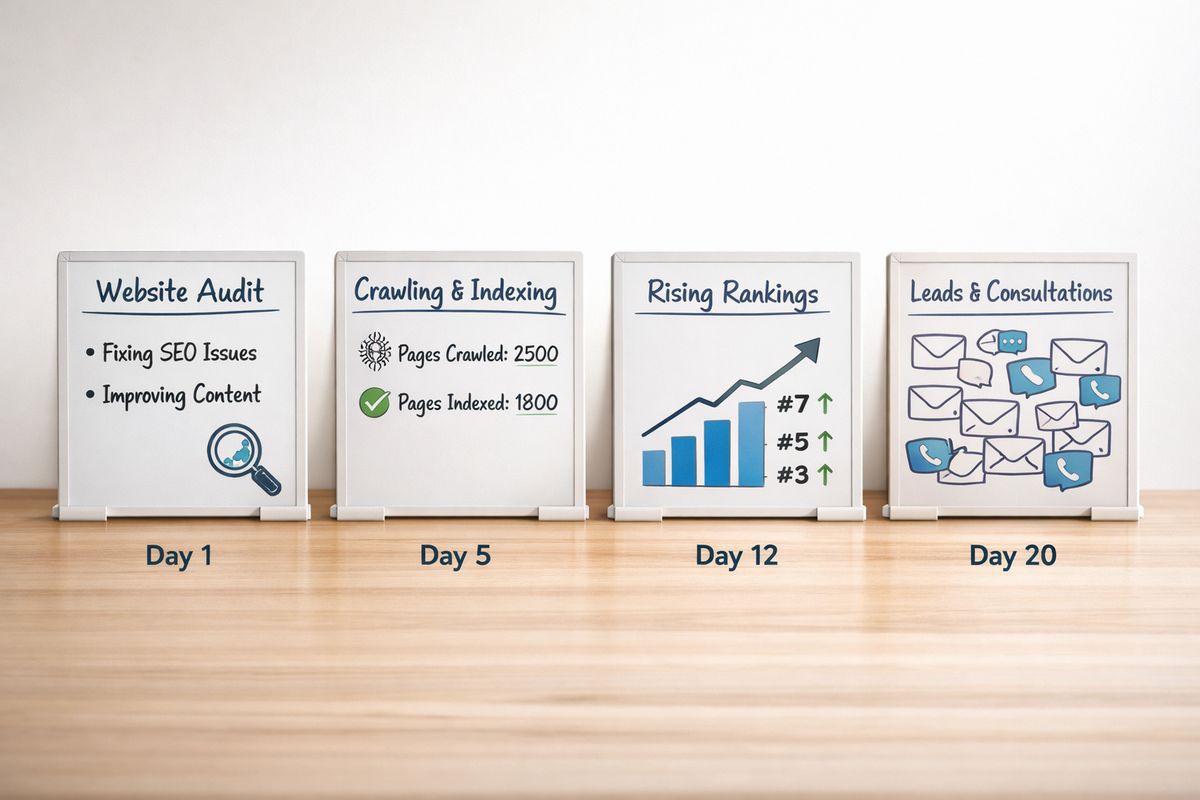
Here is the practical version. Some early signals often show up in 2 to 3 months. Better traction often starts in 4 to 6 months. Durable growth usually takes 6 to 12 months and keeps compounding after that.
That is not a stall tactic. It is just how search visibility works in the real world. Google has to crawl your updates, process your pages, compare you to competitors, test where you belong, and build confidence in your site over time. AI visibility generally rides behind that same curve.
Months 1 to 2: Audit, fixes, and foundation work
The first phase often feels strangely quiet. A lot is happening, but much of it is behind the wall, like plumbing work during a renovation. Technical issues get cleaned up. Site structure gets reviewed. page targeting gets mapped. Local listings get checked. Competitors get analyzed. Content priorities get set.
From the outside, this can look like not much is happening. But if your site has crawl issues, weak internal linking, confusing navigation, slow mobile load times, or practice pages that barely say anything, none of the exciting stuff works well until the basics are fixed.
Months 3 to 4: Crawling, indexing, and early movement
Once important changes go live, search engines need time to discover and process them. Crawling means Google finds your pages. Indexing means it stores them and makes them eligible to appear. Ranking is the part everybody obsesses over, but it comes after the first two.
This is usually when early signs start showing up. Search Console impressions may rise. More pages may appear in the index. A few priority terms may move upward. Some pages may bounce around a bit. That volatility is normal.
Months 4 to 6: First meaningful traction
This is often the point where a law firm starts feeling that something is actually working. Stronger practice pages begin to rank better. Local visibility improves. Searchers who have never heard of your firm start finding you through non-branded searches.
In less competitive markets, this can also be when the first real SEO-driven leads appear. Not a flood. But enough to prove the system is doing more than generating charts in a report.
Months 6 to 12: Authority starts compounding
By this stage, your content depth, internal linking, reviews, citations, backlinks, and engagement signals can start reinforcing each other. A better practice page earns more clicks. More clicks and better engagement support trust. More trust makes it easier for related pages to rank. More visibility leads to more brand searches. That brand growth then helps the whole site.
This is where SEO starts feeling less like faith and more like a machine that actually runs.
12 months and beyond: The gap widens
Firms that stay consistent usually pull away over time. They rank for more variations, show up in more local searches, build stronger recall, and become easier to reference across both search and AI surfaces. A firm that has spent a year building useful pages and local authority is in a very different position from one that published three blog posts, got impatient, and stopped.
That long-term compounding is also why showing up in AI results tends to follow firms that have already done the slower, less flashy work.
Why SEO Takes Time in the First Place
The short version is trust. Google does not owe a new or improved page immediate visibility just because it exists. Search engines need evidence that your pages are useful, relevant, and better than other options.
For law firms, that trust threshold is even higher because legal topics affect real lives, real money, and real risk. Thin pages and weak signals do not get much benefit of the doubt.
Search engines have to discover, process, and trust your pages
Crawling is when search engines find your pages. Indexing is when those pages get stored and become eligible to show in results. Ranking is the sorting process, where search engines decide which pages deserve visibility for a query.
That sounds technical, but the basic idea is simple. A page cannot rank well until it is found, understood, and trusted.
Legal SEO is competitive by default
Legal search is crowded. Personal injury, criminal defense, family law, immigration, and similar practice areas attract aggressive competition because the value of a signed case can be high. In many markets, you are competing against firms that have been investing in SEO for years.
That means your timeline is not just about your effort. It is also about how entrenched the competition already is.
Authority is built from many signals, not one trick
No single task flips the switch. Good SEO comes from the combined effect of strong pages, smart internal links, quality backlinks, local citations, reviews, branded searches, and a site that gives search engines a clear sense of what your firm does and where you do it.
If anybody promises one trick, it is usually a sign to keep walking.
Your starting point changes the timeline
A site with a decent domain history, solid reviews, and a few strong pages can often move faster than a brand-new site with technical problems and generic copy. Starting point matters. A lot.
That is one reason it helps to compare your SEO plan to what really matters in local visibility for law firms, not just a generic checklist borrowed from another industry.
What Makes ChatGPT “Notice” a Law Firm
ChatGPT visibility is easier to understand once you stop treating it like a secret club. AI systems tend to surface businesses and sources that look established, consistent, and trustworthy across multiple places online. That means your website matters, but it is not the whole story.
Think of it like reputation in a courthouse hallway. If your name only appears on your own door, that is one signal. If your name also shows up in directories, reviews, attorney profiles, local coverage, bar listings, and useful legal content, the picture gets much stronger.
Strong brand signals across the web
Consistency matters more than most firms expect. Your name, address, phone number, practice areas, attorney details, and public reputation need to line up across your site and the broader web. Directory listings, review platforms, local citations, award pages, attorney bios, and branded searches all help create that footprint.
That is also why reviews can influence AI visibility more than many firms assume. They are not just social proof for humans. They are part of your broader trust picture.
Content that answers real legal questions clearly
Useful content has a way of traveling farther than expected. A clearly written page about what happens after a rear-end collision, whether a DUI charge can be reduced, or how child custody works in your state can become the kind of material that gets surfaced, paraphrased, or reflected in AI answers.
The trick is not sounding clever. The trick is being clear, organized, and actually helpful.
Topical depth beats random blog posting
A solid cluster of pages around one practice area and one geography tends to outperform scattered content on unrelated topics. Ten connected pages about family law issues in your market usually do more than twenty generic blog posts about national legal news.
This is exactly why well-built service pages matter for AI search. They give search engines and AI systems a clearer map of what your firm actually does.
Off-site mentions help more than most firms expect
Mentions from bar associations, local media, sponsorships, legal directories, podcasts, community groups, and other outside sources can strengthen visibility beyond classic rankings. Off-site signals help search engines and AI systems confirm that your firm exists, serves a real market, and has some standing beyond its own website.

The Biggest Factors That Change Your SEO Timeline
Two firms can start SEO in the same month and get very different results by month six. That is normal. Timeline depends on the difficulty of your practice area, the size of your market, the state of your website, and how much consistent work is actually being done.
If you are comparing agencies, this is the section that helps you separate realistic strategy from wishful sales talk.
Practice area difficulty
Ranking for “estate planning attorney in a midsize suburb” is not the same job as ranking for “car accident lawyer” in a major metro. High-value, high-competition terms take longer because stronger sites are already defending those spots.
Market size and location
Location changes everything. Ranking in Chicago is a different fight than ranking in a smaller city or a multi-county area where fewer firms have invested heavily in SEO. In dense markets, every page has to work harder. Every signal matters more.
Website history and existing authority
An older domain is not automatically better, but history matters. If your site already has indexed pages, some quality backlinks, and a clean record, you may have a head start. If it has weak content, poor structure, or a messy past, progress can take longer.
Technical health and user experience
Slow load times, clumsy mobile layouts, crawl errors, weak internal linking, and confusing navigation all delay results. Even great content struggles when the site underneath it is hard to use or hard to understand.
Content quality and page coverage
One thin services page is not enough in competitive legal markets. You usually need strong practice area pages, subtopic pages, FAQs, attorney bios, and carefully built local pages where appropriate. Depth matters because legal searchers want specifics, and so do search engines.
Backlink profile and local citations
Trustworthy references from other sites still matter. In legal SEO, where credibility is a big signal, quality backlinks and clean local citations can help support both rankings and broader reputation.
Budget, speed, and consistency
Budget does not buy instant trust, but it can speed execution. A firm that fixes technical issues, improves pages, earns mentions, and publishes targeted content every month will usually move faster than one making small, sporadic updates.
Consistency beats bursts. That is not a slogan. It is how compounding works.
A Month-by-Month SEO Timeline for a Law Firm
A clear timeline helps you judge whether an agency is doing real work or just narrating delays. The exact mix will vary, but the overall rhythm tends to look something like this.
Month 1: Research, audit, and priority list
This is the diagnosis month. Technical audit, local audit, competitor review, keyword mapping, conversion tracking, intake goals, and quick-win identification should all happen here. By the end of the month, you should know what is broken, what matters most, and which pages deserve immediate attention.
Month 2: Technical fixes and page strategy
Now the cleanup starts. Site architecture gets improved. Metadata is tightened. Internal links get mapped. Schema may be added. Mobile issues and speed issues get addressed. Local listings get corrected. Target page outlines get planned.
You should be able to see actual changes, not just hear that work is “in progress.”
Month 3: Core practice pages go live or get rebuilt
This is often the first big turning point. Your highest-intent pages, such as personal injury, DUI defense, family law, immigration, or estate planning, get written or rebuilt with real substance. The site becomes materially more useful.
That is also when clear, useful content built for AI-era search starts helping both traditional rankings and broader visibility signals.
Month 4: Supporting content and local authority building
FAQs, carefully chosen city pages, stronger attorney bios, review generation, citation cleanup, and early outreach for mentions or links can start filling in the gaps. Your site stops being a handful of isolated pages and starts becoming a connected body of evidence.
Month 5: Early ranking wins and lead-quality review
Lower-competition terms may begin improving first. Some pages will start pulling more impressions. Some calls or form fills may get more relevant. This is the point where smart agencies stop staring only at ranking charts and start checking whether the right kinds of inquiries are showing up.
Month 6: Measurable traction
By month six, many firms should be able to point to more meaningful progress: stronger non-branded rankings, more map pack visibility, better click-through rates, and real intake conversations from organic search. Not always dramatic, but measurable.
Months 7 to 12: Expansion and compounding growth
Once certain topic clusters and pages prove themselves, the strategy expands. Strong pages get refreshed. Underperforming pages get fixed. Internal links get strengthened. Better mentions get pursued. Data shapes what comes next, instead of guesswork driving everything.

Signs Your SEO Is Working Before Rankings Fully Catch Up
SEO can be maddening if you only judge it by whether one trophy keyword hit position three yet. The better approach is to watch the signals that show momentum building underneath the surface.
More pages are getting indexed
If new practice pages, FAQs, and local pages are being indexed, that means search engines are discovering and storing more of your content. It is a foundational sign that the machine is moving.
Search impressions are rising
Impressions in Google Search Console are often one of the earliest meaningful signals. If impressions are going up, search engines are testing your pages more often for relevant queries. That comes before many clicks, and long before many leads.
More keywords are moving into striking distance
“Striking distance” usually means positions 11 to 20. Those spots matter because they suggest your content is relevant enough to compete, but still has room to improve. A page sitting at position 14 is often much closer to producing business value than it looks.
Better engagement from the right visitors
If visitors stay longer on your service pages, call from those pages more often, request directions from your Google Business Profile, or convert at a higher rate, that is meaningful progress. You want better-fit attention, not just more attention.
Branded searches start to increase
When more people search your firm name directly, that can signal growing visibility and trust. Somebody may have seen your page, your reviews, your local listing, or your name elsewhere and come back later looking for you specifically.
What Slows SEO Down for Law Firms
Sometimes SEO takes time because the market is hard. Sometimes it takes longer because the strategy is weak. There is a difference.
Thin practice area pages
Generic legal copy rarely wins. If your family law page sounds like it could belong to any firm in any city, it is not giving Google or potential clients much reason to choose you.
Too many city pages with nearly identical text
Stuffing the site with near-duplicate pages for every town in driving distance usually backfires. Search engines are better at spotting low-value local pages than many firms realize.
Ignoring reviews and local SEO
A weak Google Business Profile, inconsistent citations, and low review volume can hold local firms back even if the website content is improving. This is one reason understanding whether it makes sense to optimize for AI visibility at all has to include local trust signals, not just website copy.
Weak intake paths on the website
SEO can bring the visit, but if your phone number is hard to find, your forms are clunky, or your next steps are confusing, the gains get hidden. Bad intake paths make SEO look weaker than it is.
Constant strategy changes
Restarting every 30 days kills momentum. SEO needs adjustments, not panic. If your agency keeps lurching from one idea to the next without giving core improvements time to settle, your timeline gets longer for no good reason.
Common Myths About How Long SEO Takes
The SEO world is full of bad promises and equally bad despair. Both are misleading.
“You should see major results in 30 days”
For legal SEO, this is almost never realistic. In a narrow, low-competition niche with a strong starting point, you might see early movement fast. Major results in one month, though, is sales language, not a normal expectation.
“SEO always takes years”
That is the opposite mistake. Early traction can show up much faster, especially in local searches with clear intent and an existing foundation. It does not have to take years to know whether the work is heading in the right direction.
“More blog posts always means faster growth”
Random weekly blogging is not a growth strategy by itself. A handful of strong, targeted pages can do more than months of unfocused publishing.
“Once you rank, you’re done”
Rankings move. Competitors adapt. Content ages. Reviews change. SEO is maintenance plus growth, not a one-time install.
“AI visibility is separate from SEO”
Usually, it is not. AI discovery tends to ride on the same signals as strong organic visibility: relevance, clarity, authority, consistency, and reputation. If you want a better sense of that overlap, it helps to look at what actually works when law firms chase AI search visibility.
How to Measure Progress Without Guessing
You should not need blind faith to judge SEO. Good measurement makes the timeline easier to understand and easier to trust.
Google Search Console for impressions, clicks, and index coverage
Search Console often shows movement before analytics tells the full story. Watch index coverage, rising impressions, click growth, and which queries are starting to trigger your pages.
Google Analytics for organic traffic and conversions
Traffic alone is not enough. Look at organic landing pages, form fills, phone actions, and the quality of sessions reaching your most important pages. The point is not “more visits.” The point is better visits that turn into consultations.
Rank tracking for priority keywords
Track the terms that matter most, especially practice-area-plus-city searches. A broad keyword dashboard packed with irrelevant terms is noise. Focus on the queries that could actually bring business.
Call tracking and intake quality
Ten weak leads are not automatically better than three strong consultations. A smaller number of better-fit calls can be the bigger win, especially in legal marketing where one signed case can justify months of work.
Simple reporting questions to ask an agency
At minimum, you should be able to ask: what changed this month, what improved, what stalled, what happens next, and what does that likely mean for lead flow? If the answers stay vague, that is a problem. It also helps to review smart questions to ask before hiring an SEO agency so you can tell the difference between activity and progress.
How to Get SEO Results Faster Without Cutting Corners
You cannot compress a year of trust-building into a week. You can, however, remove avoidable delays.
Fix technical issues first
Crawl problems, speed issues, mobile friction, and poor internal linking drag everything down. Cleaning those up early gives every other improvement a better chance to work.
Start with high-intent pages, not fluff
Your money pages come first. Core practice areas, strongest locations, attorney bios, and key FAQs deserve attention before broad educational content.
Build around real client questions
The most useful topics often come straight from intake conversations: case value, timelines, fees, fault, deadlines, and what happens next. Those are the questions that matter because they sit close to hiring intent.
Strengthen local trust signals
Google Business Profile optimization, reviews, local citations, community mentions, and locally relevant links can speed traction because they reinforce what market you actually serve.
Stay consistent long enough to let the work compound
One clear rule works here: steady effort for six months usually beats one frantic month of SEO theater. Consistency wins because every good improvement supports the next one.
What to Expect From an SEO Agency if You Want Real Momentum
If you are hiring help, timeline expectations should come with a visible process. Good agencies do not promise instant domination. They show a plan, execute it, measure it, and explain it in plain English.
A real plan in the first 30 days
You should see audits, keyword strategy, content priorities, technical findings, conversion tracking setup, and a clear order of operations. If the first month produces only generic reassurance, that is not enough.
Clear monthly work, not vague promises
You should be able to point to what got fixed, published, updated, improved, or earned each month. Real SEO work leaves fingerprints.
Reporting tied to business goals
Rankings matter, but they are not the only thing that matters. Reporting should connect the work to calls, consultations, and signed cases, or at least show the path toward those outcomes.
Realistic promises about AI and search visibility
Any agency promising instant ChatGPT visibility is selling a shortcut that does not exist. A better conversation starts with how to check whether your firm is actually visible in ChatGPT now, then builds from real search and reputation signals instead of hype.
FAQs About How Long for SEO Results
How long does SEO take for a new law firm website?
For a new law firm website, early signs often show up in about 3 to 6 months, while stronger results commonly take 6 to 12 months or longer. Competition, content quality, local signals, and technical health all affect the pace. A new site in a crowded legal market usually needs more time than an established site with a clean foundation.
Can a law firm see SEO results in 3 months?
Yes, but “results” at three months usually means early traction, not full payoff. You may see more indexed pages, rising impressions, a few keyword gains, and possibly early leads in less competitive local markets. That is real progress, just not the finished picture.
How long until ChatGPT starts mentioning a law firm?
There is no fixed timeline or guaranteed switch. ChatGPT is more likely to surface firms that already have stronger organic visibility, consistent citations, trusted content, reviews, and mentions across the web. In practice, AI visibility usually follows the same general trust-building curve as strong SEO.
Does paying more make SEO faster?
A larger budget can speed up execution because more can get fixed, built, and published sooner. It can also support better content, stronger technical work, and more outreach. But money does not remove the need for search engines to process changes and build trust over time.
What should you do first if your SEO has stalled?
Start by checking for bottlenecks in technical health, core service pages, and Search Console data. If impressions are flat, pages are not indexing well, or your most important practice pages are thin, that is usually where to look first. A stalled campaign often has one or two obvious weak points once you dig into the right data.
If your firm wants a clearer picture of how long SEO should take in your market, and what it would take to become more visible in both search and AI tools, schedule a call with Attorney Visibility ai.