
If your firm is trying to decide between Google SEO vs AI search, the tempting answer is to chase the shiny new thing. That would be a mistake. For most law firms, Google still deserves the first, biggest share of your time and budget, while AI search deserves attention as a fast-moving layer on top.
Google SEO vs AI Search at a Glance
Google SEO means improving your visibility in Google’s regular search results, local map pack, practice area pages, reviews, and location-based queries. For a law firm, that usually looks like showing up when someone searches “divorce lawyer in Phoenix” or “car accident attorney near me” and then clicking through to a service page, your Google Business Profile, or your contact page.
AI search is broader and looser. It includes tools like ChatGPT, Google’s AI Overviews, Perplexity, and other answer engines that summarize information instead of just listing links. Someone might ask, “What should I do after a rear-end collision in Dallas?” and get a direct answer with a few cited sources.
Here’s the thing: this is not really a winner-take-all fight. The real choice is where your agency should focus first. If your intake team needs more qualified calls this quarter, Google SEO is the stronger play. If your firm already has strong visibility and wants to build future-proof authority, AI search becomes worth more deliberate effort.
How Potential Clients Actually Find a Law Firm
Most legal matters begin with stress, urgency, and a messy search journey. Someone gets arrested at 11:40 p.m., signs divorce papers at a kitchen counter in Naperville, or leaves an emergency room with a stack of discharge papers and a head full of questions. Search behavior shifts depending on that moment.
On Google, direct intent is obvious. Searches like “personal injury lawyer near me,” “estate planning attorney Tampa,” or “DUI lawyer open now” usually come from people close to contacting a firm. That traffic is valuable because it carries clear buying intent. Someone is not browsing for fun.
AI search often shows up earlier in the process. A person asks broad questions, tries to understand a timeline, compares options, or looks for plain-English explanations of a legal issue. That can matter, especially for practice areas with longer decision cycles. But early education is not the same thing as local client acquisition.
This is one reason the difference between AI-driven answers and traditional search behavior matters so much. Google often captures the hand-raiser. AI often captures the question-asker.
Visibility and Reach
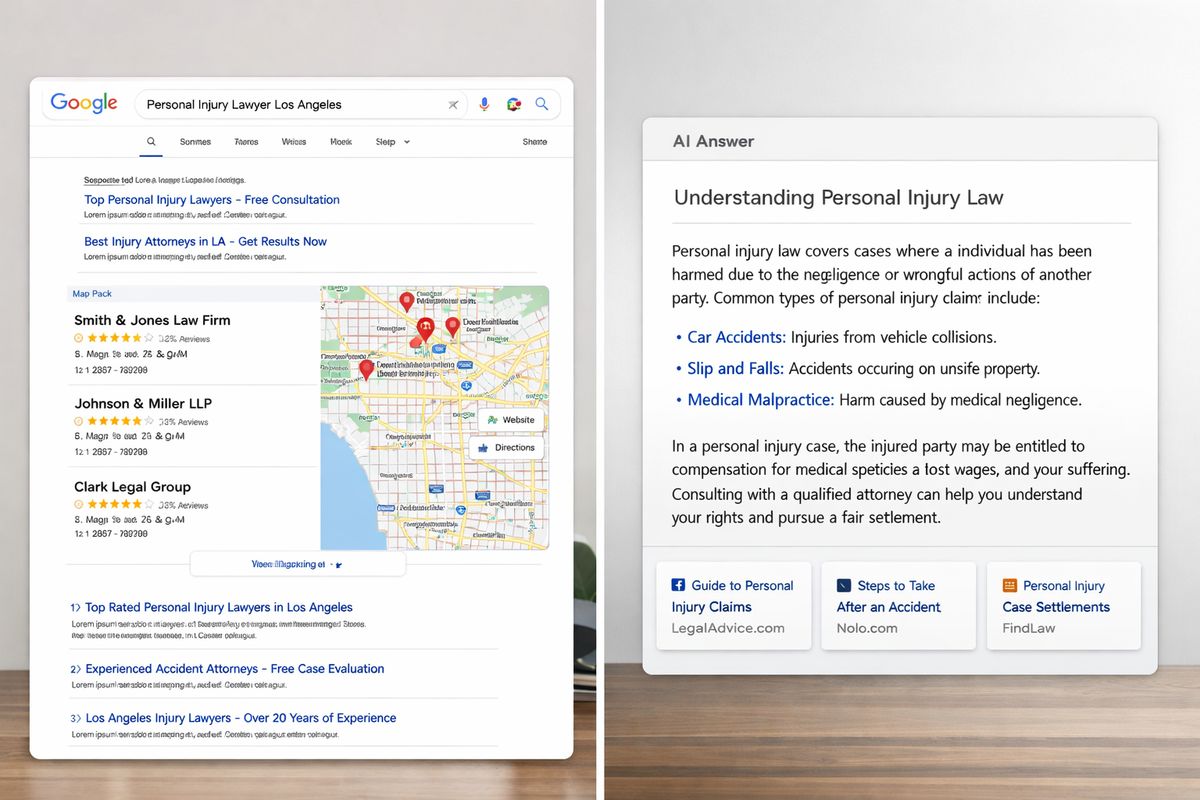
Google gives your firm multiple shots at being seen. You can appear in paid ads, the local pack, organic results, featured snippets, review profiles, and sometimes AI Overviews too. Even when competition is fierce, the ecosystem offers several entry points.
AI search usually compresses visibility. Instead of ten blue links and a map, you may get one generated answer with a handful of cited sources, or sometimes no source that sends meaningful traffic at all. If your firm is mentioned, great. If not, you are invisible in that interaction.
That makes Google the more reliable visibility engine right now. It simply creates more surface area for your firm to show up, especially for practice-area and city-based searches. AI tools can expand exposure at the top of the funnel, but they do not yet match Google’s consistency for legal discovery.
Local Search Advantage
Most law firms do not need abstract visibility everywhere. You need visibility in the counties, cities, and neighborhoods where you actually take cases. That is where Google has a clear lead.
Google understands local intent better than any AI search tool currently does. A search for “workers comp lawyer near me” triggers map results, proximity signals, reviews, office locations, business categories, and service areas. A search for “probate lawyer in Scottsdale” is tightly tied to geography in a way AI tools still struggle to handle cleanly.
The catch is that local search is not just about your website. Your Google Business Profile, review profile, location pages, citations, and local relevance all work together. If your firm wants to win nearby searches, getting the local foundation right matters more than trying to outsmart an AI answer engine.
AI search can still mention local firms, but it often gives softer recommendations. It may summarize what kind of lawyer to contact without giving a strong location-specific result, or it may pull from directory sites and broad informational pages rather than your most important local service page.
Clicks, Traffic, and Lead Flow
If your goal is phone calls, consult requests, and signed cases, Google SEO is still the better channel.
Google sends users somewhere. Even when results pages are crowded, the model is still built around discovery and clicking. A person sees your listing, reads your title and description, checks your reviews, visits your page, and decides whether to contact you. That path is measurable and familiar.
AI search can interrupt that flow by answering simpler questions directly. That is useful for the searcher, but it can reduce clicks to your site. If someone asks, “How long do you have to file a personal injury claim in Illinois?” and gets a clean summary inside the AI interface, there may be no visit at all.
For educational visibility, that is fine. For lead generation, it is weaker. Law firms usually need a marketing channel that moves people from search to contact. Google does that better today.
Trust and Credibility
Legal hiring decisions are built on trust. Not vibes, not novelty. Trust.
Google supports that trust-building process better because it gives people more ways to verify what they see. Prospects can compare firms, read reviews, visit your website, scan attorney bios, look for case results, and check whether your office seems real and established. All of that happens before the first call.
AI search can borrow trust from the sources it cites, but it compresses the process. A generated answer might mention your firm without showing the details that reassure someone enough to reach out. That is a problem in legal marketing, where credibility signals do a lot of the heavy lifting.
Strong bios matter here more than many firms realize. If your attorneys have clear, well-written profiles with credentials, practice focus, and experience, those pages support both human trust and machine understanding. That is one reason clear lawyer profile pages help AI systems understand your firm while still doing their original job for Google visitors.
Content Strategy: What Each Channel Rewards
Google rewards strong service pages, useful local content, clear site structure, and pages aligned to specific search intent. If your criminal defense page targets “DUI lawyer in Austin,” it should actually answer that need, not drift into vague firm marketing language.
AI search tends to reward content that is easy to quote, summarize, and connect to authority signals. Plain-English explanations, well-structured answers, and source-backed statements travel better in AI environments. Short paragraphs, direct definitions, and tightly organized pages help.
That does not mean writing two entirely different websites. It means writing your site so humans can act on it and machines can understand it. For many firms, building pages that answer legal questions in a natural way is the overlap zone where both channels benefit.
One note worth making: AI-friendly content is not fluff content. Generic blog posts will not save you. If your pages sound like every other law firm page on the internet, neither Google nor AI tools has much reason to surface them.
Optimization Tactics and Work Required
Google SEO usually takes more visible, ongoing operational work. Technical cleanup, internal links, practice area pages, city pages, Google Business Profile management, review generation, citation consistency, page speed, schema, and content updates all matter. It is not glamorous, but it works.
AI search optimization is lighter in some ways and murkier in others. You want clear entities, meaning your firm, lawyers, locations, and services are easy to identify across the web. You want strong consistency in how your brand appears. You want content that answers questions directly and can be cited cleanly. You also want authoritative mentions beyond your own site.
The trick is that much of AI optimization overlaps with good SEO. The tactics that help a firm show up in AI answers are often built on the same foundation: crawlable pages, trustworthy information, and a site architecture that makes sense.
So if an agency pitches AI search as a total replacement for SEO, that is a red flag.
Control Over Results and Messaging
Google gives you more control over the experience after the click. You control your service pages, attorney bios, calls to action, intake forms, testimonials, and page layout. You can improve title tags and meta descriptions. You can shape how a person moves through your site.
AI search gives you far less control. A tool may summarize your content poorly, cite an old third-party page, mention a competitor alongside your firm, or skip your firm entirely. Even when your content is used, your message can get flattened into a generic answer.
For law firms, that lack of control matters. Your intake conversion often depends on tone, specificity, and reassurance. A generated summary cannot replace a strong practice area page that speaks directly to your ideal client and makes it easy to get in touch.
Measurement and Reporting
Google SEO is easier to measure. You can track rankings, map visibility, organic traffic, calls, form submissions, consultation requests, and page-level performance. Attribution is never perfect, but it is workable.
AI search is much harder to report on cleanly. Traffic from AI tools can be inconsistent, citations are not always visible, and brand mentions inside answer engines do not always produce a click or lead you can attribute. You can test prompts manually, monitor referral trends, and review visibility patterns, but the reporting is still rough.
If your firm cares about accountability, this matters a lot. Marketing budget decisions should rest on something firmer than “your brand may be getting mentioned more.” For a deeper look, tracking whether AI visibility is doing anything useful is its own challenge.

Speed of Results and Long-Term Value
Neither channel is instant, but the value profile is different.
Google SEO usually takes time to build, especially in competitive legal markets. Yet once your location pages, service pages, authority signals, and local profile are working together, you are building an asset that can keep producing leads month after month. That staying power is the whole point.
AI search is newer and can feel faster in edge cases, especially if your content is already strong and widely cited. But the environment is unstable. Interfaces change. Citation behavior changes. Platforms change how answers are displayed. What works one quarter may fade the next.
So yes, AI search matters. But Google SEO is still the sturdier house. AI is the room you add after the foundation is poured.
Risk, Volatility, and Dependence on Platform Changes
Both channels carry platform risk. Google updates its algorithm constantly, and organic space has become more crowded with ads, maps, and AI features. That part is real.
But AI search carries even more volatility right now. Generated answers can be inconsistent, local recommendations can be weak, and the rules for visibility are still shifting. A law firm that builds its marketing strategy around AI search alone is betting on a platform category that has not settled yet.
A steadier strategy starts with assets you own: your website, your local presence, your practice area pages, your reviews, and your brand reputation. That foundation still travels well across changes in Google and AI alike.
Pricing and Budget Fit
If your firm hires an agency for Google SEO, the hours usually go into real, visible work: technical fixes, page creation, local optimization, review strategy, content improvements, and reporting. Costs can be meaningful, but the workflow is clear.
AI search preparation often costs less as a standalone line item because it overlaps with content refinement, authority building, and citation cleanup. But if an agency tries to sell it as a separate magic product with vague deliverables, be careful. You should be able to see what is being improved and why.
For most firms that need dependable lead flow, SEO usually produces the clearer return because it maps more directly to calls and consultations. If you are also comparing agencies, what to look for in a firm offering AI-focused marketing help can save you from paying for buzzwords.
When Google SEO Makes More Sense for Your Law Firm
Google SEO should be the main focus if your firm depends on local lead generation. That includes personal injury, family law, criminal defense, estate planning, immigration, bankruptcy, workers’ compensation, and most plaintiff-side practices with geographic limits.
In those categories, your intake team does not need abstract awareness. You need qualified calls from people searching for help in a place you serve. Google is still where that demand turns into action most reliably.
It also makes more sense when your current basics are weak. If your practice area pages are thin, your city pages are missing, your reviews are uneven, or your Google Business Profile is underdeveloped, there is no reason to put AI ahead of SEO. Fix the part closest to revenue.
When AI Search Deserves More Attention
AI search deserves more focus when your firm already has a strong SEO base and your growth plan includes educational authority, media visibility, or broader reputation goals. That is more common for firms with complex practice areas, a strong publishing habit, or a regional or national footprint.
It also matters more if your lawyers are known for commentary, analysis, or thought leadership. In that case, AI tools may cite your content during research-stage searches, even when the searcher is not ready to hire a lawyer yet. That visibility can shape preference before a direct search ever happens.
If your firm wants to move in that direction, understanding how legal content gets pulled into AI-generated answers helps you make smarter editorial decisions.
The Best Strategy for Most Law Firms: Build for Google, Adapt for AI
The middle ground is not complicated. Build for Google first, then shape that same foundation so AI tools can understand and cite it.
That means strong practice area pages, strong local signals, clean site structure, credible attorney bios, useful FAQs, and plain-English content that answers real legal questions without sounding canned. It also means consistency across your website, profiles, reviews, and mentions.
You do not need a separate “AI website.” You need a better law firm website, backed by better local SEO and better content discipline. Then you adapt it for AI visibility where it makes sense.
Verdict: Where Law Firms Should Focus First
Google SEO wins, clearly.
For most law firms today, Google should be the primary focus because it still drives the most dependable mix of visibility, traffic, local discovery, and qualified leads. AI search is worth watching and lightly optimizing for, but it should not replace your core SEO strategy unless your firm already dominates the basics and has a reason to invest in earlier-stage authority.
A simple rule works here: if your next growth goal is more consultations, choose Google SEO first. If your foundation is already strong, add AI search as a secondary layer.
Frequently Asked Questions
Is Google SEO still worth it for law firms now that AI search is growing?
Yes. Google SEO is still the best primary channel for most law firms because it captures high-intent searches, especially local ones, and turns them into website visits, calls, and consultation requests more reliably than AI search.
Can AI search replace local SEO for a law firm?
No. AI search is still weak compared with Google when proximity, map results, reviews, and city-based intent matter. If your firm serves a defined geographic area, local SEO remains the stronger path.
Should your law firm optimize for ChatGPT and other AI tools?
Yes, but as a secondary priority. If your site already has solid SEO fundamentals, it makes sense to improve clarity, authority signals, and structured content so AI tools can reference your firm more accurately.
Does AI search send less traffic than Google?
Usually, yes. AI tools often answer questions directly inside the interface, which can reduce clicks to your website. Google still does a better job of sending traffic that can become leads.
What kind of content helps with both Google SEO and AI search?
Clear practice area pages, strong attorney bios, useful FAQs, local service pages, and plain-English educational content tend to help in both places. The best content is specific, credible, and easy to understand.
How should your firm split budget between Google SEO and AI search?
For most firms, the larger share should go to Google SEO. AI search should get a smaller share focused on content clarity, authority building, and visibility monitoring, not a full replacement strategy.
If your firm wants a clearer plan for where to focus first, schedule a call with Attorney Visibility ai for more information.