
Google Maps ranking factors are the signals Google uses to decide which law firms show up in the local map pack when someone searches nearby. That matters fast, because when a person types “personal injury lawyer” at 8:17 a.m. from a phone in downtown Phoenix, only a few firms get seen first, and those few firms usually get the calls.
What Google Maps Ranking Factors Actually Mean for Your Law Firm
In plain English, Google is trying to answer one question: which law firm is the best local match for this search right now?
That sounds simple, but a lot is packed into it. Google looks at how well your firm fits the search, how close your office is to the searcher or searched location, and how established your firm appears online. If your firm is weak in one or more of those areas, you can have a strong reputation offline and still lose visibility online.
The practical problem is easy to picture. Someone searches “divorce attorney near me,” sees three listings, taps one, and calls. If your firm is not in that small group, your website may never even get a chance. That is why understanding how Maps visibility works for attorneys is not a side issue. It sits right in the middle of local lead flow.
The Three Core Google Maps Ranking Factors
Almost every local SEO tactic for Google Maps fits into three buckets: relevance, distance, and prominence. Google has said as much for years, and honestly, this is the cleanest way to understand the whole system.
Relevance
Relevance is about match. Google wants to know how closely your Google Business Profile matches what a person is searching for.
If your firm handles personal injury cases, but your profile is vague, missing services, or using the wrong category, Google has to guess. That is not where you want to be. Clear practice-area signals help Google connect your listing to searches like “car accident lawyer,” “truck accident attorney,” or “slip and fall lawyer.”
Your categories, service list, business description, and even parts of your website all help shape relevance. Think of it like labeling files in a cabinet. If everything is named clearly, retrieval is easy. If everything is stuffed into a folder marked “legal services,” results get messy.
Distance
Distance is the most straightforward factor, and the most frustrating one if your office is not close to the searcher.
Google looks at how near your office is to the person searching, or to the location named in the query, such as “estate lawyer in Mesa.” You cannot optimize your way into being physically closer. No trick fixes geography.
The catch is that distance is not the whole story. A firm that is a little farther away can still outrank a closer competitor if relevance and prominence are much stronger. So while you cannot move your office for SEO purposes, you can make sure every other signal is pulling in your favor.
Prominence
Prominence is your firm’s overall local authority and trust. Google is asking: does this business appear established, talked about, and chosen by real people?
Reviews are part of this. So are backlinks, directory listings, local press mentions, bar association listings, and general brand recognition. If your firm shows up consistently across credible places online, Google reads that as a sign that your business is real and trusted.
This is also why firms with average websites sometimes rank well in Maps. Their local authority is doing heavy lifting.
Your Google Business Profile Carries the Most Weight
If your map rankings are weak, your Google Business Profile is the first thing to fix. Not later. First.
Your profile is basically your storefront window on Google Maps. It tells Google what your firm is, where it is, when it is open, what services you offer, and whether people seem to trust you. If that window is incomplete or confusing, rankings usually suffer. If you want a deeper look at cleaning up the pieces that affect local visibility most, this is the center of the work.
Pick the Right Primary Category
For lawyers, your primary category has outsized impact. “Personal Injury Attorney” sends a much clearer signal than a broad label that leaves too much room for guesswork.
If your main revenue comes from family law, use “Family Law Attorney.” If criminal defense drives your firm, use “Criminal Justice Attorney” if that fits your practice and profile options. Precision matters because Google uses categories to understand what searches your listing should appear for.
A vague or mismatched category can quietly drag down relevance, even when everything else looks decent.
Fill Out Every High-Value Field
Google tends to trust complete profiles more than half-finished ones. That makes sense. The less Google has to guess, the better.
Your business name, address, phone number, hours, website, appointment link, services, and business description all matter. Missing hours create friction. A missing appointment link loses action. A weak description leaves relevance on the table.
Accuracy matters just as much as completeness. If your website says one phone number and your profile shows another, confusion starts right there.
Add Services, Practice Areas, and Real Photos
Service listings help Google understand your firm in more detail. Instead of just saying “lawyer,” you can add services like “car accident lawyer,” “wrongful death attorney,” or “child custody attorney.” Those details reinforce relevance in a natural way.
Photos do a different job. Real office, team, and exterior photos help both Google and prospective clients trust that your firm is legitimate and active. Stock images do not carry the same weight. A clear exterior shot can even help someone find your suite faster, which sounds small until somebody is already stressed and driving to a consultation.

Reviews Do More Than Build Trust
Reviews are not just social proof. They also shape local prominence and influence who clicks your listing once it appears.
For law firms, that second part matters a lot. A firm with 83 strong reviews often gets more clicks than a firm with 9, even if both rank in the same pack.
Review Quantity, Quality, and Freshness
A steady stream of recent reviews is better than a giant pile from three years ago. Freshness signals current activity. Detail signals authenticity.
Specific language can help too. When a review naturally mentions your service or location, it reinforces what your firm does and where it works. A review that says your office helped after a car accident in Tempe is more useful than “great lawyer” and nothing else.
You do not need every review to read like a marketing script. In fact, that would look odd. You need honest, specific feedback over time.
Responding to Reviews the Right Way
Responding to reviews shows activity and professionalism. It also signals that your profile is being managed, not abandoned.
For lawyers, the trick is to keep responses warm and short without exposing confidential details. Thank the person, stay general, and avoid confirming facts about the matter. If your intake and follow-up process is slow, even strong rankings can go to waste, which is why tracking where calls and leads actually go matters more than many firms realize.
Consistency Across the Web Still Matters
https://www.youtube.com/watch?v=6B2oxiJESoY
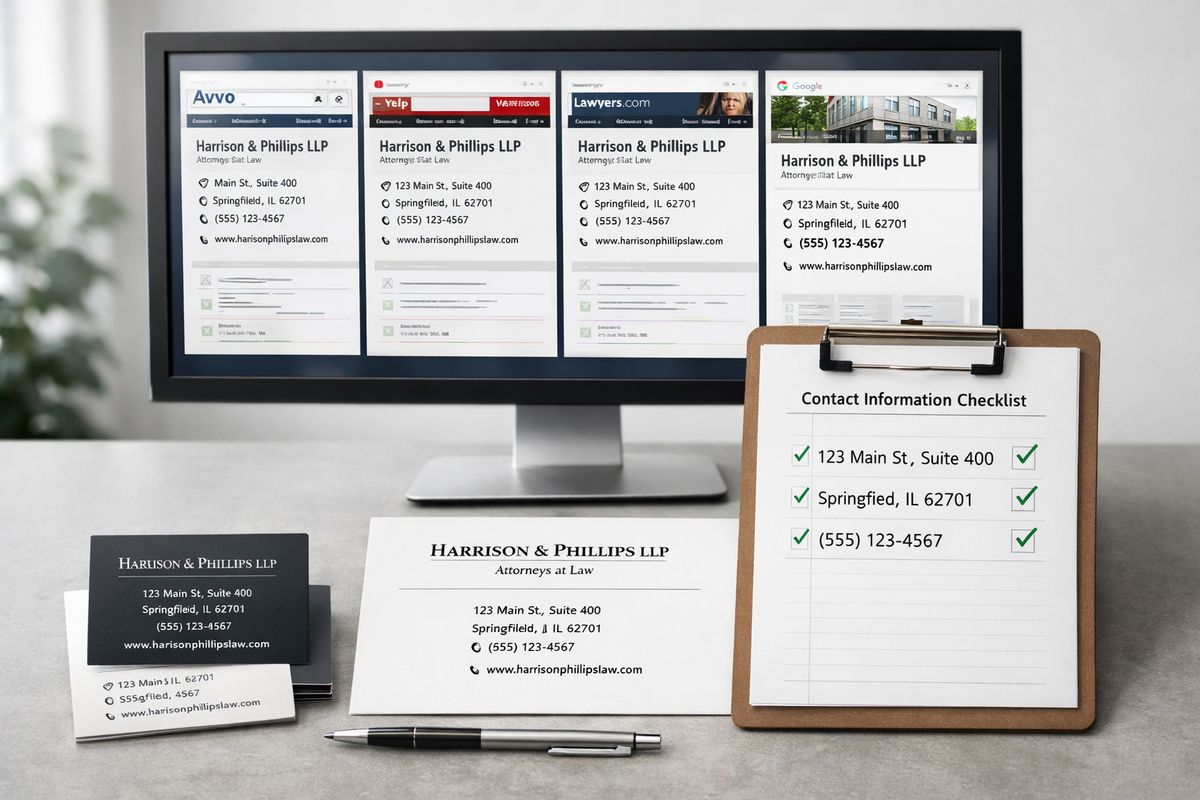
Citations are mentions of your firm’s name, address, and phone number on other sites. Think of it like making sure your office sign, letterhead, and voicemail all say the same thing.
If one directory lists Suite 400, another says Ste. 400, and a third has an old phone number, Google gets mixed signals. A few inconsistencies will not destroy rankings, but enough of them can weaken trust.
Keep Your NAP Identical Everywhere
NAP stands for name, address, and phone number. Those details should match as closely as possible across your website, Google Business Profile, and major directories.
Law firms run into this problem all the time after mergers, office moves, or phone system changes. Tracking numbers can also complicate things if they are used carelessly. If you rely on tracking, make sure you understand how phone tracking interacts with local SEO before spreading extra numbers across citations.
Consistency is boring work. It also works.
Focus on Legal Directories and Local Citations
For lawyers, not all citations are equal. Strong legal directories and local business listings matter more than mass submissions to random sites nobody uses.
Avvo, FindLaw, Justia, state bar listings, chambers of commerce, and strong local directories carry more weight because they are relevant and credible. One accurate listing on a respected legal site beats twenty sloppy listings on weak directories.
Your Website Helps Google Trust Your Map Listing
Your website supports your Maps rankings by reinforcing your location and practice focus. Your site and your profile should tell the same story.
If your Google profile says you handle family law in Scottsdale, but your website barely mentions family law and has no local context, your signals are weak. Google notices that mismatch.
Build Strong Location and Practice Area Pages
Separate pages for major practice areas help Google understand what you do. Separate pages for key cities or office locations can help too, especially if you serve multiple nearby markets.
The catch is quality. Swapping city names into the same copied page rarely helps for long. Good local pages need real substance, local context, and content that actually answers what someone in that market wants to know. If you are working on making city and service pages more useful instead of repetitive, that is the standard to aim for.
Show Local Signals on the Page
Local signals on the page make your site feel grounded in a real place. That can include your office address, embedded map, attorney bios, nearby landmarks, parking details, or examples of local case context.
A page that mentions your downtown Phoenix office hours or where clients can park is doing more than filling space. It proves your presence. Schema markup can help too, though it works best when the visible content is already strong.
Make Sure the Site Works on Mobile
A lot of map searches happen in the moment, from a phone, with somebody ready to call now.
If your site is slow, hard to tap through, or missing click-to-call functionality, a good ranking can still produce a bad result. Mobile usability affects real outcomes because people abandon clunky sites fast. A fast page, clear phone button, and simple consultation path make a real difference.
Backlinks and Local Authority Can Tip Close Rankings
Backlinks are links from other websites to your site. In local SEO, they act like reputation signals.
Not every link matters equally. A mention from a respected local publication or legal organization can do far more than a pile of junk links from irrelevant websites.
Earn Links From Local and Legal Sources
Useful local and legal sources include bar associations, local news, legal organizations, event sponsorships, nonprofit partnerships, and reputable directories. If your firm supports a neighborhood event and gets listed on the organizer’s website, that can be a meaningful local signal.
This part of SEO is less about volume and more about legitimacy. One solid local mention often beats ten weak links from nowhere.
Build Authority Around Your Practice Areas
Strong practice-area authority comes from useful content, clear FAQs, local legal guides, and case-result pages where appropriate and compliant. Over time, that kind of content can attract mentions and reinforce what your firm is known for.
It also helps conversion. Somebody who lands on a page that clearly explains a spinal injury claim or custody modification issue is more likely to call. If your broader growth plan includes choosing a marketing partner that can connect SEO with intake and lead quality, this is one of the places that connection shows up.
Behavioral Signals: What People Do After Seeing Your Listing
Google pays attention to how people interact with listings. If more people click your profile, call your office, ask for directions, or engage with your listing, that can reinforce performance over time.
You cannot fake this in any durable way. The listing has to be useful enough that people choose it.
Improve Click-Through With Better Listing Elements
Better reviews, better photos, accurate categories, and a stronger description all make your listing more clickable.
This matters because ranking third with an appealing listing can outperform ranking second with a weak one. If your stars look stronger, your office looks real, and your practice focus is obvious, more searchers will choose you.
Turn Views Into Calls and Consultations
Getting the ranking is only half the job. The other half is turning visibility into actual consultations.
Correct hours, fast phone response, online booking, and landing pages that match the search all help. If somebody clicks after searching “car accident lawyer” and lands on a generic homepage with no obvious next step, momentum drops. Fast intake systems, including tools that keep inquiry follow-up from slipping through the cracks, can protect the value of every map lead you earn.
Ranking Mistakes Law Firms Make All the Time
Some map ranking problems come from missing basics. Others come from shortcuts that look smart for five minutes and create bigger issues later.
Keyword Stuffing Your Business Name
Adding words like “Best Dallas Car Accident Lawyer” to your business name is against Google’s guidelines unless that is your real-world business name. Yes, some competitors do it. That still does not make it a good move.
Stuffed names can trigger edits, suspensions, or trust issues. Short-term gains are not worth building on something unstable.
Creating Thin or Duplicate Location Pages
Near-duplicate city pages usually do not hold up. If every page says the same thing except for the city name, Google can spot it.
Thin pages also fail the human test. A person looking for legal help in a specific city wants real local relevance, not a template with a word swap. Useful beats inflated every time.
Ignoring Spam, Suspensions, and Profile Issues
Duplicate listings, wrong categories, fake competitor listings, and suspended profiles can quietly crush visibility. A lot of firms do not notice until calls slow down.
Your profile needs regular checkups. If something feels off, start with common reasons a firm disappears or drops in Maps before assuming the issue is your website or reviews.
What Matters Most If You Want Better Google Maps Rankings
https://www.youtube.com/watch?v=Ub3CiBQFnlk
If you want the short version, focus here.
Your biggest wins usually come from a fully built and accurate Google Business Profile, strong and recent reviews, consistent citations, a website that clearly supports your practice areas and locations, and real local authority from credible mentions and links.
That order matters. Fancy tactics will not rescue a broken foundation. If your category is wrong, your hours are missing, your phone number is inconsistent, and your reviews are stale, fix those first. The trick is not chasing every ranking factor at once. The trick is tightening the few that matter most.
A Simple First Step to Try This Week
Open your Google Business Profile, your website contact page, and your top directory listings side by side. Then fix the first mismatch you find.
That could be a suite number, a wrong phone number, missing hours, a weak category, or a service that is absent from your profile but clearly part of your practice. One clean correction is better than another month of vague “SEO work” that never touches the real problem.
Frequently Asked Questions
How long does it take to improve Google Maps rankings for a law firm?
Small fixes can help within days or weeks, especially if your profile has obvious issues. Bigger gains from reviews, citations, website updates, and authority building usually take longer. Local SEO moves faster when your foundation is already solid.
What is the single most important Google Maps ranking factor?
There is no single factor in isolation, but your Google Business Profile usually has the most direct impact. If your category, services, hours, and core business details are wrong or incomplete, everything else gets harder.
Do reviews help rankings or just conversions?
Both. Reviews can strengthen local prominence and also improve click-through once your listing shows up. For law firms, recent and specific reviews often do more good than a large number of old generic ones.
Can call tracking hurt Google Maps rankings?
It can create problems if it causes inconsistent phone numbers across your citations and profile. Used carefully, call tracking does not have to hurt local visibility. The key is keeping your core business information consistent.
Why does a competitor rank above your firm even with fewer reviews?
Reviews are only one part of the picture. A competitor may be closer to the searcher, have a better primary category, stronger local backlinks, cleaner citations, or a more relevant website. Maps rankings come from the combined signal, not one metric.
Do location pages help if your firm serves multiple cities?
Yes, but only if those pages are genuinely useful. Strong pages explain your services in that area, include real local context, and support the office or service connection. Thin pages built by swapping city names usually do not help much.
If your firm wants clearer answers on what is holding back your local visibility, schedule a call with Attorney Visibility ai for more information.