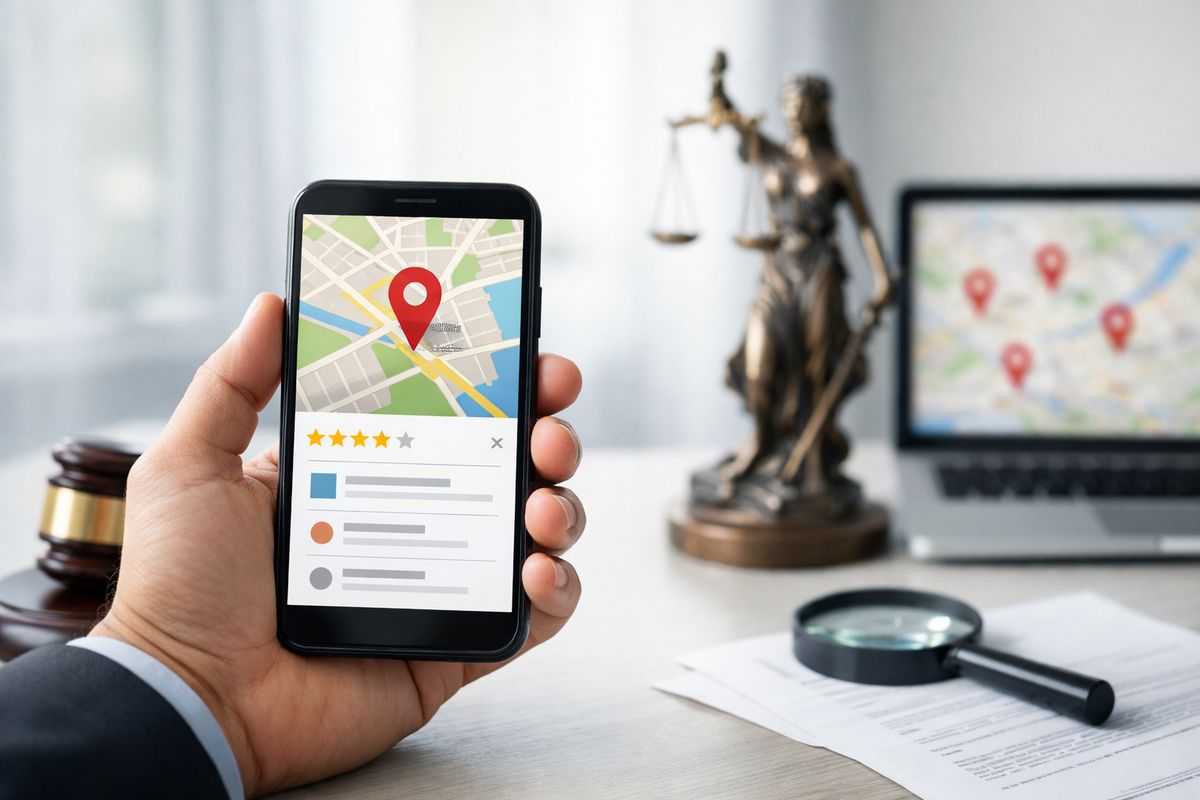
A 2024 Google Business Profile Help resource indicates that local ranking depends on relevance, distance, and prominence. For a law firm, Google Maps optimization means improving those three signals so your office appears more often in map results and the local pack for searches tied to legal services in a specific place. Unlike general SEO, this work happens inside a location-based system where your profile, office footprint, reviews, citations, and local authority often matter as much as your website.
What Google Maps optimization means for law firms
Google defines local ranking through relevance, distance, and prominence in its guidance on improving local ranking. That framework matters because a law firm does not compete only for organic blue links. Your firm also competes for limited local pack placements that appear above or alongside standard results for queries such as “car accident lawyer near me” or “estate planning attorney Dallas.”
Google Maps optimization is the process of improving your Google Business Profile, website alignment, reviews, citations, and local authority signals so Google can match your firm to those local queries. Relevance covers how well your profile reflects the search. Distance measures how close your verified office is to the searcher or the specified area. Prominence reflects how established your firm appears across the web, including reviews, links, mentions, and brand visibility.
The limitation is clear. Google publishes the framework, but not a complete weighting model. You can identify strong patterns, but not a fixed formula for every market or practice area.
Finding: Google Maps optimization for law firms centers on improving relevance, distance alignment, and prominence signals within Google Business Profile and the broader local search ecosystem.
How Google Maps rankings work in legal search
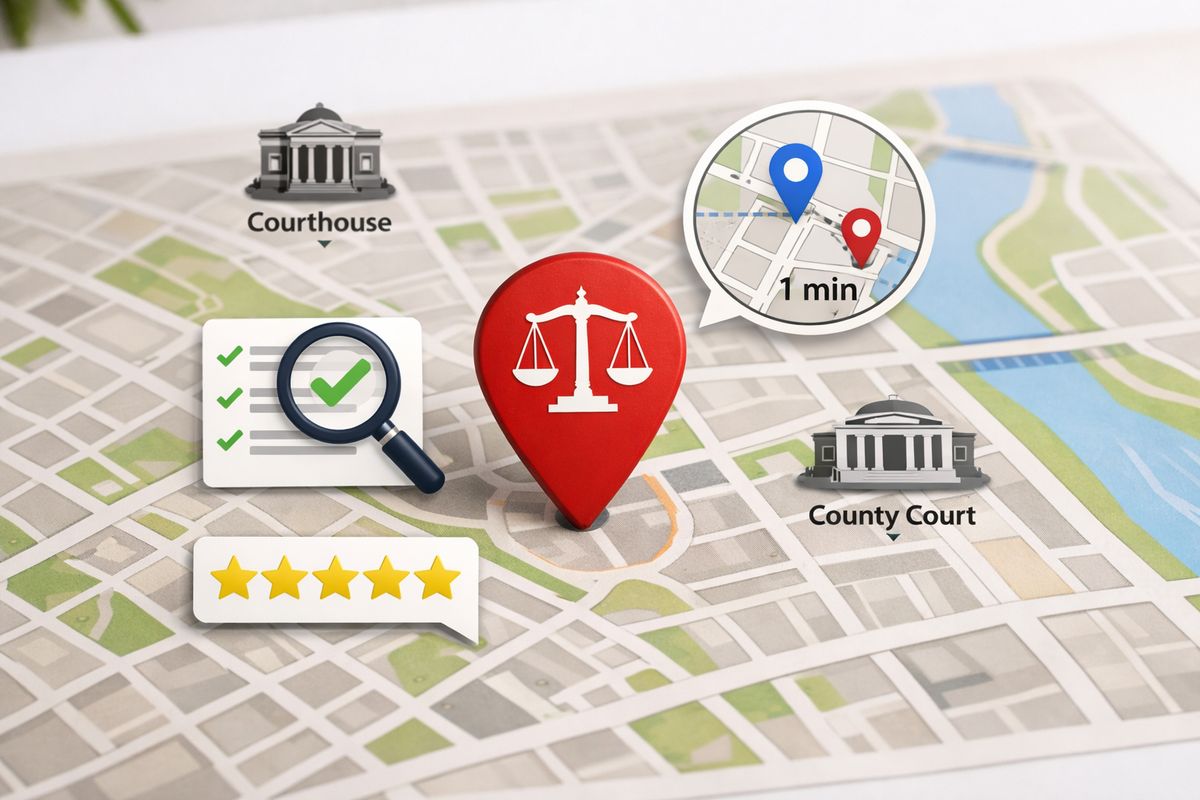
Google’s 2024 local ranking documentation states that local results depend on relevance, distance, and prominence, while the 2023 Whitespark Local Search Ranking Factors survey indicates that Google Business Profile signals, reviews, on-page signals, and links remain the most influential controllable factors cited by experienced practitioners. For a law firm, that means your main ranking levers are known, even if the exact weighting is not.
Some factors sit inside your control. You can choose categories carefully, complete your profile accurately, strengthen location pages, earn reviews, and correct citations. Some factors do not. You cannot change the searcher’s location, and you cannot fully offset a major proximity gap in every query. In legal search, this matters because practice areas often map tightly to city intent.
A practitioner survey is still a survey, not Google’s internal ranking data. It reflects informed observation across many campaigns, which is useful but not conclusive.
Finding: Your main levers are relevance and prominence, while distance remains only partially controllable through office location and service-area setup.
Relevance: how closely your profile matches legal intent
Google’s 2024 profile guidance advises businesses to provide complete and accurate information, including categories, services, and descriptions. For a law firm, relevance improves when your profile clearly states what you actually do: personal injury, family law, criminal defense, immigration, estate planning, or another verifiable service.
That clarity helps Google map your profile to legal-intent searches. A firm that lists “Personal injury attorney” as a primary category and includes related services is easier to match to accident-related searches than a generic profile with vague language. The same principle applies across practice areas and jurisdictions.
The limitation is policy risk. Adding keywords for services you do not truly offer can create inconsistency and increase the chance of edits or trust issues.
Finding: Relevance improves when your profile reflects actual legal services with complete and consistent detail.
Distance: what location signals can and cannot do
Google states that distance is based on what is known about the searcher’s location and the business location. For a single-office law firm, that creates a practical ceiling. You can optimize the profile thoroughly and still struggle to rank across an entire metro if your office sits far from high-volume search zones.
For multi-office firms, each verified office creates a separate chance to rank in its surrounding market. For service-area practices, the reality is narrower than many firms expect. Service areas help communicate coverage, but they do not replace the importance of a legitimate verified location.
Optimization can improve visibility within your realistic geographic range. It does not erase a significant location disadvantage.
Finding: Distance constrains rankings, so office footprint and verified location strategy shape the ceiling of local visibility.
Prominence: authority signals that compound over time
Google’s explanation of prominence includes information from across the web, such as links, articles, directories, and reviews. In legal search, prominence often decides which firms break away once categories and location basics are similar.
Prominence grows from accurate legal directory listings, branded searches, local press mentions, bar association references, review volume and quality, and links from relevant local sources. That makes it slower to build than profile completeness, but often more durable once established. If your firm is already building broader local SEO signals for lawyers, Maps performance usually improves alongside that work.
The limitation is pace. Prominence tends to accumulate over months, not days.
Finding: Prominence grows through reviews, citations, links, and brand visibility, and usually determines which similar firms separate from the pack.
Build the Google Business Profile correctly before optimizing it
Google’s 2024 setup materials indicate that complete, accurate profiles are easier for users to discover and evaluate. For a law firm, setup starts with claiming the profile, completing verification, using the exact real-world firm name, selecting categories, adding the correct phone number and website, publishing hours, and detailing services.
This is basic entity integrity. Google first needs confidence that your firm is real, staffed, and tied to a verified location. If your name, phone, office details, and website do not align, later optimization efforts rest on weak data.
Completeness alone will not guarantee rankings in a competitive legal market. But poor setup almost always limits performance. Firms managing growth across offices often need tighter profile maintenance processes because small errors compound quickly.
Finding: Correct setup is the prerequisite layer; without it, later optimization has reduced effect.
Choose the right primary and secondary categories
Categories remain one of the strongest relevance signals under your direct control. Your primary category should match your core firm identity or highest-value practice area. Secondary categories should reflect actual services, not speculative expansion areas.
A multi-practice firm faces tradeoffs here. If most revenue comes from personal injury, that category may deserve priority even if your firm also handles employment or civil litigation. If your brand is positioned broadly, a more general legal category may be appropriate, but only if that reflects how your market searches and how your firm operates.
Finding: Category selection is one of the strongest relevance signals you can directly control.
Write services and descriptions for clarity, not keyword stuffing
Your business description and service list should explain legal offerings in plain language, with service specificity and geographic context where relevant. Clear descriptions help Google interpret the profile and help prospective clients decide whether to contact you.
Repetition does not improve that signal. Overloaded descriptions filled with city names and repeated practice terms often reduce clarity without adding useful evidence. Google’s spam policies discourage misleading or low-quality content.
Finding: Clear, specific service language supports relevance better than repetitive keyword insertion.
Use photos, hours, and attributes to improve profile completeness
Google advises businesses to keep photos, hours, and details current. For a law firm, the highest-value assets are office exterior photos, interior reception images, attorney headshots, accessibility details, current holiday hours, and consultation options if offered.
These fields often affect conversion more directly than ranking. A complete visual and operational profile helps confirm legitimacy before contact, which matters in legal search where trust screening is high. If your firm is not appearing at all, the issue usually goes deeper than missing photos and may relate to the causes covered in why firms disappear from Maps results.
Finding: Completeness signals legitimacy and can improve engagement even when direct ranking impact is modest.
Align your website with your Maps profile
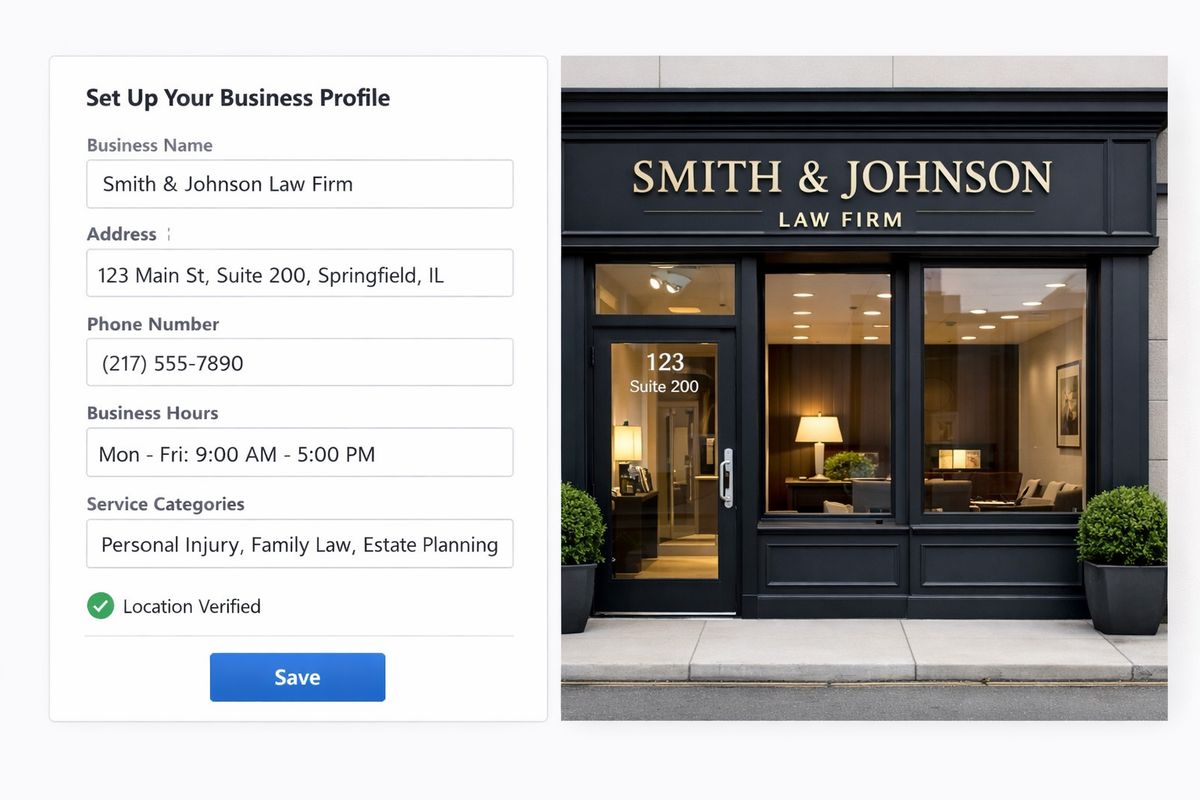
The 2023 Whitespark survey and Google’s local guidance both point to on-page signals as meaningful support for local rankings. Your website should validate the same entity, services, and geography shown in your profile. If your GBP says one thing and your site says another, Google gets mixed signals.
That alignment starts on the homepage and contact page, then extends to practice-area and location pages. Your office name, address, phone, attorney presence, and legal service scope should match across those assets. In low-competition markets, a strong profile can sometimes rank despite a weak site. In competitive legal SERPs, that pattern becomes less common.
Finding: Your website validates the local entity behind the profile and strengthens both relevance and prominence.
Create location pages that match real offices
A location page should document a legitimate office with unique local context. That usually includes exact NAP, attorney presence, office directions, parking information, areas served, jurisdiction details, and localized service content. Generic city-swap pages rarely hold up well.
The key limitation is legitimacy. A virtual office or mail drop presented as a staffed location creates both ranking and compliance risk. If your firm is improving local landing pages built for actual offices, the page must reflect a real place where your business operates.
Finding: Location pages perform best when they document a real office and local service context with unique details.
Strengthen local entity signals with schema and consistent NAP
Structured data helps search engines interpret your location information. LegalService or LocalBusiness schema, crawlable NAP on the page, embedded maps, and internal links between office and practice pages all reduce ambiguity.
Schema is not a shortcut. It works best as reinforcement for information already visible and consistent. Citation errors, mismatched suite numbers, or tracking numbers used carelessly can still create confusion. That is especially relevant when evaluating how call tracking affects local visibility.
Finding: Structured and consistent location data reduces ambiguity and reinforces your firm’s local entity signals.
Reviews are a ranking and conversion signal, but quality control matters
Google states that review count and review score can improve local ranking. A 2023 BrightLocal Local Consumer Review Survey found that reviews remain a major factor in how local businesses are evaluated before contact. For law firms, reviews influence both visibility and selection because legal clients often compare reputation before calling.
The limitation is variation. Review impact differs by market, and legal ethics rules may affect how and when you request testimonials. In some jurisdictions, disclosures and testimonial handling require extra care.
Finding: Reviews affect both rankings and lead conversion, but the process must follow bar rules and Google policy.
How to request reviews without creating policy or ethics risk
A durable process asks eligible clients consistently, without incentives, pressure, or selective filtering. Direct review links help, but your intake and follow-up sequence should also reflect local bar rules around testimonials, solicitation, and confidentiality.
For many firms, review requests work best when embedded into broader intake and follow-up systems rather than handled ad hoc. That same discipline usually improves post-consultation follow-up flows inside your CRM.
Finding: A standardized, policy-compliant review process is more durable than aggressive solicitation tactics.
What review content helps most
Review text that mentions service type, responsiveness, professionalism, and city context tends to send stronger relevance signals than star ratings alone. A detailed review about estate planning in Phoenix or a car accident case in Tampa gives Google more context than “great lawyer.”
The limitation is authenticity. You cannot script client wording too tightly without creating compliance and trust concerns.
Finding: Specific, authentic review text supports stronger local relevance than volume alone.
Respond to reviews to reinforce trust and profile activity
Google recommends responding to reviews. For law firms, that requires restraint. You can acknowledge feedback, thank the reviewer, and invite offline resolution for concerns, but you should avoid confirming confidential facts or case details.
Responses support maintenance and show that the profile is active. They also shape how future prospects interpret criticism. Negative reviews should be assessed carefully, especially when factual disputes or possible policy violations exist.
Finding: Review responses improve profile maintenance and trust signals, provided confidentiality boundaries stay intact.

Citations, legal directories, and local links still shape prominence
The 2023 Whitespark survey indicates that citation consistency, local links, and third-party prominence signals still matter, especially in competitive categories. For law firms, authoritative listings on Avvo, Justia, FindLaw, Yelp, chambers of commerce sites, and local bar resources help validate your business information and category fit.
The counter-finding is that bulk citation building has lost value compared with earlier local SEO periods. Quality and consistency now matter more than raw volume.
Finding: Citation accuracy still matters, but authoritative legal and local mentions outperform bulk directory submissions.
Audit and correct core citations
Citation cleanup should focus on consistency across major data sources, legal directories, map platforms, and local business listings. Duplicate profiles, old suite numbers, rebrands, and inconsistent call tracking setups can split entity signals.
This work is often operational, not glamorous. But Google relies on consistency to confirm trust. If your firm uses tracking, proper configuration matters, and a dedicated guide to phone attribution for legal marketing can help prevent confusion.
Finding: Citation cleanup removes trust friction and strengthens the consistency Google uses to validate your firm.
Prioritize links and mentions with local legal relevance
Not all links carry equal local value. A local newspaper mention about a verdict, a chamber sponsorship, a bar association profile, or a community legal resource usually contributes more context than another generic directory listing.
Relevance matters here. A local legal mention ties your brand to both place and practice area, which supports prominence more directly.
Finding: Locally relevant authority signals usually outperform high-volume but low-context link tactics.
Ongoing profile activity: posts, Q&A, updates, and monitoring
Google’s profile tools allow regular updates, and practitioner research from 2023 and 2024 suggests that freshness features can support conversion and sometimes visibility. That said, evidence for direct ranking impact from posts is weaker than for categories, reviews, and website alignment.
Your profile should not sit untouched. Hours change, attorneys join or leave, offices move, and consultation details evolve. Monitoring also protects against incorrect public edits and unanswered questions.
Finding: Ongoing profile management supports completeness and conversion, but foundational signals still matter more.
Use Google Posts for service updates and credibility signals
Posts work best for factual updates: office changes, attorney recognitions, community involvement, educational legal resources, and seasonal reminders tied to actual services. Informational content tends to fit legal marketing better than heavily promotional copy.
Posts can improve engagement and keep the profile current. The ranking effect remains less certain.
Finding: Posts help keep the profile current and can improve engagement, even if ranking effects are inconsistent.
Manage questions and answers before inaccuracies spread
Public Q&A often shapes pre-contact trust. Questions about consultation fees, languages spoken, parking, service coverage, and appointment logistics should not remain unanswered if the information is already public and appropriate to share.
Unanswered questions create space for incorrect public answers. Monitoring reduces that risk and improves intake clarity.
Finding: Q&A management reduces misinformation risk and improves pre-contact clarity.
Multi-location law firms need a different Maps strategy
Google’s local framework applies at the individual location level. A multi-office firm cannot simply replicate one successful profile across every market. Each office needs a legitimate local presence with distinct validation signals.
Problems often appear when firms create overlapping listings, copied location pages, or offices without meaningful staffing. Those setups can create duplicate risk, weak differentiation, and compliance concerns.
Finding: Each office needs its own defensible local entity, not a copied version of the main profile.
Avoid duplicate profiles and overlapping location signals
Each office should have clear ownership, accurate information, and a distinct landing page. Unique phone numbers can help when managed carefully, and service boundaries should reflect actual operations. Overlap creates confusion and can trigger edits or suspensions.
Finding: Clean separation between offices protects ranking stability and reduces duplicate-risk issues.
Balance brand consistency with local specificity
Brand standards should stay consistent across offices, but categories, descriptions, reviews, and local page content should reflect each office’s actual market and services. A downtown Chicago office and a suburban Naperville office may share branding while needing different local detail.
Finding: Multi-location firms perform better when brand standards coexist with genuine local differentiation.
How to measure Google Maps optimization for a law firm
Google’s 2024 Business Profile performance dashboard provides data on searches, calls, directions, website clicks, and message activity. GA4, CRM reporting, and call tracking add more useful visibility into consults and retained matters. That matters because profile activity alone does not equal business value.
Legal sales cycles are often long, and some interactions never convert into qualified cases. Measurement should connect visibility to intake quality, not stop at clicks or calls. Firms investing in better lead qualification and attribution usually make stronger decisions about what local SEO is actually producing.
Finding: Measurement should track both visibility and qualified intake outcomes, not profile activity alone.
Core KPIs: rankings, profile interactions, and qualified leads
A manageable KPI set includes local pack rankings by market, calls, direction requests, website clicks, form fills, consultation bookings, and signed-case rates where available. Branded and non-branded performance should be separated so you can tell discovery from existing demand.
The highest-value dashboard usually ties rankings and profile interactions to qualified consultations and matter value, not just lead volume.
Finding: The most useful dashboard combines local visibility with downstream intake and matter quality.
Common reporting mistakes
Common errors include using rank trackers without zip-level granularity, counting branded searches as net-new demand, ignoring call quality, or attributing every local lead to Maps. Another frequent mistake is treating dashboard activity as proof of revenue impact.
Good reporting uses local geographic detail and intake validation. Without that, optimization decisions drift toward vanity metrics.
Finding: Accurate reporting depends on geographic granularity and intake-level validation, not top-line profile metrics alone.
Common Google Maps optimization mistakes law firms should avoid
Google’s spam policies and ranking guidance make clear that manipulative tactics can create visibility loss or suspension risk. The most common problems are keyword-stuffed business names, fake offices, duplicate listings, inconsistent NAP, thin location pages, and neglected review workflows.
A limitation remains. Some noncompliant competitors may rank temporarily. That does not make the tactic durable. Enforcement, edits, and suspension risk tend to catch up over time.
Finding: Short-term gains from manipulative tactics carry higher suspension and volatility risk than compliant optimization.
Practices that can trigger suspension or manual edits
Risk increases when a firm presents a virtual office as staffed, uses misleading categories, posts fake reviews, or allows unauthorized profile changes. Misrepresentation is a more common suspension trigger than incomplete optimization.
Finding: Suspension risk usually comes from entity misrepresentation rather than lack of optimization effort.
When to escalate to an agency
Outside support becomes more useful when your issue crosses systems: multiple offices, suspended profiles, citation cleanup after a merger or rebrand, competitive metro rankings, or measurement problems involving calls, forms, and retained cases. If your challenge spans GBP setup, website alignment, attribution, and intake operations, the work often exceeds a simple listing update.
Finding: Agency support becomes most useful when the problem spans profile management, website alignment, and attribution at the same time.
Frequently Asked Questions
How long does Google Maps optimization take for a law firm?
Basic profile corrections can affect visibility within weeks, especially when categories, NAP, and verification issues are involved. Prominence signals such as reviews, links, and citations usually take longer, often several months in competitive legal markets.
Can a law firm rank in Google Maps without a strong website?
In lower-competition markets, a firm can sometimes rank with a modest website if the profile is accurate and the office is close to the searcher. In competitive metro areas, website alignment usually becomes a stronger differentiator.
Do service areas help a law firm rank outside its office city?
Service areas help communicate coverage, but Google still relies heavily on the verified business location and the searcher’s location. Service-area settings do not override a major distance disadvantage.
How many reviews does a law firm need to rank better?
There is no fixed number. Review impact depends on market competition, review quality, recency, rating profile, and competing firms. In practice, a steady flow of authentic, detailed reviews matters more than hitting a single threshold.
Should each law office have its own Google Business Profile?
Yes, if each office is a legitimate, client-facing location that meets Google’s guidelines. Each office should also have distinct supporting signals, including a matching location page and consistent citations.
What changes once your Maps strategy is working?
You usually see better alignment between where your firm can realistically compete and where it actually appears. Rankings become more stable, profile interactions become easier to interpret, and intake data becomes more useful for deciding where to expand local visibility.
If your firm needs a clearer diagnosis of local ranking issues, profile structure, or attribution gaps, schedule a call with Attorney Visibility ai for more information.