
According to the American Bar Association’s 2023 Legal Needs Survey, people facing legal problems often start online and make fast judgments about who to contact. That is why AI lead generation for lawyers matters now: it helps you show up earlier, respond faster, and convert more of the prospects already looking for help. In plain English, it means using AI to attract the right inquiries, qualify them, and move them toward a signed engagement without wasting staff time or ad spend.
What AI lead generation for lawyers actually means
A 2024 Salesforce State of Marketing report found that high-performing teams use automation and AI most heavily in lead capture, personalization, and measurement. What this means in practice is simple: AI works best when it improves the path from search to consultation, not when it tries to replace legal judgment.
For a law firm, that path has three jobs. It must get in front of people with legal intent, persuade them to contact you, and keep the inquiry alive long enough for intake to do its job. AI can support each step by identifying better search themes, improving ad and page relevance, replying instantly to new inquiries, and scoring which matters deserve priority.
The boundary matters. AI should never decide legal strategy, make unsupported claims, or publish client-facing content without review. Your advantage comes from using it to improve marketing operations and intake speed while keeping legal accuracy and ethics under human control.
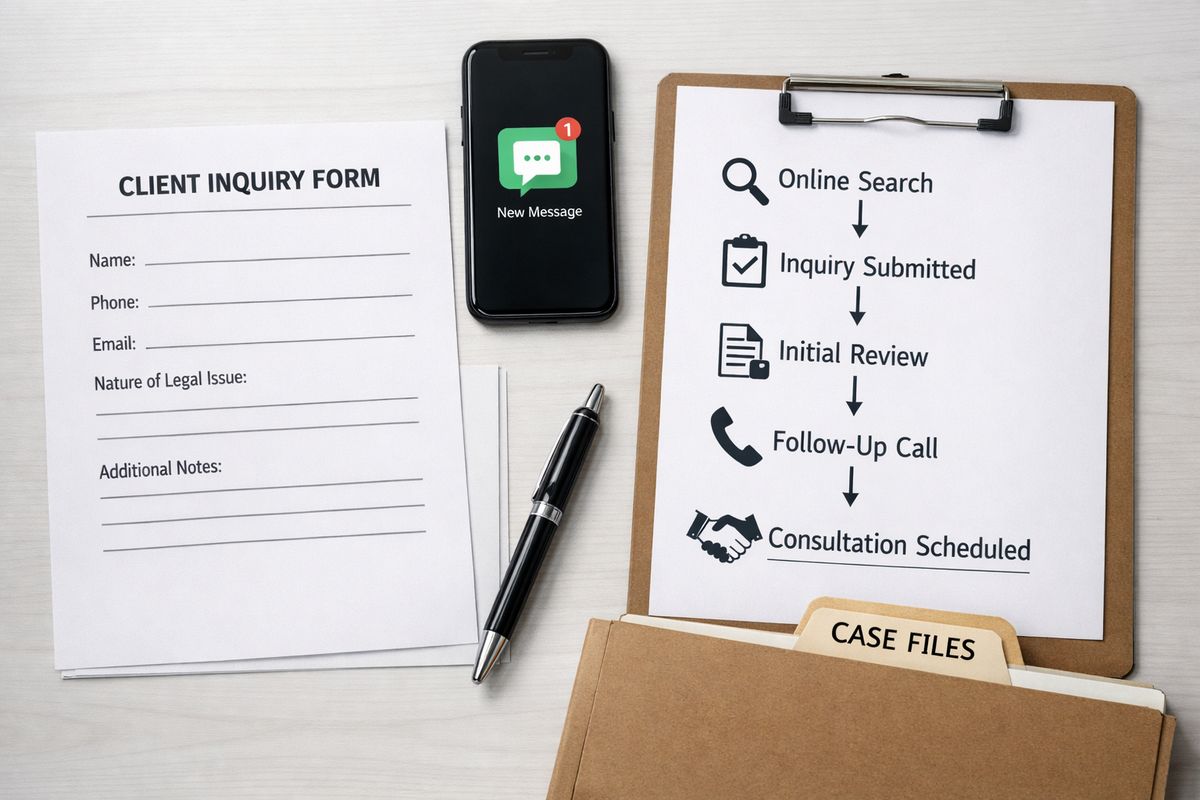
The move that works this week is mapping your current path from Google search to signed client. Write down every step, every tool, and every handoff. Bottlenecks get obvious fast.
Start with the three places AI changes results
A 2021 Harvard Business Review analysis of lead management found that response delays and funnel friction destroy conversion rates long before firms feel the loss in revenue. That is the right frame for this topic. AI changes results in three places: traffic, conversion, and intake follow-up.
Too many firms buy one shiny tool and expect it to fix client acquisition. It does not. If traffic is weak, more automation just speeds up failure. If landing pages are vague, more clicks just create more bounce. If intake is slow, better SEO only delivers more missed opportunities.
The full system is what matters. Search visibility gets the opportunity. Conversion pages turn attention into action. Intake speed turns interest into revenue.
Pick the single stage where your firm is losing the most opportunities right now. Fixing one broken stage beats adding another platform.
Traffic: getting in front of people with legal intent
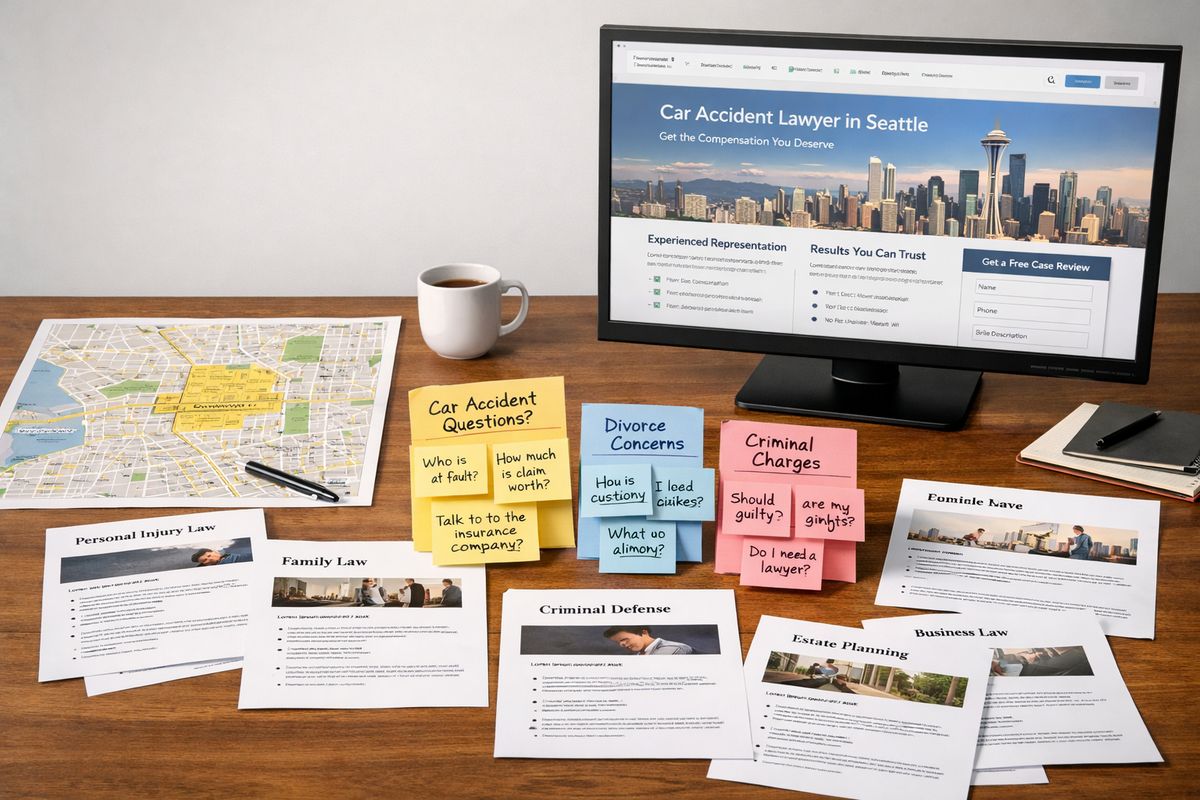
A 2024 Google economic impact update highlighted how high-intent searches often lead directly to calls, visits, and service inquiries. In legal marketing, intent beats reach. A thousand untargeted impressions are worth less than one search for “car accident lawyer near me” from somebody ready to act.
AI improves traffic acquisition by helping you match keyword themes, ad groups, local signals, and content topics to the exact language prospects use. That includes search ads, local organic results, map visibility, and practice-area content. The gain is not volume for its own sake. The gain is sharper alignment between the problem typed into Google and the page you put in front of that person.
If local visibility is weak, spend time on the ranking signals that move map visibility before adding more channels.
Conversion: turning visits into consultations
A 2020 Nielsen Norman Group study on web usability found that clarity and relevance consistently outperform clever phrasing when users need to make decisions quickly. Legal prospects are not browsing for entertainment. Your page either confirms “you handle my problem” or it does not.
AI helps here by testing headlines, rewriting weak sections, tightening forms, and generating page variants by location or case type. But the principle stays human: your best-performing pages speak directly to the matter, the location, the urgency, and the next step.
Choose one high-intent page, usually a top practice-area page, and tighten the headline, proof, and call to action around one exact search intent.
Intake: converting inquiries before they go cold
A widely cited InsideSales lead response study found that contacting a lead within five minutes dramatically improves contact rates compared with waiting even 30 minutes. In legal intake, that delay costs consultations and signed cases every day.
AI helps by sending instant acknowledgments, asking two or three routing questions, assigning the lead correctly, and triggering follow-up while your staff is busy. The point is not robotic intake. The point is keeping momentum until a real person takes over.
Measure your current average first-response time across forms, chat, and missed calls. Most firms discover the problem right there.
Use AI for legal SEO that brings in qualified leads
A 2024 BrightLocal survey found that local search remains a major driver of calls and website visits for service businesses. For law firms, organic search still produces some of the highest-intent traffic in the funnel because prospects are actively describing a legal problem.
What works in legal SEO is not mystery. Practice-area pages, city pages, FAQ content, schema markup, internal linking, and intent-based site structure drive qualified visibility. AI speeds up the parts that take the most time: search analysis, question mining, content briefs, content refreshes, and on-page testing. It does not remove your responsibility to publish accurate, jurisdiction-safe content.
If you want stronger organic performance, start with the local SEO plays that actually move law firms up.
Pick one service page and rebuild it around one search intent, not five.
Find the questions prospects actually ask before they hire
A 2023 Semrush analysis of search behavior showed that long-tail queries and question-based searches often reveal stronger intent than broad informational terms. That matters because “how long do I have to file a truck accident claim in Texas” is a far better lead signal than “truck accidents.”
AI tools can group People Also Ask questions, surface comparison searches, summarize intake transcripts, and identify recurring concerns across reviews and call logs. That gives you content topics that pre-qualify leads before contact. Instead of attracting random traffic, your pages answer the exact questions serious prospects ask before hiring counsel.
Build landing pages that match intent, location, and practice area
A 2024 Unbounce conversion benchmark reinforced a boring truth: relevance lifts conversion. For lawyers, the simplest version of this is one page per matter type and market, built around the language of that case and that location.
Your strongest landing pages do four things fast. They confirm the problem, establish local relevance, show proof, and make the next step obvious. AI is useful for producing page variants, testing headline angles, and identifying weak sections, especially if you are expanding into nearby cities.
For a closer look at stronger location-specific pages built to convert legal searches, study how page structure changes by market and practice area.
Refresh old content before creating more
A 2023 Ahrefs study of millions of search results found that content performance shifts constantly as search intent, competitors, and SERP layouts change. Old pages decay. The upside is that updates often produce faster gains than net-new articles.
Refreshing content means tightening the title and heading structure, improving internal links, adding fresher FAQs, updating local signals, and fixing weak calls to action. If a page already ranks and gets traffic, it has momentum. AI helps you diagnose what is missing and generate revision drafts faster.
Update your highest-traffic service page this week before publishing anything new.
Use AI in paid ads to cut waste and improve lead quality
Google’s own advertising documentation has long shown that automation performs best when fed strong signals and clean intent. In legal advertising, AI helps most with bidding, search-term analysis, ad variation testing, and budget allocation. It does not rescue a bad offer or a sloppy account structure.
Use AI to reduce waste, not to surrender control. That means tighter keyword clustering, better negatives, cleaner location targeting, and pages that match the ad promise exactly. If you run Local Services Ads, compare that channel against search ads based on signed-case quality, not lead count alone. A useful starting point is understanding how LSAs and search campaigns differ in legal lead flow.
Review your search terms report and cut obvious waste this week.
Write ad copy that reflects legal urgency, not generic promises
A 2024 WordStream benchmark showed that ad relevance remains one of the biggest controllable drivers of paid performance. Generic claims like “experienced representation” are wallpaper. Case-specific urgency wins attention.
AI is good at producing variations tied to matter type, geography, and pain point. Use that strength to create tighter alignment between keyword, ad, and landing page. A search for emergency custody help should not land on a broad family law page with vague copy.
Feed the platforms better conversion signals
A 2023 Google Ads best practices update emphasized the value of offline conversion imports for smarter optimization. That matters because raw form fills are weak signals. Signed consultations and retained matters are strong signals.
Connect call tracking, CRM status updates, and qualified-lead scoring back into your ad platforms. When the system learns which clicks turn into real cases, bidding gets sharper. If your reporting ends at “submitted form,” your campaigns optimize for noise.
This is where connecting marketing data to your intake system stops being a tech project and starts becoming a growth lever.
Use retargeting to recover high-intent visitors
A 2024 Criteo commerce study found that repeated brand exposure improves return visits and conversion probability. Legal prospects behave the same way, especially for higher-stakes matters that involve discussion with family, insurance carriers, or employers.
Retarget visitors who viewed practice pages, began a form, or called without hiring. Keep the message simple and specific. Familiar firms get the second click. That second click often becomes the consultation.
Fix intake first because speed wins legal business
A 2011 study from Dr. James Oldroyd at MIT, published through Harvard Business Review, found that firms responding to leads within five minutes were far more likely to connect with prospects than firms that waited longer. Legal intake follows the same rule with even higher stakes. Most firms do not have a lead problem. Your intake process is the problem.
AI closes the gap between inquiry and human contact through instant SMS, email acknowledgments, chatbot triage, calendar booking, missed-call text-back, and smart routing. What this means in practice is simple: AI keeps the conversation alive until your staff takes over.
Turn on an automatic response for every form submission and missed call. That alone changes outcomes fast.
Respond in under five minutes
Fast response changes contact rates because legal urgency fades quickly. Prospects keep searching, call competitors, or lose confidence if nothing happens.
Use AI-driven replies that confirm receipt, set expectations, collect the minimum routing details, and offer the next step. Done right, this does not sound robotic. It sounds organized.
If you want a realistic picture of how automated replies connect with actual intake workflows, focus on timing and handoff rules.
Qualify leads without creating friction
A 2024 HubSpot forms study found that shorter forms generally convert better because every extra field adds resistance. Intake teams still need enough detail to route matters correctly. The answer is not a long form. It is a smart one.
Use branching questions by practice area and collect only what you need early: case type, location, urgency, and best contact method. Everything else can wait until the conversation starts. The move that works is reducing delay without sacrificing fit.
Route the right matters to the right person
A routing error wastes the one thing legal prospects care about in the first hour: confidence. If somebody reaches your firm about a DUI arrest in one county, that inquiry should not drift to a generic inbox.
Use clear rules for practice area, geography, urgency, and language preference. AI handles the sorting well when the underlying rules are clean. That removes handoff errors and shortens time to consultation.

Choose AI tools that support the full funnel
A 2024 Gartner marketing technology survey found that tool sprawl reduces adoption and weakens reporting. More software does not create better lead generation. Better alignment does.
Organize your stack around outcomes: SEO and content, paid ads, chat and intake, CRM, analytics, and call intelligence. The best setup is the simplest version that shares data across marketing and intake. If you are evaluating platforms, start with what legal lead tracking should actually show you.
Audit your tools this week and remove one duplicate system.
AI SEO and content tools
Use AI here for clustering topics, generating briefs, refreshing stale pages, and spotting internal link gaps. Keep human review on every legal claim, jurisdictional statement, and client-facing page. Speed is useful. Accuracy is non-negotiable.
AI ad and creative tools
These tools are good at ad-copy variation, landing-page testing support, bid pattern analysis, and surfacing negative keywords. Keep approvals centralized and judge performance by qualified consultations, not click-through rate alone.
AI intake, CRM, and call intelligence tools
The right tools score leads, summarize calls, book consultations, capture source data, and show where matters stall in the pipeline. If that data does not flow into one system, you do not have intelligence. You have fragments.
Measure what actually matters: from lead volume to signed cases
A 2023 Ruler Analytics attribution report found that businesses making channel decisions from downstream revenue data outperform those relying on top-of-funnel metrics alone. That is especially true for law firms, where a cheap lead often becomes an expensive distraction.
Lead volume is not the goal. Qualified consultations, show rates, cost per qualified lead, signed-case rate, and revenue by channel are the metrics that matter. If your AI setup only reports clicks, chats, and form fills, it is blind.
Define a qualified lead in writing this week. If that definition is fuzzy, every optimization decision gets worse. For a sharper framework, review the difference between lead volume and the inquiries worth pursuing.
Track the metrics that expose bottlenecks
Lead-to-contact rate exposes intake speed problems. Contact-to-consult rate points to weak qualification or poor follow-up. Consult-to-retainer rate often reveals message mismatch, pricing friction, or case-selection issues. Response time and no-show rate tell you if your process feels urgent and credible.
Each metric should point to one fix. That is how reporting becomes useful.
Build attribution that connects marketing to revenue
Use call tracking, CRM source capture, UTM discipline, and offline conversion syncing. Keep the rule simple: the platform that gets credit gets budget.
If you avoid call tracking because of SEO concerns, make sure you understand how tracking numbers affect local visibility when set up correctly. Done properly, attribution improves without damaging search performance.
Stay compliant, accurate, and brand-safe
A 2024 Stanford University report on generative AI behavior found that large language models still produce false or unsupported statements with confidence. In legal marketing, that is a direct risk. AI accelerates work, but every public claim, intake prompt, and automated reply must follow bar rules and your standards.
Review is not optional. That includes website copy, ad copy, FAQs, chatbot scripts, testimonials, and every automated message. Security matters too, especially when intake data includes medical facts, employment issues, criminal allegations, or family details.
Require human approval on all client-facing AI outputs starting now.
Prevent inaccurate claims and risky copy
Unsupported specialization claims, implied guarantees, misleading comparisons, and sloppy testimonial language create compliance risk fast. Approval workflows protect your firm by forcing a final review before anything goes live.
Protect intake data and client confidentiality
Check vendor permissions, retention rules, transcript storage, redaction options, and access controls. Security is not abstract policy. It is trust, risk control, and basic professional discipline.
Build the AI lead generation system that actually works for your firm
A 2023 McKinsey implementation study found that focused pilots outperform broad change programs because narrow systems get adopted faster and measured more clearly. That is exactly how to approach AI lead generation for lawyers.
Use one traffic source, one conversion point, one intake workflow, and one reporting view for a single high-intent practice area. Prove results there. Then scale. The move that works is not building a giant AI stack. It is tightening one revenue path until it performs predictably.
Choose one high-intent practice area this week, shorten response time, and track signed consultations for the next 30 days.
The 30-day rollout for a single practice area
Start by improving one page around one search intent. Then tighten one ad group so the keyword, ad, and page match. Add one intake automation for instant response and routing. Finally, build one dashboard showing leads, qualified consults, show rate, and signed matters. That sequence keeps the system manageable and measurable.
When to hire an agency instead of building this in-house
If attribution is weak, intake is slow, landing pages are underperforming, ad costs are rising, or case quality is inconsistent, outside help is the smarter move. The right partner brings legal marketing experience, CRM integration depth, intake expertise, and reporting tied to signed cases, not vanity metrics.
Frequently Asked Questions
Can AI replace intake staff at a law firm?
No. AI handles instant acknowledgment, basic qualification, routing, and follow-up. Your staff still needs to take over quickly for judgment, empathy, and case evaluation.
What is the best use of AI lead generation for lawyers?
The highest-impact use is improving speed and relevance across the full funnel. That means better search targeting, better landing pages, and faster intake response.
Does AI help with legal SEO or just paid ads?
It helps with both. In SEO, it speeds research, outlines, refreshes, and intent mapping. In paid ads, it improves bidding, search-term analysis, ad testing, and audience exclusions.
How do you measure if AI lead generation is working?
Track qualified consultations, response time, show rate, signed-case rate, and revenue by channel. Raw lead count is not enough.
Is AI lead generation compliant for law firms?
Yes, if you keep human review in place, follow advertising rules, protect intake data, and approve all client-facing outputs before publication or automation.
The move to make this week
Choose one high-intent practice area, improve one page, enable instant intake response, and track qualified consultations to signed matters for 30 days. If you want a faster path with the right systems, data flow, and legal marketing strategy, schedule a call with Attorney Visibility ai for more information.