
An ideal client profile is the clearest possible definition of the clients your law firm is built to attract, sign, and serve profitably. If your marketing feels busy but not efficient, your ideal client profile is usually the missing piece, and fixing it changes how your agency targets, writes, qualifies, and reports.
What an Ideal Client Profile Means for a Law Firm
A 2024 Thomson Reuters report on law firm performance and client demand reinforced a plain truth: competition for profitable legal work is getting tighter, and firms that grow are not chasing every lead. Growth comes from better fit, better positioning, and better follow-through.
In plain English, an ideal client profile is the specific type of client or matter your firm wants more of because it fits your strengths and produces strong business results. It is not a vague audience description like “people who need legal help” or “businesses in the area.” It is a working definition of the cases, companies, or individuals that make sense for your team, your economics, and your growth goals.
That matters because your agency cannot build sharp campaigns from fuzzy inputs. If your agency does not know which matters you want, which clients are profitable, which consultations turn into signed engagements, and which leads waste time, campaign performance stalls. You get more activity, not better outcomes.
What this means in practice: this article explains what a digital marketing agency needs from you to build an ideal client profile that improves lead quality, signed matters, and return on ad spend. Write down the three types of matters you want more of this year.
Why Your Agency Needs an Ideal Client Profile Before Running Campaigns
A 2024 Clio Legal Trends Report showed again that lead flow and revenue are not the same thing. Firms win when inquiries convert into consultations, consultations convert into clients, and clients convert into profitable matters. Raw lead volume tells only a small part of that story.
Your agency needs an ideal client profile before launching campaigns because every marketing decision depends on it. Without one, targeting becomes too broad, messaging becomes generic, intake becomes inconsistent, and budget gets spread across the wrong searches, wrong locations, and wrong offers. The result is familiar: plenty of calls, too few signed cases.
With a clear ICP, your agency can choose channels based on fit instead of habit. That changes how paid search gets structured, how local SEO pages are prioritized, how forms are built, and how consultations are qualified. If your current reporting still centers on clicks and total leads, it helps to align it with how qualified legal inquiries should actually be defined.
What this means in practice: identify the single business outcome that matters most right now, more signed cases, higher-value matters, shorter sales cycles, or expansion into a new practice area.
What an Agency Actually Uses an ICP For
A 2023 HubSpot State of Marketing report found that segmentation and relevance improve conversion efficiency across channels. That finding is not abstract. It maps directly to law firm marketing execution.
Your agency uses your ICP to decide which search terms deserve budget, which topics deserve content, which pain points belong on landing pages, and which questions belong in intake forms. It shapes CRM routing, consultation follow-up, and reporting by source. It also affects how local visibility gets built, especially if your growth depends on showing up in the map pack for the right nearby searches.
Here is the simplest version of this: an ICP is not a brand exercise. It is an operating document. Ask your agency to show exactly where your ICP appears in campaign strategy and reporting.

Ideal Client Profile vs. Buyer Persona for Law Firms
A 2023 Salesforce State of Marketing report found that high-performing teams are more likely to use audience segmentation and personalization in a structured way. That only works when the basic categories are clear.
Your ideal client profile defines the right fit at the business level. A buyer persona describes the person involved in choosing you and what that person cares about. Those are related, but they are not the same.
For a law firm, your ICP might be “owner-led healthcare companies with 20 to 150 employees facing recurring employment compliance issues” or “personal injury claimants within 30 miles who need representation within seven days and have documented treatment.” Your buyer persona, by contrast, might be the founder, operations executive, spouse, injured driver, or general counsel who actually makes contact and asks questions.
That distinction matters because your agency needs both layers to perform well. The ICP tells your agency who to pursue. The persona helps shape the message that persuades the right person to call. Separate “who is the right fit” from “who makes the hiring decision” in your current marketing notes.
ICP for Consumer-Facing Practice Areas
A 2024 FindLaw consumer legal needs survey highlighted how consumers choose lawyers under stress, with speed, trust, proximity, and clarity all playing major roles. In consumer-facing practice areas, your ICP is rarely based on company size or annual revenue. It is based on matter fit and readiness to hire.
For personal injury, that often means geography, accident type, treatment status, insurance involvement, and potential claim value. For family law, it may center on county, urgency, custody complexity, and ability to pay. For criminal defense, timing and charge severity dominate. For immigration, case type, language needs, and filing deadlines matter more than almost anything else. For estate planning, life stage, asset mix, and decision readiness often separate high-fit prospects from time-consuming tire-kickers.
What this means in practice: your agency should target consumer matters using urgency, location, and economics, not broad demographics alone. Define your top consumer matter by urgency, location, and economic value.
ICP for B2B and Corporate Practice Areas
A 2024 Association of Corporate Counsel survey continued to show that legal buyers inside businesses care about specialization, responsiveness, industry understanding, and predictable value. In business-facing practice areas, your ICP needs a different lens.
For employment law, useful filters include industry, employee count, litigation exposure, and HR maturity. For corporate and M&A, deal frequency, ownership structure, and transaction complexity matter. For IP, the strongest signals often include product pipeline, funding stage, and enforcement needs. For compliance and commercial litigation, regulatory pressure, outside counsel spend, and internal decision structure matter a lot.
This changes everything about marketing execution. A page aimed at founder-led SaaS companies with multistate employment issues should not sound like a page aimed at local retailers needing handbook updates. Define the company traits that make an engagement profitable and repeatable for your firm.
The Core Traits That Belong in a Law Firm ICP
A 2024 Salesforce State of Sales report found that stronger qualification improves sales efficiency and win rates. Law firm marketing works the same way. Better qualification upstream protects time, budget, and intake capacity downstream.
Your agency needs a law firm ICP built from traits that actually affect outcomes. The big ones are practice area fit, geography, matter value, urgency, fee fit, decision-maker profile, conflict risk, complexity, timeline, and likelihood of retention. Each one changes a campaign decision.
Practice area fit tells your agency what not to market. Geography shapes local pages, ad radius, and map visibility. Matter value influences budget tolerance and follow-up speed. Urgency affects ad copy and intake rules. Fee fit helps screen out prospects who will never retain. Decision-maker profile changes messaging. Conflict risk and complexity prevent wasted consultations. Timeline reveals whether someone is ready now or just researching.
That is also why clean attribution matters. If you cannot connect signed matters back to their sources, you cannot sharpen your ICP with confidence. A good place to tighten that process is tracking where retained clients actually came from. Circle the five traits that most strongly separate your best clients from your worst-fit leads.
Revenue and Profitability Signals
A 2024 Clio Legal Trends Report underscored that revenue without efficiency tells an incomplete story. A matter that bills well but drags on for months, gets discounted, and creates collection issues is not an ideal matter.
Profitability signals are more useful than top-line invoices. Look at fee model, realization, matter duration, staff time, write-downs, and collection reliability. A flat-fee estate plan with quick turnaround and low friction often outperforms a bigger but chaotic litigation matter on margin. A recurring employment advisory client can be more valuable than a larger one-off dispute because service is predictable and repeat work follows.
Here is the move that works: stop confusing biggest invoice with best client. Review your last 20 matters and mark which ones produced the strongest margin, not just the biggest invoice.
Fit and Friction Signals
A 2023 HubSpot sales trends report found that friction in the buying process lowers conversion and raises acquisition cost. That pattern shows up in law firm intake every day.
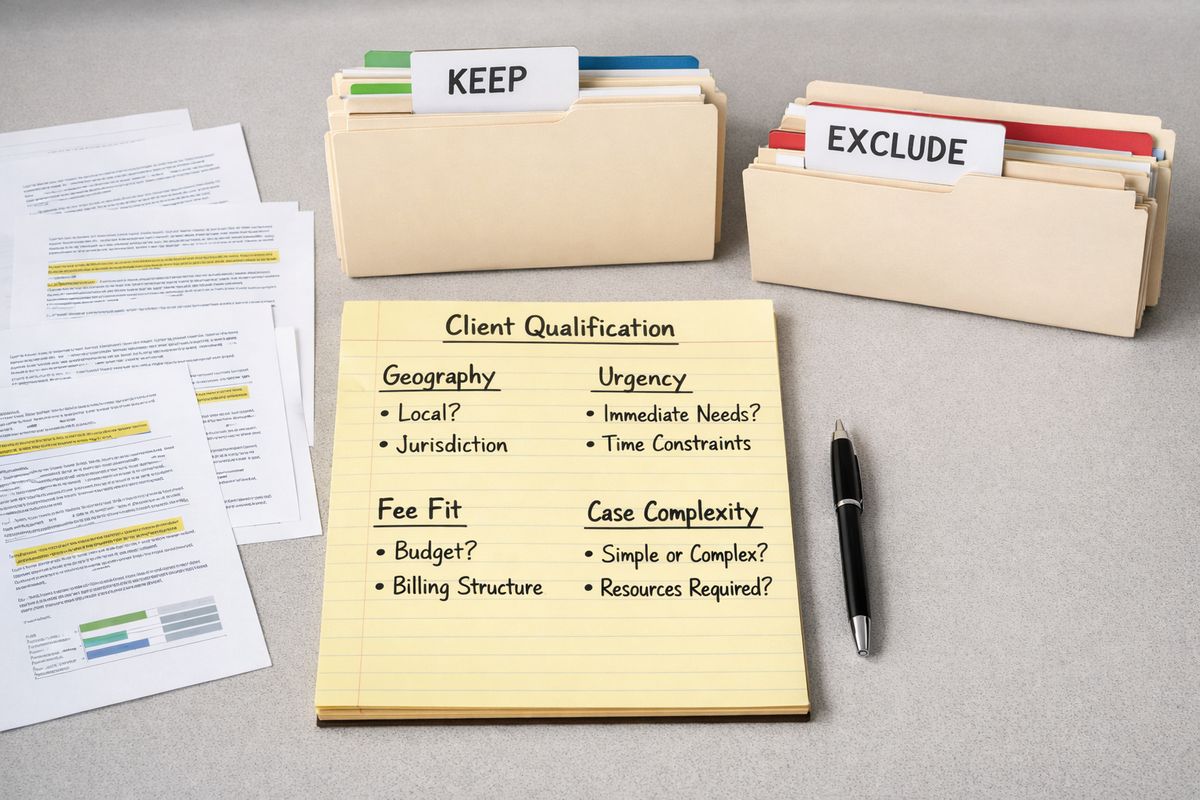
Poor-fit leads usually signal themselves early. Unrealistic expectations, slow responses, resistance to fees, missing documents, constant reassurance needs, and scope expansion all point to low-fit matters. These leads consume intake time, clutter pipelines, and make campaign performance look worse than it is.
Your agency needs exclusion criteria just as much as target criteria. Negative keywords, excluded counties, disallowed case subtypes, and disqualifying intake questions all come from this part of the profile. If you also rely on call-heavy intake, it helps to understand how call attribution sharpens marketing decisions without guesswork. Write a short “do not target” list based on the leads that consume time and never become strong matters.
How to Build an Ideal Client Profile From Real Law Firm Data
A 2024 LawPay Legal Industry Report emphasized the value of tracking intake, payments, and firm performance in connected systems. Data is not decoration here. It is the only reliable way to separate assumption from pattern.
Build your ICP from signed clients and completed matters, not from raw leads. Start with the work that produced strong outcomes. Find the common traits. Compare those traits against profitability, retention, and referral value. Then convert the pattern into a profile your agency can actually use in campaigns.
This sounds more complex than it is. Pull your best matters, identify what repeats, and document it in plain language. If your intake and follow-up systems are disconnected, fixing the handoff between marketing and your CRM makes this process much easier. Pull a list of your best 10 clients or matters from the last 12 months before your next agency meeting.
Start With Your Best Existing Clients
A 2023 Gartner sales enablement study showed that teams perform better when customer definitions are based on actual high-value accounts rather than assumptions. For a law firm, that means starting with current wins.
“Best” does not mean most famous. It means profitable, efficient, aligned with your strengths, likely to refer, likely to return, and likely to leave a strong review. Prestige without margin is a trap. So is volume without ease.
The simplest version of this is a two-score system. Give each of your top 10 matters one score for value and one score for ease. Rank your best 10 clients using one score for value and one score for ease.
Add Intake and Sales Conversation Data
A 2024 InsideSales benchmark on lead response reinforced a basic truth: the language prospects use early in the process predicts intent better than broad assumptions do. Billing data tells only part of the story. Intake conversations tell the rest.
Call notes, consultation transcripts, web forms, and email inquiries reveal urgency, objections, fears, and hiring triggers. Prospects do not describe problems the way lawyers describe problems. That gap matters. If a prospect says “I need to keep this out of court” or “I just want custody settled fast,” that language belongs in pages, ads, and follow-up.
Here is how to use it: review five recent consultation calls and note the phrases prospects use to describe their problem.
Validate With Your Agency’s Campaign Data
A 2024 Google Ads benchmark from WordStream showed wide performance variation by intent, keyword specificity, and landing page relevance. For law firms, source-level data matters because not every lead source produces the same quality.
Your agency should validate your ICP against campaign performance. Which keywords produce qualified consultations? Which locations sign? Which landing pages bring in low-value noise? Which offers attract fast-moving prospects? This is where internal firm knowledge meets real market behavior.
That validation also helps you choose channels more intelligently, especially if you are weighing which paid options fit your practice area and budget. Ask for a report that separates qualified leads from total leads by channel.
The Questions Your Agency Should Ask to Define Your ICP
A 2023 Salesforce sales operations report found that stronger discovery improves sales outcomes because better inputs produce better decisions. The same principle governs agency strategy.
A good agency should ask about matter type, profitability, geography, urgency, objections, intake patterns, and post-signing success. Not just demographics. Not just practice areas. Actual operating questions that reveal what a good case or client looks like inside your firm.
This process should feel direct. Which matters close fastest? Which leads stall? Which cases create stress? Which ones turn into reviews and referrals? Which ones fit your team’s strengths? Answer these questions in writing before kickoff so strategy starts faster.
Questions About Your Best Matters
Your agency should ask which matters generate the best margin, move efficiently, align with your skills, and lead to referrals or repeat work. That reveals what to scale. It also forces clarity about where your firm wins instead of where it merely participates.
If one matter type consistently closes faster and creates less friction, that is not a coincidence. It is a signal. Name the one matter type you want your firm to become known for locally or within your niche.
Questions About Bad-Fit Leads
Your agency should also ask which leads never sign, which matters drag on, which case types produce poor reviews, and which locations underperform. Exclusions make targeting better because every dollar not spent on weak-fit leads can be redirected toward the right ones.
This matters just as much as your positive profile. A weak exclusion list turns every campaign into a cleanup job. List the three lead patterns you want to stop paying for.
Questions About Decision-Makers and Hiring Triggers
Your agency needs to know who starts the search, who influences the decision, what event triggered the search, and what concern delays signing. In family law, that trigger may be a filing deadline or safety issue. In employment counsel, it may be a demand letter or internal complaint. In estate planning, it may be a health event or new child.
That knowledge sharpens page headlines, ad copy, and follow-up messaging. It also improves how consultations are routed and nurtured. Identify the top trigger that causes your ideal client to contact a lawyer.
How an Ideal Client Profile Improves Law Firm Marketing Performance
A 2024 Google consumer insights report kept pointing to the same pattern: relevance raises response. When marketing matches intent, conversion improves.
A strong ICP improves every part of law firm marketing because it forces specificity. Your message gets tighter. Your keywords get cleaner. Your offers become more believable. Your reviews strategy gets more focused. Your intake handoff becomes more disciplined. Instead of speaking to everyone, your marketing starts sounding like it was written for the right client.
That improves local pages, map visibility, forms, ad creative, and follow-up workflows. It also makes it easier to remove generic content and build pages that actually convert, especially if you are refining location-specific pages built around real legal intent. Compare one current landing page against your ICP and remove generic language this week.
Better SEO and Content Strategy
A 2024 Semrush search behavior report found that high-intent, specific queries produce stronger conversion potential than broad informational traffic. Law firm SEO performs best when content maps to real hiring situations.
Your agency should create content around matter type, location, urgency, jurisdiction, and client questions. A page about “business lawyer services” is weak. A page about “outside employment counsel for multi-location dental practices in Illinois” is useful. The same goes for consumer practices. “Car accident lawyer” is broad. “Rear-end crash injuries with ongoing treatment in Maricopa County” is much closer to actual intent.
That specificity is what turns search traffic into consultations. Choose one high-value client question and turn it into a content brief for your agency.
Better Paid Search and Social Targeting
A 2024 WordStream digital advertising benchmark showed that tighter targeting and stronger alignment between query and message improve conversion rates while lowering wasted spend. Law firm paid media follows that rule exactly.
ICP clarity improves keyword selection, negative keywords, geo-targeting, audience lists, ad copy, and form design. If you know the exact matter type and urgency level you want, your ads stop attracting curiosity clicks and start attracting consultations with real fit. The same principle applies when deciding between channels like search ads and LSAs, especially if you are comparing how the two Google ad formats differ for legal lead quality.
Review your paid campaigns and add exclusions for the searches or audiences that never become viable clients.
Better Intake and Conversion Rates
A 2024 Harvard Business Review analysis of lead response and conversion reinforced a familiar pattern: speed and relevance in follow-up have a direct effect on conversion. Marketing performance does not end at the click. It continues through intake.
Your ICP gives intake staff better rules and better language. If your team knows the right geography, urgency level, matter value, and disqualifying factors, consultations get booked faster and weak leads get filtered earlier. The same traffic produces more signed matters because qualification improves before attorney time gets consumed.
That is also where structured follow-up matters. If your process breaks after the first missed call or delayed consultation, tightening the sequence that keeps prospects engaged after first contact protects conversion. Update your intake script to ask one question that immediately identifies fit.
Common Mistakes Law Firms Make With Ideal Client Profiles
A 2024 legal marketing benchmark from Clio continued to show that firms lose performance when follow-up, targeting, and qualification are too broad. The waste is rarely dramatic. It is cumulative. Generic campaigns pull in generic leads, and generic leads drain resources.
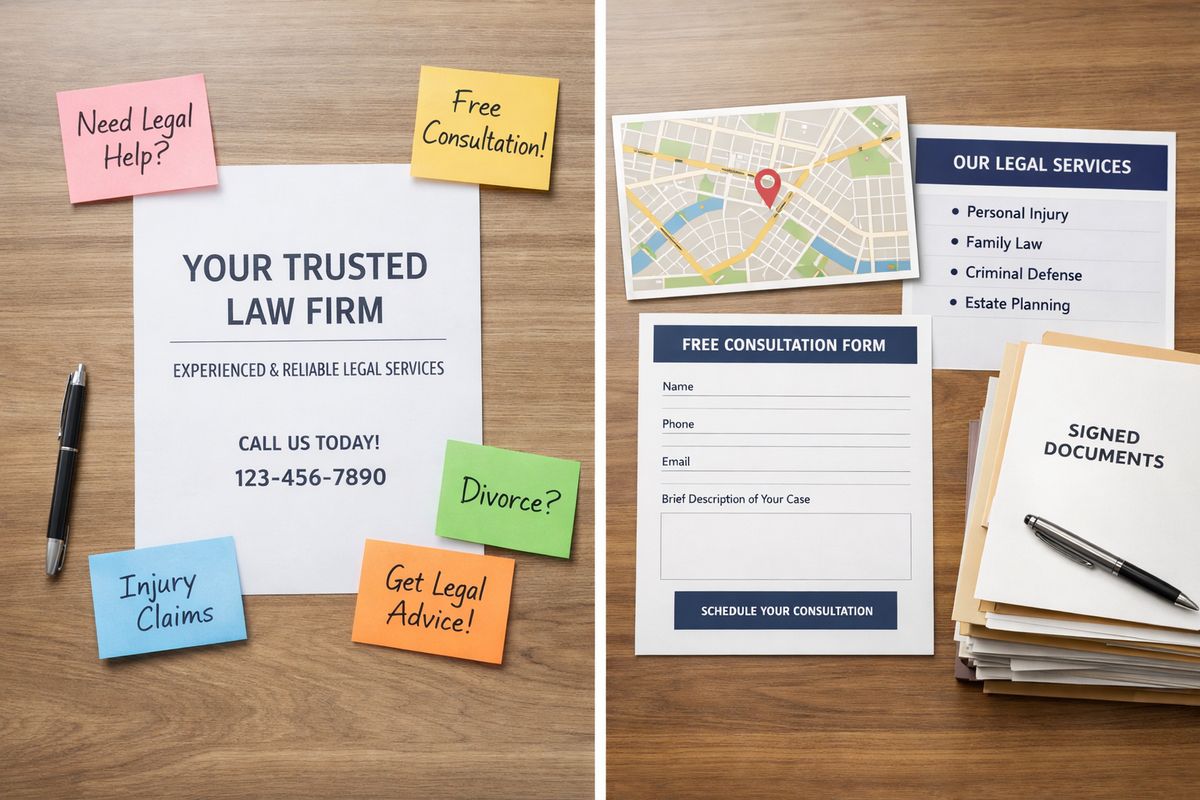
The most common mistake is defining your ICP too broadly. The second is confusing prestige with profitability. The third is ignoring warning signs from bad-fit leads. The fourth is building the profile from opinion instead of signed-matter data. The fifth is treating the profile as permanent.
That is why vague target descriptions fail. “Anyone needing legal help” is not a strategy. “Small to midsize businesses” is still too wide if your best matters come from one industry, one company stage, or one type of legal trigger. Remove one vague phrase from your current target description this week.
Building the ICP Around Aspirations Instead of Actual Wins
Many firms describe the clients they want before proving they can attract, convert, and serve those clients profitably. That sounds ambitious, but it produces weak marketing because the agency has no evidence to work from.
Build the first version of your ICP around actual wins. Once you dominate that segment, expand. Base your first ICP on existing successful engagements, not on a future market position.
Treating Every Practice Area the Same
Different practice areas need different ICPs because the triggers, economics, and intake patterns are different. Personal injury is not family law. Estate planning is not commercial litigation. Employment counsel is not M&A.
If your practice areas use different intake questions, pricing logic, or service models, they need separate profiles. Split your target client definition by practice area if your intake paths or economics differ.
How Often to Update Your Ideal Client Profile
A 2024 ABA legal industry trends coverage reflected how client expectations, competition, and demand patterns keep shifting. Your ICP is not a one-time workshop output. It is a working document.
Update it when your firm changes direction, when profitability shifts, when new locations open, when intake improves, or when campaign data starts showing a different quality pattern. Quarterly is a strong default because it is frequent enough to catch drift without turning the process into noise.
The key is simple: if your market changes and your ICP does not, performance decays. Schedule a quarterly ICP review with your agency and intake lead.
The Metrics That Tell You Your ICP Needs Revision
Watch the numbers that reflect fit, not just activity. Signed-case rate, qualified-lead rate, cost per qualified lead, matter value, realization, time to hire, and review quality all tell you whether your current target still matches reality.
If qualified leads are rising but signed matters are falling, your targeting is off. If matter values are dropping, your economic filters need tightening. If review quality slips, your fit assumptions need a second look. Pick one ICP health metric and start reviewing it monthly.
A Simple Ideal Client Profile Template Your Agency Can Use
A 2023 HubSpot CRM adoption study found that teams perform better when shared customer definitions are documented and visible. That matters because an ICP stuck in someone’s head does not improve execution.
Your one-page law firm ICP should include: practice area, client type, geography, matter type, urgency, fee fit, common trigger, decision-maker, qualification criteria, exclusion criteria, and preferred channels. That is enough. Anything larger usually gets ignored.
The move that works is consistency. Your agency, intake team, and attorneys should all use the same version. Create a one-page ICP document and require your agency and intake team to use the same version.
What to Do This Week to Give Your Agency a Usable ICP
A 2024 Asana work innovation study found that focused execution beats scattered improvement efforts. That applies here. Your agency does not need a perfect theory of your market. Your agency needs a clear picture of the clients worth attracting.
So keep it simple. Send your agency a list of your 10 best recent clients or matters, with notes on profitability, fit, and why each was worth winning. That single step gives strategy, messaging, targeting, and intake a much stronger foundation.
If your firm wants sharper targeting, better leads, and a marketing plan built around the right matters, schedule a call with Attorney Visibility ai for more information.
Frequently Asked Questions
What is an ideal client profile for a law firm?
An ideal client profile is a documented description of the types of clients or matters your firm wants more of because they fit your practice, sign reliably, and produce strong margins. It helps your agency target the right searches, write better messaging, and reduce wasted spend.
How is an ideal client profile different from a target audience?
A target audience is broad. An ideal client profile is selective. “Business owners in Texas” is a target audience. “Founder-led manufacturing companies in Dallas with 25 to 200 employees facing recurring employment compliance issues” is an ICP.
Should your firm have more than one ideal client profile?
Yes, if your practice areas operate differently. A consumer-facing PI matter and a recurring B2B employment advisory engagement need different targeting, messaging, and intake rules. Separate ICPs make marketing more accurate.
What data should you use to build an ideal client profile?
Start with signed matters, profitability, realization, matter duration, referral value, review quality, and intake notes. Then validate those patterns with campaign data by channel, keyword, page, and geography.
How often should you update your ideal client profile?
Review it quarterly and revise it whenever firm priorities, market conditions, intake performance, or campaign quality shift. If signed-case rate or matter value drops, update it sooner.
Can an agency build your ideal client profile without your input?
No. Your agency can structure the process and validate patterns, but only you know which matters are profitable, efficient, and worth repeating. The strongest ICPs come from your internal data combined with campaign performance.