If you’ve started using ChatGPT in your firm’s marketing, it can feel oddly efficient right up until you need to know whether anything it said is actually true. That is the real issue in ChatGPT vs Google search for law firms: one tool gives you polished answers fast, and the other helps you see what is real, current, and worth trusting. For most firms, Google Search is the better foundation, while ChatGPT is the better assistant.
Quick overview of ChatGPT and Google Search
ChatGPT and Google Search can look similar from a distance because both start with a question box. But the jobs are different.
ChatGPT generates an answer in a conversation. Google Search helps you find pages, sources, listings, court sites, agency pages, competitor content, and local results across the web. If you treat those as interchangeable, your marketing gets shaky fast.
For a law firm, that difference matters in everyday work. A practice area page about personal injury, a DUI FAQ, or an attorney bio needs more than smooth wording. You need facts you can verify, language that fits search intent, and proof that your content matches what people in your market are actually seeing online.
So here’s the direct answer: if your goal is reliable legal marketing, Google Search wins. If your goal is speed in drafting and idea development after you already have solid source material, ChatGPT earns a place.
How each tool actually works
ChatGPT is powered by a large language model, which is just a system trained to predict the next likely word based on patterns in massive amounts of text. That sounds abstract, but the practical point is simple: it is built to produce plausible language.
Google Search works differently. It indexes pages on the web, then ranks and displays results based on relevance, authority, location, freshness, and many other signals. Instead of generating a single answer from patterns, it points you toward existing sources.
That difference changes how you should use each one. If you ask ChatGPT to explain comparative negligence in Arizona, you may get a clean, readable summary in seconds. If you use Google Search, you can find state-specific pages, current law firm competitors, court resources, and recent material that helps you check whether your explanation holds up.
For legal marketing, that means ChatGPT is often a useful language tool, not a source tool. Google Search is still where you go to inspect the landscape, verify claims, and understand what your market is showing people right now.
Speed and convenience
ChatGPT often feels faster because it removes the scavenger hunt. Instead of opening six tabs and piecing together an answer, you get one neat response. For brainstorming blog topics, outlining a page, or turning messy notes into cleaner copy, that convenience is real.
The catch is that speed can be fake if you have to spend the next 20 minutes checking every sentence. A quick draft is only a shortcut if the material underneath it is sound.
Google Search is still faster when you need something concrete. If you want to see local competitors ranking for “car accident lawyer Phoenix,” check map results, compare title tags, or find a state agency page, search gets you there directly. No prompt tuning. No coaxing. Just results.
Busy legal teams usually notice this pretty quickly. ChatGPT is fast at turning information into usable language. Google Search is fast at finding the information in the first place.
Accuracy and trustworthiness
This is where the lawyer’s reality check really lands.
ChatGPT can sound certain while being wrong. It may blend outdated information, oversimplify a legal issue, or fill gaps with wording that feels convincing but has no support behind it. In legal marketing, that is not a small problem. A bad sentence on a criminal defense page or immigration FAQ can damage trust before a prospect ever calls.
Google Search is not automatically accurate either. Search results can include weak blog posts, thin directory pages, and outdated articles. But Google gives you a path to verify. You can trace a claim back to a court, agency, bar association, statute summary, or a credible publication. That ability to inspect the source is the real advantage.
You see the difference in practice when writing anything that touches legal standards, deadlines, penalties, or jurisdiction-specific rules. ChatGPT may give you a polished explanation. Google Search helps you confirm whether it belongs on your site.
If your firm is serious about AI search, it helps to understand how AI systems pull from source material in legal topics, because that explains why confident wording and reliable sourcing are not the same thing.
Source transparency and citation checking
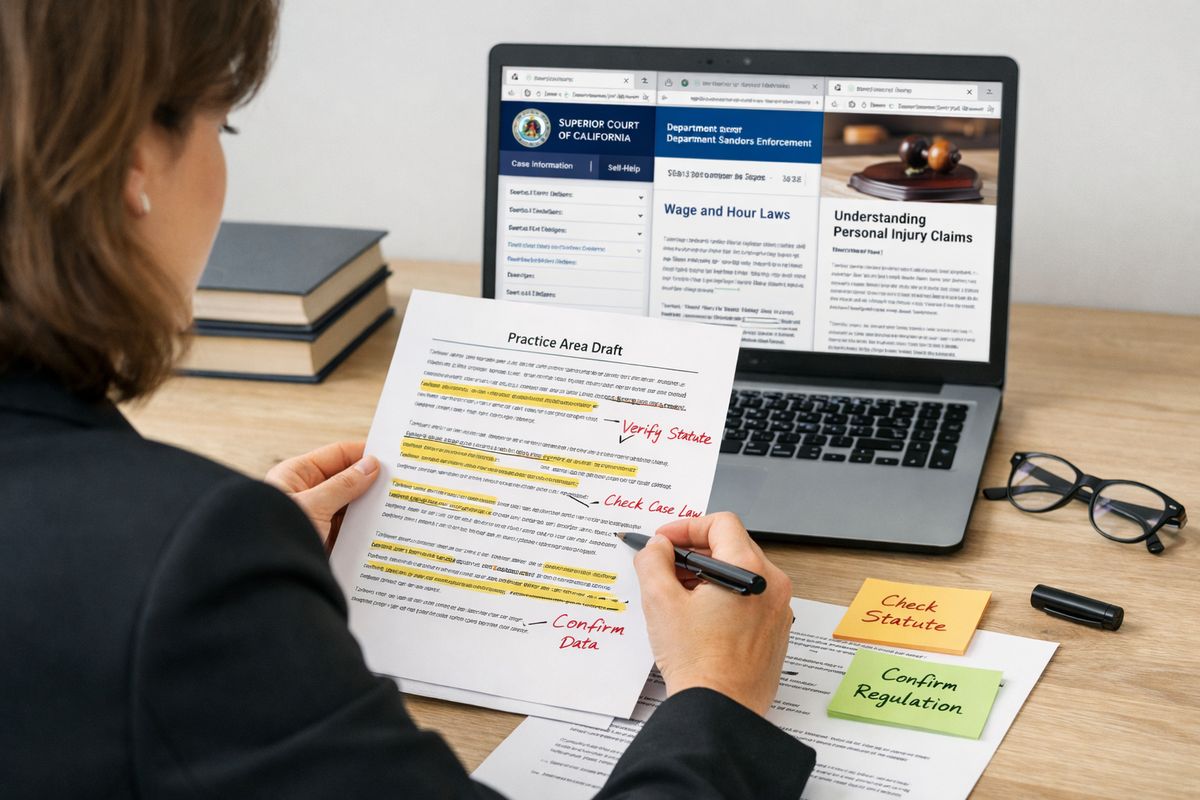
For law firms, source transparency is not optional. If a practice area page says a certain filing deadline applies, or an FAQ explains what happens after an arrest, you need to know where that claim came from.
Google Search makes this easier because the source is the point. You click through to the page, inspect the publisher, compare multiple sources, and decide whether the information is solid. You can see the court page. You can see the state bar guidance. You can see whether the article was updated last month or five years ago.
ChatGPT often hides that path. Even when it provides citations or references in some versions, you still need to check them carefully. The clean answer box creates a false sense of closure. It feels finished before the work of verification has actually started.
For legal marketing, that matters most on high-trust pages: attorney bios, FAQs, service pages, and lead magnets. If a claim cannot be traced and checked, it should not be published. That rule alone will save your team a lot of cleanup.
Freshness of information
Legal marketing is full of topics that age badly. Laws change. Court procedures shift. Local search results move around. A page that worked last year can drift out of date faster than most firms expect.
Google Search has the edge here because it reflects the live web. If a state-level rule changes, current pages begin to appear in results. If local competitors publish new content, update titles, or gain visibility in map results, you can see that movement.
ChatGPT is weaker when freshness really matters. Even with web-connected features, the output can still smooth over missing details or present stale information too confidently. If your firm in Phoenix updates a DUI page after a change in state law, polished guesswork is the last thing you need.
That is why firms trying to improve visibility in both traditional and AI search should pay attention to what affects local presence in AI-driven discovery. Local accuracy starts with current, grounded information.
Research depth for legal topics
https://www.youtube.com/watch?v=f9YgsdA4BgI
ChatGPT is good at helping you think. Google Search is better at helping you prove.
If you are exploring a topic for a consumer-facing blog, ChatGPT can help surface subtopics, simplify jargon, and turn dense ideas into plain English. That is useful. It can also help you spot common questions a potential client may ask before calling.
But when the topic gets more specific, Google Search pulls ahead. Statutes, case summaries, jurisdiction-specific details, bar guidance, local court pages, and competitor positioning all live in the search environment. That is where you can compare explanations, see what is missing, and confirm what deserves emphasis.
This becomes especially useful when building content clusters. A broad query in ChatGPT might suggest ten article ideas. A search results page shows which ones actually have intent behind them, which ones trigger local results, and which ones are crowded with strong firms. That is a much better basis for deciding what to write next.
Content creation for law firm marketing
For drafting, ChatGPT is often the more productive tool. It can turn rough notes into a blog outline, rewrite stiff intake copy into plain language, expand an FAQ section, or help organize a downloadable guide. If your team has ever stared at a blank page at 4:45 p.m., that help feels very real.
But content creation for law firms does not start with typing. It starts with knowing what the page needs to do.
Google Search helps you ground the piece in reality. You can study competing pages, inspect headings, notice whether search results lean educational or transactional, and spot missing angles. ChatGPT can then help turn those observations into a draft much faster.
That is usually the best sequence. Search for the signals. Draft with ChatGPT. Verify again before publishing.
This is also where building pages that help AI systems understand your firm becomes more practical. Better source material leads to better drafts, and better drafts are easier to refine into something worth ranking.
SEO and search intent insights
If your goal is rankings, Google Search is non-negotiable.
Search intent just means what a person is really trying to get when typing a query. Google shows that intent in plain view. You can see featured snippets, map packs, People Also Ask boxes, directory listings, and competing law firm pages. That live results page is one of the best research tools your firm has.
ChatGPT can help after that. Once you understand what the results are doing, ChatGPT is excellent at turning those observations into angles, briefs, title ideas, and content structures. It can also help compare page approaches quickly, though you still need to judge the quality yourself.
For firms sorting out where to put effort, it helps to look at how traditional rankings and AI visibility overlap. In practice, strong SEO work still feeds almost everything else.
Local search and visibility for law firms
When a potential client wants help nearby, Google Search is miles ahead.
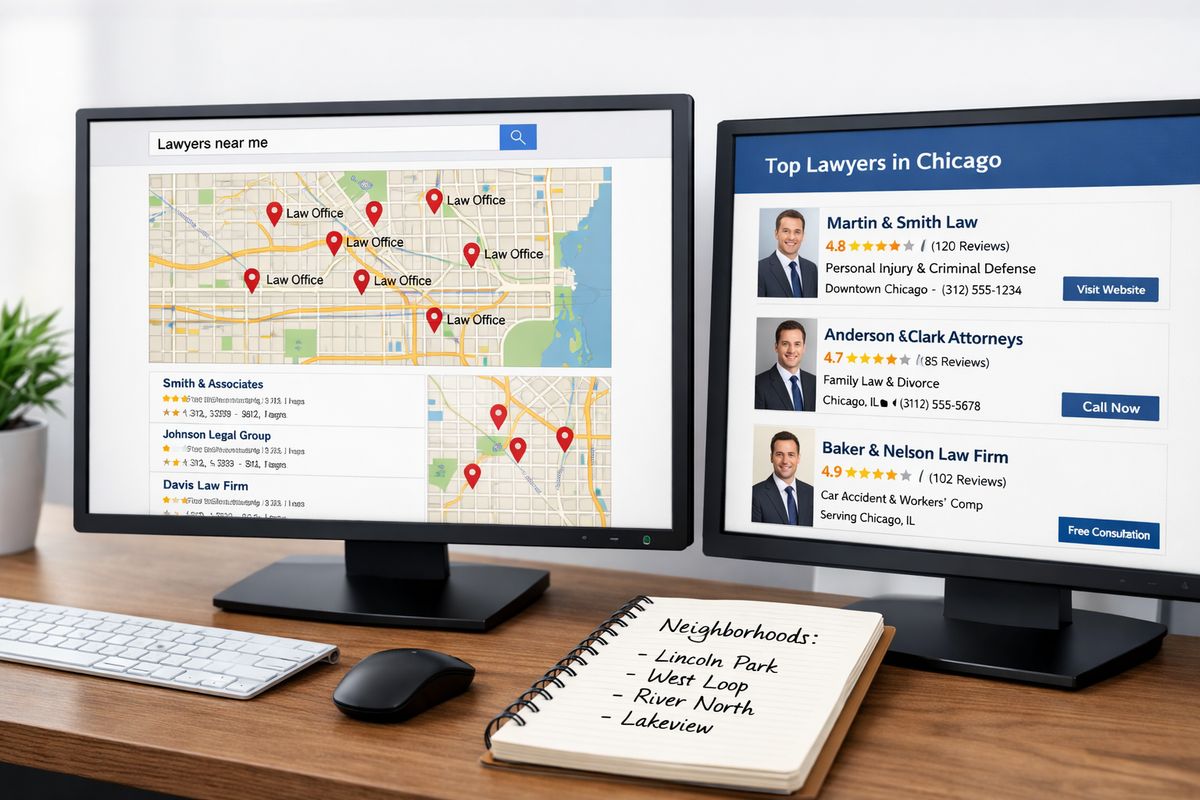
Local intent shows up in map packs, review profiles, business listings, nearby office pages, and practice-area-plus-city searches. If you want to know how your firm appears for “divorce lawyer near me” or “truck accident attorney Tampa,” Google gives you the actual environment your next lead is seeing.
ChatGPT is much less useful for that live local picture. It may help you brainstorm location page topics or rewrite local copy, but it does not replace seeing real map results, review counts, office competitors, and local SERP features.
That matters because local search is often where law firm marketing becomes revenue, not just traffic. Ranking in a broad national conversation feels nice. Showing up when somebody nearby needs help today matters more.
Ease of use for busy legal teams
Google Search wins on familiarity. Everybody in your office already knows how to use it, from attorneys to office managers to marketing staff. That lowers friction, which matters more than most firms admit.
ChatGPT is easy to start using but harder to use well. Basic prompts get basic output. Better results usually depend on clearer instructions, stronger context, and repeated refinement. That learning curve is not huge, but it is real.
The good news is that once your team gets comfortable with prompting, ChatGPT becomes more useful in everyday workflows. It can clean up bios, reshape blog intros, rephrase FAQs, and turn long-winded notes into tighter messaging. Firms focused on showing up more clearly in AI-driven answers usually learn that the tool works best as an assistant, not a replacement for judgment.
Privacy, confidentiality, and risk
Not every question belongs in a chatbot. Honestly, that should be the starting rule.
If your prompt includes sensitive client facts, internal strategy, privileged information, case details, or anything confidential, stop. Neither convenience nor curiosity is worth the risk. Even in tools with stronger privacy settings, the safer habit is simple: do not paste private information into systems built for general use.
Google Search is not a safe place for confidential information either, of course, but the usage pattern is different. You are usually retrieving public information, not feeding private material into a prompt.
For legal teams, the best practice is boring but smart. Use both tools for research and drafting structure. Keep confidential details out of both. Strip prompts down to generic fact patterns when you need writing help. That one habit prevents a lot of unnecessary risk.
Pricing and access
Google Search is free to use, at least on the surface. ChatGPT has free access too, with paid plans for more capable models and features.
But the visible subscription cost is not the whole story. The hidden cost is staff time.
If ChatGPT gives your team a draft that looks good but contains unsupported claims, somebody still has to check every line. If Google Search sends your team through too many weak results, somebody has to filter the noise. In both cases, “free” can become expensive if the workflow is sloppy.
That said, for many firms, a paid ChatGPT plan is worth it if your team uses it for outlining, editing, repurposing, and ideation regularly. The savings show up when the tool shortens the blank-page phase without adding verification headaches.
When ChatGPT is the better choice
https://www.youtube.com/watch?v=k0uFKtij3Lk
ChatGPT wins when the source material is already there and the problem is speed, clarity, or organization.
It is especially useful for brainstorming blog angles, generating FAQ ideas, simplifying dense legal language, rewriting rough notes into cleaner website copy, and producing first-pass outlines for service pages or lead magnets. It also helps when your team knows the subject well but needs a faster way to package it for a prospect.
Think of it like a sharp paralegal-style drafting assistant for marketing language, not a research authority. If you feed it solid inputs, you can get usable output quickly. If you feed it assumptions, you get polished assumptions back.
When Google Search is the better choice
Google Search is the obvious choice when facts matter, and in legal marketing, facts matter a lot.
Use it to verify claims, inspect competitors, understand search intent, review local results, find statutes and agency pages, and confirm whether a topic deserves its own page. Use it when you need to know what is actually ranking, what people in your city actually see, and what support exists for a claim before it goes live on your site.
This is also where your firm should keep an eye on whether your pages are getting noticed in AI-driven results at all. If the foundation is weak in search, the AI side usually is too.
Best results: using ChatGPT and Google Search together
The strongest workflow is not choosing one forever. It is using each tool for the job it actually does well.
Start in Google Search. Review the live results for your topic. Check the map pack if local intent is involved. Open competing firm pages. Look at the questions, angles, and sources that keep appearing. Notice what is missing.
Then move to ChatGPT. Use those findings to build an outline, tighten the structure, generate FAQs, or rewrite weak sections in cleaner language. After that, go back to Google Search and verify every factual claim, date, rule, and supporting point before publishing.
That process is not flashy. But it works.
Verdict: which one wins for law firms?
Google Search wins for law firms. That is the clear answer.
It is the more reliable foundation for legal marketing, fact-checking, local visibility research, and search intent analysis. It shows you the real web, the real competition, and the real sources behind your claims.
ChatGPT still matters, just in a different role. It is the better assistant for speed, drafting, simplification, and idea development once your source material is solid. If you ask it to replace search, you invite mistakes. If you use it after search, you usually get the best of both tools.
The one move to try next
Pick one practice area topic this week and run a simple test. Search the topic in Google first, study the live results, open a few strong pages, and note what the search page is telling you. Then drop those findings into ChatGPT and ask for a cleaner outline or first-pass draft.
You will see the difference fast. One tool shows you the terrain. The other helps you move across it.
If your firm wants a clearer plan for AI search, local visibility, and content that holds up under scrutiny, schedule a call with Attorney Visibility ai for more information.
Frequently Asked Questions
Can ChatGPT replace Google Search for law firm marketing?
No. ChatGPT can speed up drafting and brainstorming, but it should not replace Google Search for fact-checking, local research, competitor review, or search intent analysis.
Is ChatGPT accurate enough to write legal website content on its own?
Not on its own. It can produce clean copy quickly, but legal website content still needs source checking, current information, and human review before publication.
Why is Google Search better for local law firm SEO?
Google Search shows live local signals such as map packs, reviews, nearby competitors, and city-based queries. That makes it much better for understanding how your firm appears in the market where clients are actually searching.
When should your staff use ChatGPT instead of Google Search?
Use ChatGPT when your team needs help organizing ideas, rewriting rough drafts, simplifying legal language, or generating FAQs from material you already trust. Use Google Search first when the question depends on facts, sources, or live results.
Does using ChatGPT help your law firm show up in AI results?
Using the tool itself does not automatically improve visibility. What matters more is your site content, structure, credibility signals, and whether your firm publishes information that AI systems can understand and cite.
Is a paid ChatGPT plan worth it for a law firm marketing team?
Often, yes, if your team uses it regularly for outlines, rewrites, and content support. The value comes from time saved, but only if your workflow still includes verification through search and trusted sources.