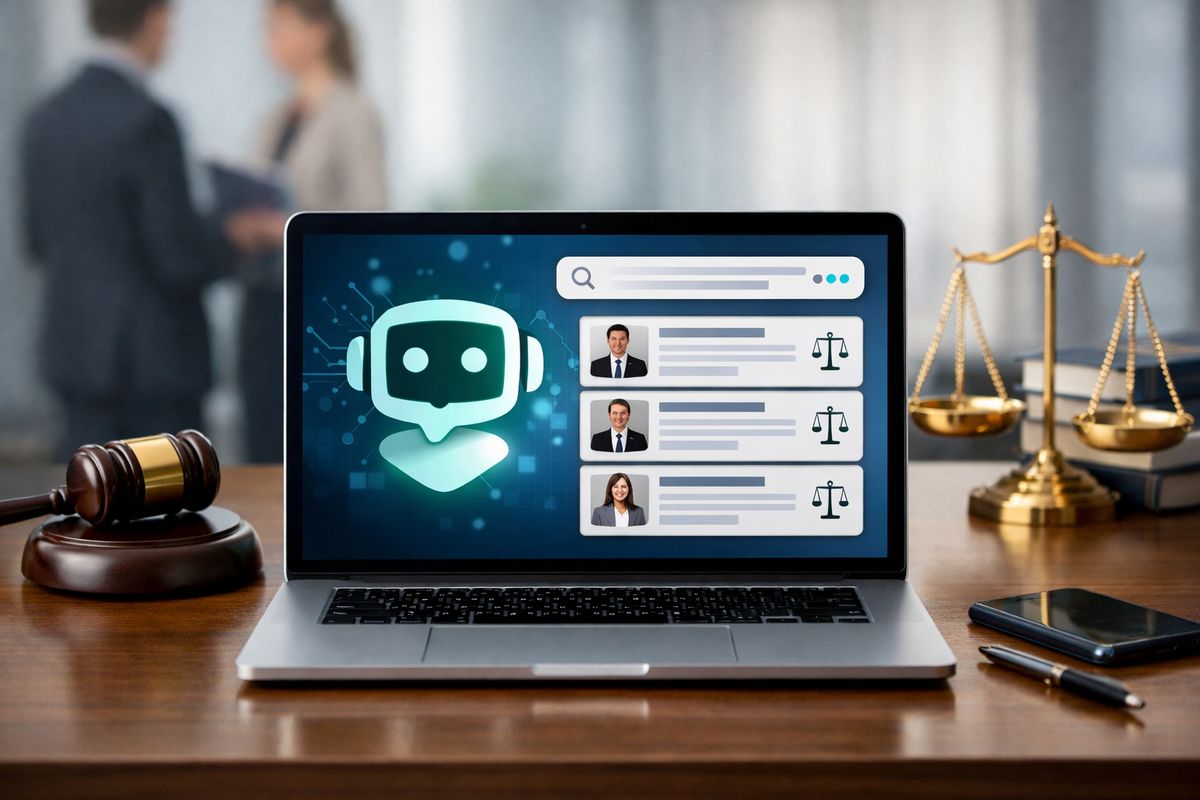
AI search is already reshaping law firm marketing. OpenAI reported in 2025 that ChatGPT reached 400 million weekly active users, which means a growing share of legal research now starts inside answer engines instead of a page of blue links. If you want your firm to show up in AI search results, you need more than rankings. You need clear authority, consistent signals, and content that answer engines can trust enough to cite.
AI search is changing how clients find law firms
Microsoft’s 2024 Work Trend reporting on AI adoption made one thing obvious: people are comfortable asking AI for help with serious decisions. Legal hiring sits squarely inside that behavior shift. Prospects now ask ChatGPT, Bing Copilot, Google AI Overviews, and Perplexity questions like “What should I do after a rear-end crash in Houston?” and “Who are the best employment lawyers near me?”
That changes the mechanics of discovery. Traditional search rewarded pages that ranked. AI search rewards sources that can be retrieved, understood, and summarized into a direct answer. Your firm does not need to “rank number one” inside ChatGPT, because there is no classic ranking position to win. Your job is to become one of the sources these systems repeatedly mention, cite, or rely on when forming an answer.
What this means in practice: stop treating AI search like a side project. Treat it as the next layer of visibility in your law firm marketing strategy.
How AI search for lawyers actually works
A 2024 Google announcement on AI Overviews explained the direction clearly: search engines are moving from link lists toward generated answers built from multiple sources. ChatGPT, Bing Copilot, Google AI Overviews, and Perplexity all follow the same broad pattern. A user enters a prompt, the system retrieves information from its index or connected search layer, evaluates source credibility, then generates a summarized response.
Showing up here means three things: your firm gets mentioned, your pages get cited, or your facts get reused in a recommendation. That is the simplest version of AI search for lawyers.
If you need a broader primer before going deeper, start with a plain-English breakdown of how AI-driven discovery works for law firms.
AI visibility is not the same as Google rankings
A 2024 analysis from Semrush found that AI-generated search experiences often cite pages outside the top traditional rankings. That matters because firms still assume Google position equals AI inclusion. It does not.
Answer engines look for corroboration, clarity, and entity confidence. If your attorney bios are complete, your practice areas are unambiguous, your directory profiles are verified, and your reviews are current, your firm can appear in AI answers even when you do not dominate a competitive organic term. That is why the smart comparison is not “SEO or AI.” It is understanding where traditional rankings and answer-engine visibility diverge.
The action here is simple: audit one practice area and one city, then compare top Google results with firms cited in AI answers. The gaps reveal what AI values beyond rank.
Informational prompts vs. hiring-intent prompts
A 2024 Bain & Company consumer behavior update found that users increasingly rely on AI for both research and recommendation tasks. Legal prompts split into two categories.
Informational prompts ask for guidance: “How long do you have to file a personal injury claim in Arizona?” Hiring-intent prompts ask for a provider: “Best wrongful death attorney in Phoenix.” The first type rewards clear educational content. The second leans harder on reviews, directories, location authority, and reputation signals.
What this means in practice: build content assets for both. Informational pages educate prospects early. Hiring-intent assets prove your firm deserves the shortlist.
Why law firms are especially exposed to AI search shifts
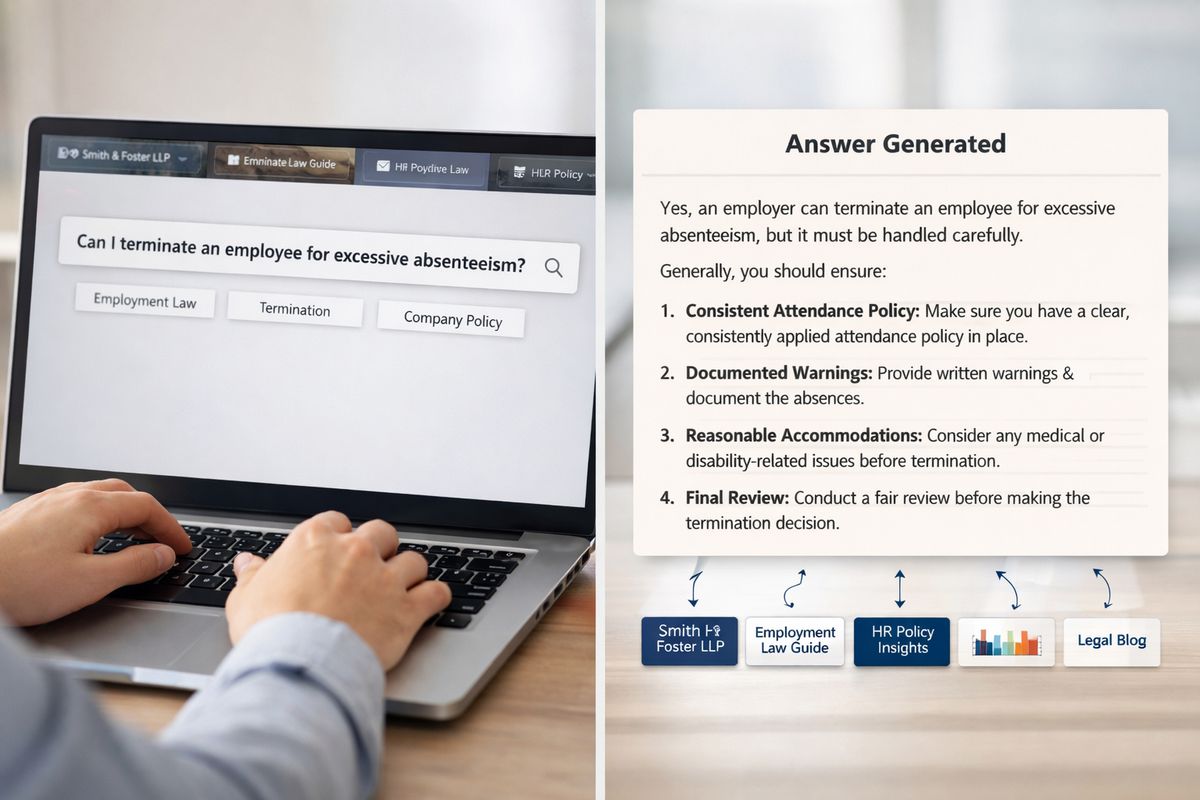
A 2024 Thomson Reuters report on professional services technology adoption showed that high-stakes information categories are rapidly moving into AI-assisted research behavior. Legal matters carry financial, personal, and medical consequences, so answer engines apply stronger trust filters before surfacing a source.
That raises the bar for law firms. A vague website, thin attorney profiles, and inconsistent third-party data do more than hurt SEO. They remove your firm from AI consideration at the moment a prospect is narrowing options. Invisibility here directly affects consultations and signed cases.
The move that works is building enough public proof that an answer engine sees your firm as a safe recommendation.
Legal topics trigger stronger trust and authority filters
Google’s long-standing guidance on quality for high-impact topics, often discussed as YMYL, sets the tone for legal visibility. Law is not casual content. AI systems look for evidence that your firm is real, qualified, current, and specific.
Your website needs clear attorney names, jurisdictions, bar admissions, office locations, practice limitations, and case-type specificity. Your bios need facts, not adjectives. Your public profiles need matching information. For a deeper look at why this matters, review how stronger attorney profile detail influences AI understanding.
The practical step is to rewrite your top attorney bio this week so every claim is factual, verifiable, and tied to a credential or experience marker.
AI is becoming a new referral layer
A 2024 PwC survey on generative AI behavior found that users increasingly trust AI to narrow choices before taking action. That makes AI a new referral layer. Not a replacement for human referrals, but a digital filter that shapes who gets considered.
Instead of visiting ten law firm websites, a prospect now asks one tool for a shortlist. The answer engine compresses comparison shopping into one interaction. If your firm is absent, you never enter the conversation.
What this means in practice: think of AI visibility as referral positioning. You are not only trying to be found. You are trying to be recommended.
The trust signals that help law firms appear in AI search results
A 2024 Ahrefs study on AI search citations found that answer engines consistently pull from sources with strong authority and corroboration. For law firms, the main signal groups are clear website information, third-party validation, review consistency, and demonstrated expertise.
Chasing hacks fails because AI systems rely on patterns across the open web. The move that works is strengthening the same trust markers across every place your firm appears.
Clear practice area and location signals on your website
Your site should state exactly what you do, where you do it, and who does the work. Practice area pages, city pages, FAQs, attorney bios, case results, and contact details all contribute. Ambiguity kills visibility.
A page titled “Legal Services” tells an AI system almost nothing. A page titled “Chicago Medical Malpractice Lawyer” with jurisdiction-specific FAQs, filing deadlines, and attorney credentials is easy to parse and summarize. That is why strong service-page architecture matters so much in AI discovery.
The action is to rewrite your highest-value practice area page with direct headings, location terms, and concrete legal scenarios clients actually ask about.
Third-party validation from legal directories and rankings
A 2024 BrightLocal trust study showed that third-party validation continues to shape provider credibility online. In legal, that means Avvo, Justia, FindLaw, Super Lawyers, Best Lawyers, Chambers, state bar profiles, and respected association listings.
These sources carry weight because they are not self-published. An award listing, verified directory profile, or bar association page confirms your identity and experience from outside your own website. AI tools lean on that kind of corroboration.
The practical move is to complete and standardize your top legal directory profiles before publishing another blog post.
Reviews, review recency, and reputation consistency
According to BrightLocal’s 2024 Local Consumer Review Survey, 83% of consumers use Google to find local business reviews. Law firms are no exception, but volume alone is not enough.
AI systems look for recency, consistency, and specificity. Ten detailed reviews from the last six months across Google and legal directories beat fifty stale, generic comments from years ago. If your reputation signals are uneven, your firm becomes harder to trust and easier to skip. This is exactly why a focused approach to public reputation signals for AI recommendations matters.
Your action is to build a review process that produces recent, specific feedback tied to real practice areas and office locations.
Demonstrated experience, outcomes, and credentials
A 2023 Stanford study on source credibility found that concrete evidence beats abstract claims in trust formation. Legal prospects and AI systems both respond to proof: verdicts, settlements, years in practice, board certifications, clerkships, publications, speaking engagements, and representative matters.
“Fierce advocate” is filler. “Board-certified in civil trial law with 18 years of plaintiff-side trucking litigation experience” is evidence. One can be reused in an answer. The other cannot.
The practical step is to replace every vague authority phrase on your site with a verifiable fact.
Build a website that AI systems can understand and cite
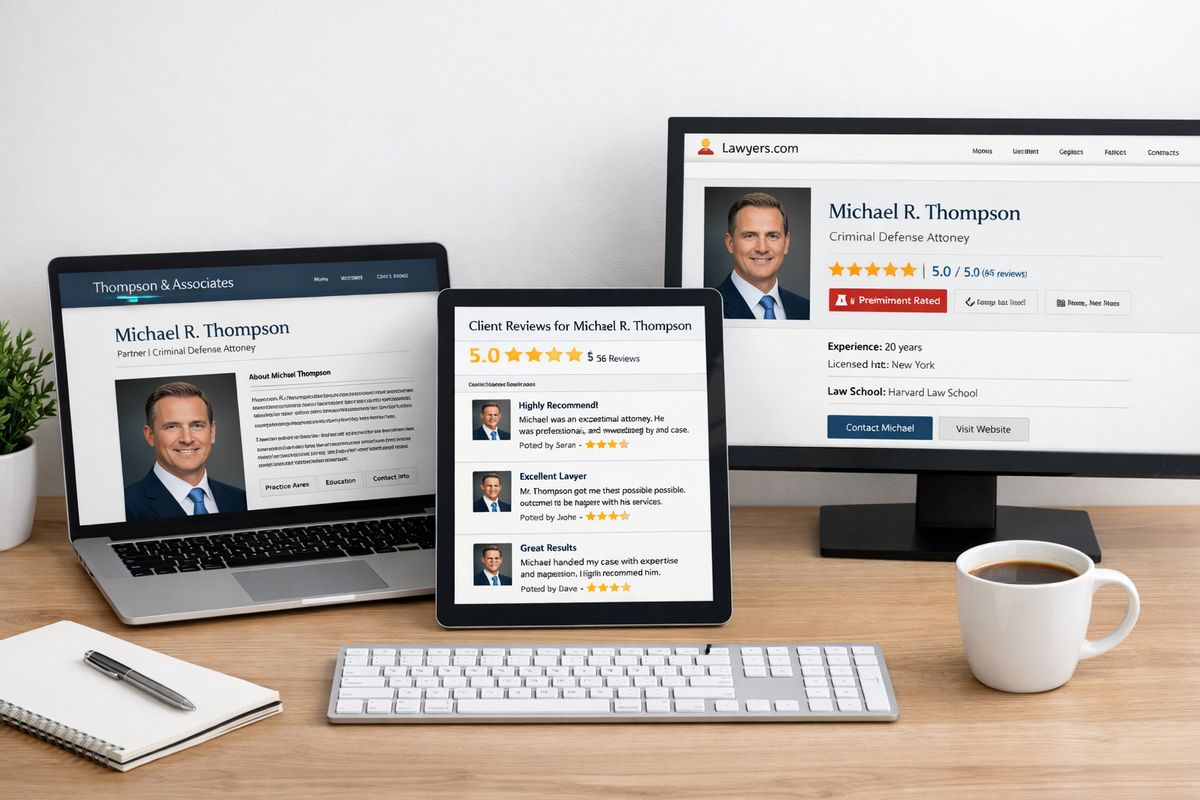
Google’s 2024 search documentation reinforced a basic truth: structured, clear, useful pages are easier for machines to extract and summarize. Strong law firm marketing now serves two audiences at once, human prospects and answer engines.
Your site does not need gimmicks. It needs clean architecture, direct language, and facts that can be cited without interpretation.
Write practice area pages in direct, citation-friendly language
A 2024 Nielsen Norman Group review of AI reading patterns found that systems perform better when content is explicit, well-labeled, and plainly written. That applies directly to legal pages.
Use question-based headings, define case types in plain English, include jurisdiction details, and answer high-intent concerns like fees, deadlines, evidence, and process. If you want more depth on the format, study what content structures tend to get reused inside AI answers.
The action is to add a concise FAQ block to your top practice page using the exact wording prospects use during intake.
Strengthen attorney bios with proof, not filler
A 2024 Edelman Trust Barometer update confirmed that expertise is more believable when attached to named credentials and visible track records. Attorney bios should surface bar admissions, courts, case focus, publications, speeches, languages, and representative outcomes.
Strip out “dedicated to fighting for clients” language unless it is backed by specifics. AI systems cannot do much with empty positioning copy. They can do a lot with “former assistant district attorney,” “admitted in the Northern District of Texas,” or “speaker on wage-and-hour litigation.”
Your practical move is to turn each attorney bio into a fact sheet written in full sentences.
Use structured data and entity consistency
Schema helps machines understand businesses, people, services, and locations. Consistent names, addresses, phone numbers, and practice labels reduce confusion. That sounds technical, but the mechanism is simple: matching data across your site and public profiles gives answer engines confidence that all those mentions refer to the same firm.
The action is to align your firm name, attorney names, office information, and practice terminology everywhere they appear online.
Expand your presence beyond your own website
A 2024 Seer Interactive analysis of AI citation behavior showed that answer engines pull from a web of corroborating sources, not just brand-owned websites. If your firm exists only on your own domain, your trust footprint is thin.
Winning firms create a broad, consistent presence across directories, local publications, associations, and credible third-party mentions.
Claim and complete every major legal profile
Incomplete profiles create weak signals. Missing attorney headshots, outdated phone numbers, wrong office hours, and inconsistent practice categories all reduce confidence. Your Google Business Profile, Bing Places, Avvo, Justia, FindLaw, state bar pages, and major local citations should all match.
One strong starting point is tightening the local foundation described in this breakdown of local visibility signals that influence AI results.
The action is to choose your top five public profiles and make every field complete, current, and identical where it should match.
Earn mentions on trusted local and industry sources
A 2024 Cision media credibility survey found that earned media still carries disproportionate trust versus self-published brand claims. Local business journals, bar association spotlights, university pages, podcast appearances, sponsorship pages, and legal trade coverage all help.
These mentions become supporting evidence. An AI system deciding whether to mention your firm sees not just your own claims, but a network of outside references.
The practical step is to secure one credible local or industry mention tied to a specific attorney or practice area this month.
Use Reddit, forums, and Q&A sites carefully
Reddit increasingly appears in search and AI citation patterns because public discussion can reveal real user concerns. But legal marketing on forums can go wrong fast. Spam, solicitation, and sloppy advice damage trust.
Use community sites to understand language patterns and common questions, not to push promotional answers. The safest move is listening first, then building better website content around the concerns you see.
Publish the content AI engines reuse in answers
A 2024 HubSpot content trends report found that high-quality educational content remains one of the strongest visibility drivers across search formats. For ChatGPT for law firms, this is where content strategy directly affects citations.
Answer engines prefer concise, accurate explanations they can summarize cleanly. If your firm publishes them first and publishes them well, your wording starts shaping the answer.
Create high-intent FAQ content around legal scenarios
Scenario-based FAQs attract better leads because they match real hiring behavior. Questions about fault, deadlines, fees, evidence, timelines, and next steps reflect immediate legal intent.
Better answers reduce friction before the consult. Shared intent reduces follow-up. Prospects arrive better informed, and answer engines have usable blocks of content to quote.
The practical step is to publish one FAQ page for your highest-value case type in your highest-value city.
Publish jurisdiction-specific explainers
Legal content without jurisdiction is weak. State deadlines, local courts, filing rules, liability standards, and venue realities vary. A generic national article gives AI less reason to trust your relevance for a local legal prompt.
Jurisdiction-specific explainers show that your firm understands the rules where you actually practice. That is the move that works for local authority.
Turn attorney expertise into quotable content
Bylined articles, legal commentary, checklists, media quotes, and concise guides create reusable source material. The best format is tight, direct, and factual. Short paragraphs. Clear claims. Specific examples.
If your firm wants stronger answer-engine visibility, invest in what actually earns citations and mentions across AI tools.
The action is to turn one attorney’s repeated intake explanation into a polished article with clear subheads and jurisdiction detail.
Optimize for local AI search and recommendation prompts
A 2024 BrightLocal local search behavior update confirmed that proximity alone does not drive discovery. Relevance and prominence still matter. AI recommendation prompts work the same way.
When someone asks for the best employment lawyer near them, answer engines look for firms with corroborated local authority, strong reviews, aligned categories, and real geographic ties.
Strengthen your Google Business Profile and Bing Places presence
Google Business Profile remains central for local visibility, and Bing Places matters more than many firms realize because Microsoft powers key AI experiences. Categories, service descriptions, office hours, Q&A, photos, and review responses all strengthen local trust.
The action is to fully optimize both profiles for one office location and one core practice category before expanding further.
Build location authority with proof of community relevance
Thin city pages no longer work. Real local authority comes from courthouse-area knowledge, office-specific bios, community involvement, local press, and area-specific service pages.
A firm with a visible footprint in Phoenix should be able to prove it through names, places, events, and public references. That proof is what answer engines can trust.
Avoid the mistakes that keep law firms out of AI results
A 2024 Content Marketing Institute benchmark showed that generic content underperforms because it fails to differentiate. In legal AI visibility, the same pattern keeps showing up: vague copy, stale profiles, conflicting data, and overreliance on rankings.
This section saves wasted budget because most firms do not have a visibility problem. They have a clarity problem.
Generic website copy that says nothing specific
“Aggressive representation” tells nobody anything. It does not name a case type, venue, injury pattern, or result. AI systems cannot cite empty language because it carries no information.
Specificity wins. Name the matter types you handle, where you handle them, what process clients should expect, and what credentials support your role.
Inconsistent firm data across the web
Conflicting names, wrong phone numbers, outdated attorney rosters, and mismatched practice descriptions create identity confusion. Answer engines avoid uncertain sources.
The action is to run a consistency audit across your site, directories, and local profiles, then fix the single worst mismatch first.
Thin content and stale profiles
Old awards from 2018, retired attorneys still listed on bios pages, empty FAQ sections, and dormant profiles all signal neglect. Freshness does not mean publishing daily. It means your public-facing facts are current.
The practical move is to update your top ten public pages and profiles before creating anything new.
Measure whether your firm is gaining visibility in AI search
A 2024 Gartner report on search disruption highlighted a major measurement issue: answer engines do not provide the neat ranking dashboards firms are used to. That does not mean visibility is unmeasurable.
You need a different scorecard, one built around prompts, citations, brand mentions, referral traffic, and intake patterns.
Track prompts, citations, and brand mentions
Build a repeatable prompt set by practice area and geography. Test prompts monthly across ChatGPT, Bing Copilot, Perplexity, and Google AI Overviews. Record whether your firm appears, which sources get cited, and which competing firms show up.
For a more detailed framework, use a process like this guide to checking your presence across ChatGPT-driven results.
The action is to establish a 20-prompt baseline for one office and one service line this week.
Connect AI visibility to leads and signed cases
Visibility matters only if it turns into consultations and revenue. Add intake questions about how prospects found you. Use call tracking, CRM source fields, and branded search trend monitoring. Watch for assisted conversions, not just direct attribution.
Here’s how to use it: compare consultation quality from AI-influenced discovery against other channels over 90 days, then reallocate budget toward the signals producing signed matters.

Ethics, accuracy, and risk management in AI-facing law firm marketing
The American Bar Association continues to emphasize truthfulness, confidentiality, and proper supervision in technology-assisted legal work. That applies directly to AI-facing content.
Accuracy is not just a compliance issue. It is a visibility strategy. Firms with clean, verifiable, well-supervised content earn more trust from both bar regulators and answer engines.
Keep every public claim verifiable
Outcomes, specialties, awards, and superlatives should be supportable. If you call someone the “best,” you create risk and weaken credibility. If you state a board certification, court admission, ranking, or published result that can be independently checked, you strengthen both trust and compliance.
The action is to review every superlative on your top pages and replace any unsupported claim with a verifiable fact.
Use AI tools without publishing inaccurate legal content
AI is useful for outlines, draft structure, topic expansion, and content planning. It should never publish unsupervised legal guidance under your firm’s name. Attorney review before publication is non-negotiable.
The practical step is to create a content approval rule: no AI-assisted legal page goes live without attorney fact-checking and jurisdiction review.
Your 90-day plan to help your law firm get found on ChatGPT and other AI search tools
A 2024 McKinsey report on digital transformation success found that sequencing matters more than speed. The same applies here. Law firms that win in AI search fix the foundation first, then add proof, then publish authority content.
If you want a sharper view of what it takes to get cited and recommended by ChatGPT, this is the framework to follow.
Days 1 to 30: fix clarity and consistency
Start with your website messaging, attorney bios, practice area pages, schema basics, and directory cleanup. If your foundation is vague or inconsistent, nothing built on top of it works.
Your one action for this phase is to standardize your firm identity and top practice pages across every major public touchpoint.
Days 31 to 60: build trust signals
Focus on reviews, verified awards, legal directories, local mentions, and visible credentials. This is where corroboration takes shape.
Your one action for this phase is to strengthen third-party proof around the practice area that generates your highest case value.
Days 61 to 90: publish the pages that earn citations
Now publish scenario-based FAQs, jurisdiction pages, and attorney-led thought leadership. These are the assets answer engines actually summarize.
Your one action for this phase is to launch one tightly focused authority cluster around a single practice area and city.
What to do this week to start showing up in AI search results
Run an AI visibility audit for one practice area and one city. Prompt ChatGPT, Bing Copilot, Google AI Overviews, and Perplexity with both an informational question and a hiring-intent question. Compare the sources cited against your actual footprint, then fix the single biggest gap first.
If your firm is missing from legal directories, fix that. If your bios are thin, rewrite them. If your reviews are stale, address that before anything else. The move that works is not doing everything at once. It is removing the biggest trust deficit first.
Frequently Asked Questions
Can ChatGPT actually recommend law firms?
Yes. ChatGPT and similar tools regularly surface firms, directories, review platforms, and local sources when users ask hiring-intent questions. The recommendation is shaped by credibility signals, location relevance, and corroborated public information.
Do you need to rank first in Google to show up in AI search?
No. AI visibility is not the same as traditional rankings. Firms appear in answer-engine results because their information is clear, trusted, and supported across multiple sources.
What content helps law firms get found on ChatGPT?
The strongest content includes jurisdiction-specific practice pages, attorney bios with verifiable credentials, high-intent FAQs, and concise legal explainers written in direct language. AI systems reuse content that is specific, factual, and easy to summarize.
Do reviews affect AI search for lawyers?
Yes. Recent, detailed, and consistent reviews help answer engines trust your firm. Reviews across Google and legal directories carry more weight than an outdated volume of generic comments on one platform.
How do you measure success in AI search for law firms?
Track recurring prompts, brand mentions, citation sources, referral traffic, intake attribution, and signed-case patterns. The right metric is not a single ranking. It is whether your visibility turns into qualified consultations.
Is optimizing for AI search worth it for law firms now?
Yes. Prospects already use AI to research legal issues and narrow shortlists. Firms that build strong authority signals now will hold a clear advantage as answer-engine behavior becomes more common.
If you want a faster path to stronger AI visibility, schedule a call with Attorney Visibility ai for more information.