

According to Google, local results depend on relevance, distance, and prominence, and that framework decides who gets seen when someone searches for an attorney nearby. That is why local SEO for lawyers matters so much: it puts your firm in front of high-intent prospects at the exact moment they are looking for legal help in a specific place. In plain English, local SEO for lawyers is the work of improving your website, Google Business Profile, reviews, citations, and local authority so your firm appears in the map pack and local organic results for searches tied to practice area and geography.
Why local SEO moves the cases you actually want
Google’s own local ranking guidance makes the stakes clear: local search is built to connect users with nearby businesses that best match intent. For law firms, that means searches like “car accident lawyer near me” or “divorce attorney in Phoenix” are not casual browsing. Those are bottom-of-funnel searches from people ready to call, compare, and hire.
What this means in practice is simple. Local SEO does not chase random traffic. It targets searches that carry urgency, location intent, and commercial intent at the same time. A person searching for “estate planning lawyer Scottsdale” is not looking for a legal dictionary entry. That person wants a firm in a place, for a problem, now.
The move that works is treating local search as a case acquisition channel, not a branding side project. If your firm does not appear in the local pack for your core services and cities, competitors get the calls, the consults, and the signed matters. That is the cost of inaction.
This week, search your top practice area plus your top city, along with a “near me” variation, and audit whether your firm appears in the local pack.
How Google ranks law firms in local search
Google states that local rankings rely on relevance, distance, and prominence. That sounds abstract until you translate it into law firm terms. Relevance asks whether your firm clearly matches the service being searched. Distance asks how close your office is to the searcher or searched location. Prominence asks whether your firm looks established and trusted across the web.
Local pack rankings and organic rankings overlap, but they are not the same system. Your Google Business Profile has enormous influence on map visibility. Your website has enormous influence on organic visibility. In competitive legal markets, you need both. A strong profile without a strong site limits reach. A strong site without a strong profile leaves map pack visibility on the table.
What this means in practice is that you need a benchmark before making changes. Choose one revenue-driving practice area and one core city, then record your current map pack and organic position. If your firm struggles in maps, it helps to understand the exact signals behind local map visibility.
Relevance: how closely your firm matches the search
Relevance is about alignment. If your profile says “Law Firm” but your highest-margin work is personal injury, and your website barely mentions that service in connection with your city, Google gets a weak signal. Weak signals produce weak rankings.
The simplest version of this is clarity. Your primary category, secondary categories, service pages, page titles, headers, and profile fields should all reinforce what you do and where you do it. If you handle criminal defense in Tampa, that should be obvious everywhere important.
Profile completeness matters here too. A filled-out Google Business Profile with services, hours, description, photos, and accurate business details gives Google more evidence about your practice. So does a website structure that includes distinct pages for practice areas and locations instead of one generic services page.
Your action: make your core practice area and primary city unmistakable across your profile and your top landing pages.
Distance: why proximity shapes visibility
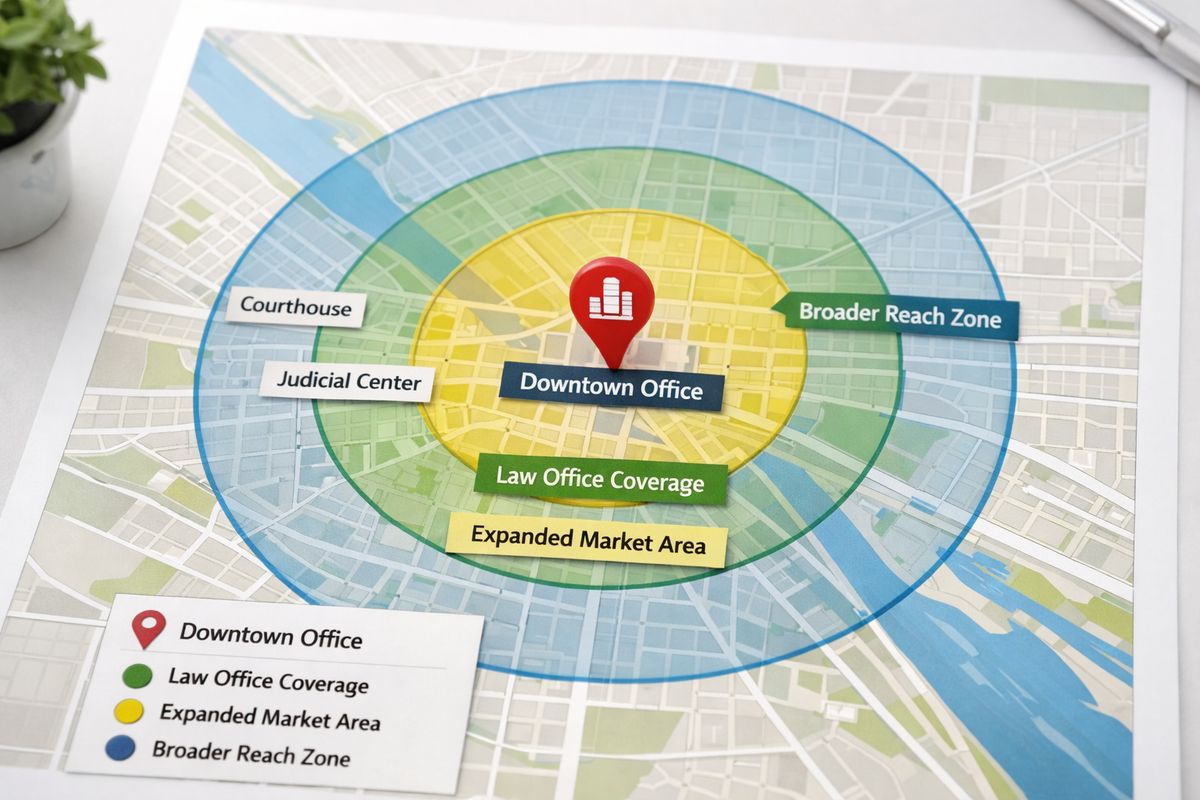
Distance is the ranking factor law firms try hardest to outsmart, and that is where bad local SEO starts. Google wants to show nearby results. If a searcher is in downtown Dallas, firms with a real office near downtown have an advantage for many searches. That is true even if another firm has a better website.
For a single-office firm, this means your office location shapes the radius where you compete most naturally. For a multi-office firm, each real office creates a new local ranking footprint. Service-area businesses do not get a free pass in legal. If you want to rank in a city, a real staffed office in that city remains the cleanest path.
What this means in practice is strategic focus. Stop trying to force rankings across an entire state from one office. Build strength in the city where your office actually sits, then expand outward with real local content and, when justified, additional offices.
Your action: pick one core city where your physical location gives you the best ranking advantage and build around that first.
Prominence: the authority signals that move you up
Prominence is the trust layer. Google looks at reviews, backlinks, citations, mentions, website authority, and your broader reputation. A law firm with dozens of credible reviews, strong local citations, relevant legal directory listings, and links from local organizations looks more established than a competitor with a bare profile and no web footprint.
This is where many firms lose momentum. Prominence is not built in one place. It comes from the combination of your website, your profile, third-party directories, and real mentions across the web. Reviews help. Local links help. Brand mentions help. Consistency helps.
That is also why local SEO cannot live inside one login. Your map rankings depend partly on what happens off Google. For a deeper look at how map visibility works, review the mechanics behind getting your firm seen in local map results.
Your action: identify the one authority gap that stands out most right now, reviews, backlinks, or citations, and fix that first.
Build your local keyword map before you touch a page
Google’s search quality guidance consistently rewards pages that satisfy clear intent, and local legal intent is usually specific, not broad. The searches that produce consultations are rarely vanity terms like “lawyer.” They are longer, sharper phrases tied to a practice area and place.
What this means in practice is that keyword mapping comes before page edits. A local keyword map assigns one clear job to each important page on your site. That prevents overlap, weak targeting, and the classic law firm mistake of making every page try to rank for every city and every service.
A useful keyword map does not need fancy software to start. List your top practice areas, pair each with your main city, then expand to suburbs, county terms, and “near me” modifiers where those searches are commercially meaningful.
Your action: create your top 10 money keywords this week by combining practice area and location.
The local keyword patterns that bring consultations
High-intent local legal keywords tend to follow predictable patterns. “Personal injury lawyer in Denver,” “DUI attorney near me,” and “probate lawyer Maricopa County” all signal service intent plus geography. That is the combination that matters.
Modifiers change intent. “Best” often signals comparison mode. “Near me” signals urgency and mobile behavior. County-based searches matter more in practices tied to courts, filings, or regional processes. Practice-specific language matters too. In some markets, “lawyer” outperforms “attorney.” In others, both deserve inclusion across the page naturally.
The mistake is chasing volume instead of value. A broad keyword with 5,000 searches and weak intent is less useful than a city-based term with 90 searches and a high consultation rate. Your best keywords are the ones tied to signed matters, not ego.
Your action: prioritize local commercial-intent phrases over broad informational terms when assigning targets.
How to assign keywords to the right pages
Your homepage should usually target your brand plus your broadest location signal. Your main practice area pages should target service terms. Your location pages should target city-plus-service combinations. That is the clean structure.
Keyword cannibalization happens when multiple pages target the same phrase without a clear reason. If your homepage, personal injury page, and Dallas page all try to rank for “Dallas personal injury lawyer,” Google gets mixed signals. One page should own that target. The supporting pages should reinforce it through internal linking and related language.
A clean map makes the rest of SEO easier. It tells you what to optimize, what to write next, and what not to duplicate.
Your action: assign one primary keyword and two or three close variants to each priority page, and remove overlap.
Turn your Google Business Profile into a ranking asset
A 2023 Whitespark local search industry analysis found that Google Business Profile signals remain one of the strongest influences on local pack rankings. That result tracks with what shows up in legal markets every day. Firms with complete, accurate, active profiles win more visibility and more clicks.
Your Google Business Profile is not a listing to claim and forget. It is a ranking asset. It shapes how your firm appears in Maps, how often your phone number gets tapped, and whether a prospect trusts you enough to click. For law firms managing growth across markets, disciplined Google Business Profile upkeep and optimization directly affects lead flow.
Your action: complete every field in your profile this week, starting with your primary category.
Set the right primary and secondary categories
Category selection is one of the strongest local signals you control directly. Your primary category should match your main revenue-driving practice focus as closely as possible. If your firm is primarily a personal injury practice, choose the category that reflects that. Do not dilute the signal with vague or irrelevant selections.
Secondary categories help, but only when they reflect real services. Use them to support adjacent practice areas, not to spray every possible legal label into the profile. Relevance beats breadth here.
The move that works is alignment between category choices and page targets. If your primary category points one direction and your site points another, rankings suffer.
Your action: review your category choices and make sure the primary selection matches your most valuable service.
Write a business description that supports local intent
Your business description should explain what your firm does, who you help, and where you serve clients in clear language. It is not a place to stuff cities and keywords awkwardly. Google does not reward spammy descriptions, and prospects do not trust them.
Good descriptions mention core practice areas, geographic focus, and differentiators such as trial experience, years in practice, or language capabilities. Keep it factual. Keep it readable. Keep it aligned with the rest of your local signals.
What this means in practice is that your profile should sound like a real law firm, not a scraped landing page.
Your action: rewrite your description so it clearly names your top services and main market in natural language.
Add services, photos, posts, and Q&A
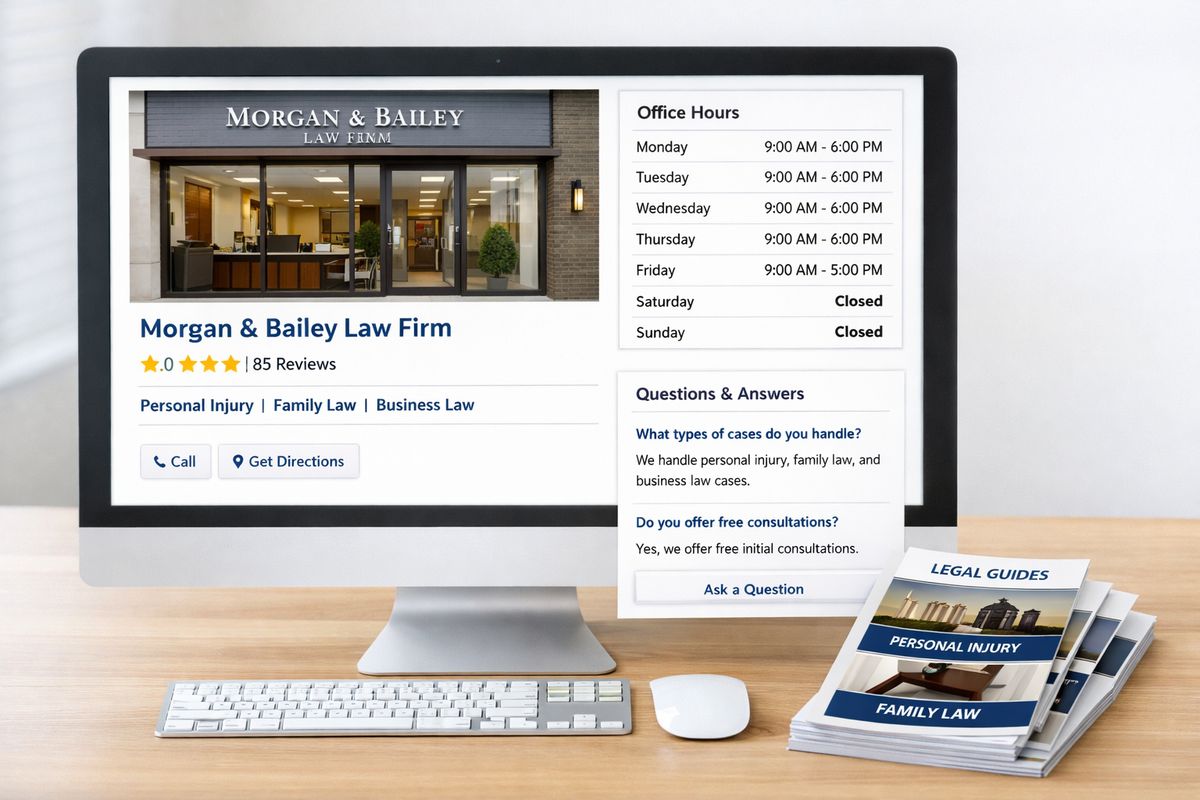
These fields strengthen completeness and engagement. Services help Google understand your offerings. Photos make the profile feel real. Posts keep the profile active. Q&A gives you a chance to answer the exact concerns prospects have before calling.
The best photos are simple: office exterior, reception area, attorneys, conference rooms, team photos, and anything else that confirms a legitimate local presence. Posts should support real activity, such as case-type FAQs, community involvement, or firm updates. Q&A should answer practical questions about consultations, office access, and services.
Your action: upload fresh office and team photos, then add three useful Q&A entries tied to common intake questions.
Avoid suspensions and profile setbacks
Law firms get into trouble when shortcuts replace accuracy. Name stuffing, fake suites, virtual office abuse, and constant inconsistent edits are the fastest ways to trigger profile problems. Once suspended, local lead flow drops fast.
Accuracy wins over tricks. Use your real business name. Use a real staffed office. Keep your details consistent everywhere. If your firm is not appearing where it should in Google Maps, do not assume the answer is more optimization. Sometimes the issue is a compliance or profile integrity problem.
Your action: remove any profile element that exists only to manipulate rankings.
Fix the on-page signals that tell Google where you win
Search Engine Journal’s summaries of Google guidance repeatedly point to a basic truth: your website confirms the relevance your profile starts. If your Google Business Profile says one thing and your pages say another, local rankings stall.
Your site needs to reinforce service plus location clearly. That starts with the basics, then gets stronger through internal links and trust signals. The page does not need to be fancy. It needs to be unambiguous.
Your action: rewrite the title tag and H1 on your highest-value local landing page this week.
Optimize title tags, H1s, URLs, and meta descriptions
Title tags and H1s should include your main service and location naturally. A page targeting “Chicago car accident lawyer” should say exactly that in the title or a close variant. URLs should stay clean and readable. Meta descriptions should support click-through, not just keyword insertion.
The mistake is overdoing it. Repeating the city five times in the title, headline, and first paragraph makes the page weaker, not stronger. Write for clarity first, then optimize around the clear target.
Your action: tighten your top local page so every major on-page element reinforces one target phrase naturally.
Use internal links to strengthen local page authority
Internal links help Google understand hierarchy and importance. Your homepage, attorney bio pages, blog posts, and related service pages should link toward the pages that drive your local business. That tells search engines which pages matter and gives users cleaner pathways to conversion.
This works especially well when educational content supports city and practice pages. A blog about local accident steps should link to the relevant city service page. A bio for a family law attorney should link to the family law and city pages tied to that attorney’s market. If your city pages need work, stronger localized landing page structure and content will raise the ceiling.
Your action: add internal links from your highest-authority pages to your top local targets.
Embed trust signals on key pages
Trust signals improve rankings indirectly and conversions directly. Bar memberships, awards, office address details, attorney credentials, testimonials, speaking history, and case results disclaimers all help a page feel legitimate and established.
For legal SEO, trust matters more than design flourishes. Prospects want proof. Google wants corroboration. A location page that includes real office details, attorney information, and visible contact options outperforms a generic page with stock copy.
Your action: add one visible trust block to every top local page, starting with credentials and office details.
Create location pages that deserve to rank
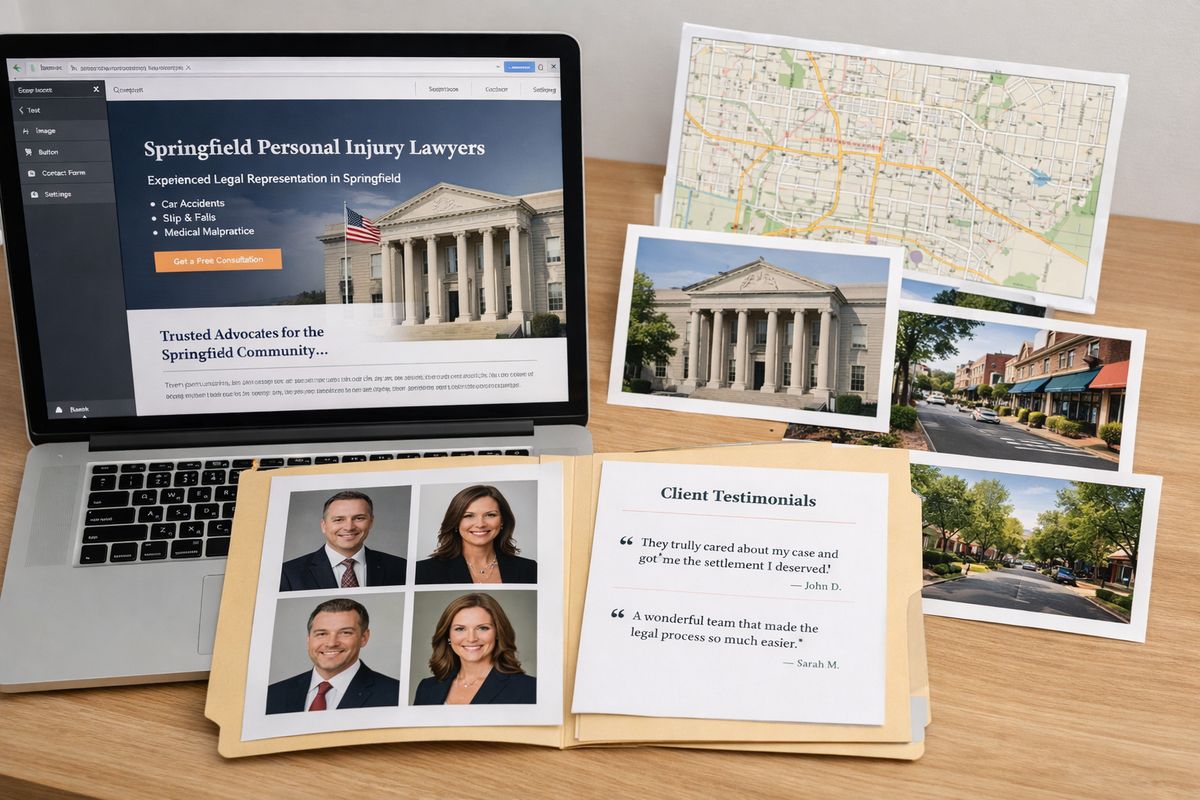
Google’s helpful content systems reward original, useful pages built for people, not mass-produced doorway pages. That matters in legal SEO because city pages often decide whether you can expand beyond your main office footprint.
A useful location page proves local relevance. A thin location page simply swaps city names into the same template. One earns rankings. The other invites suppression.
Your action: build or rewrite one city page this week with unique proof, not boilerplate.
What every high-performing law firm location page includes
A strong location page includes your office address or local service context, practice-specific copy, attorney information, FAQs, reviews, and a direct call to action. It also includes local details that prove familiarity with the market, roads, courts, neighborhoods, or filing realities.
What this means in practice is that each location page should answer two questions fast: why your firm for this issue, and why in this place. If the page cannot answer both, it will not convert well and it will not rank well.
Your action: add local proof elements to your top city page, not just service language.
How to avoid doorway pages and duplicate content
Cloned city pages fail because they do not add new value. Google sees the repetition. Prospects see the laziness. In competitive legal markets, duplicate local pages are dead weight.
Differentiate pages with local court references, neighborhood specifics, case-type examples, unique FAQs, office details, and distinct attorney context. Even if the service stays the same, the page should feel grounded in the city it targets.
Your action: delete or rewrite any city page that differs only by place name.
Multi-location law firms: structure that scales
Multi-location firms need clean architecture. Give each office its own page. Give each major city or market its own location page when you have enough proof to support it. Pair practice area and city pages only for the combinations that matter commercially.
Do not create hundreds of thin pages. That creates index bloat and maintenance problems. Build the site around real offices, real markets, and real demand.
Your action: simplify your location structure so every indexed local page has a distinct purpose.
Use content to win searches before prospects are ready to call
Google’s Zero Moment of Truth research established years ago that buyers research before they contact, and legal prospects behave the same way. High-consideration services attract questions early. If your firm only targets bottom-of-funnel phrases, you miss future clients during the research stage.
Educational local content solves that problem. It captures people earlier, builds topical authority, and gives your local pages stronger support. It also improves intake quality because informed prospects arrive with better expectations. That is the same logic behind stronger lead qualification and case-fit filtering.
Your action: publish one city-specific FAQ article this week based on a real consultation question.
Publish local practice-area guides
Local guides match how people actually search. “What to do after a car accident in Atlanta” is a real query shape. So is “how child custody works in Harris County.” These topics connect legal problems with local context, which makes them far more useful than generic blog posts.
The best guides support nearby service pages through internal links and topical alignment. They also give you content to reference in posts, emails, and follow-up sequences.
Your action: publish one local guide tied to your strongest practice area and city.
Answer the questions that show up in consultations
Your intake process already contains your content strategy. Questions about fees, timelines, court procedures, fault rules, or filing requirements are search topics. If people ask before hiring, people search before calling.
Turn those recurring questions into concise, useful pages or articles. Focus on plain language. Explain the process. Remove uncertainty. That builds trust before the first consult.
Your action: pull one repeated intake question from the last month and turn it into a search-focused article.
Support local SEO with attorney bios and E-E-A-T signals
Attorney bios often waste ranking potential. They list credentials but fail to show experience, local ties, speaking, publications, memberships, and case-type focus. In legal search, those details matter.
Strong bios support both trust and topical relevance. So do pages about firm history, community involvement, published articles, and practice-area experience. Search visibility improves when your expertise is visible, specific, and connected to the services you sell.
Your action: expand your lead attorney bio with concrete experience and local credibility signals.
Build citations that confirm your firm exists where you say it does
Whitespark’s local search findings continue to show that citation accuracy supports local trust, especially when combined with strong profile and review signals. Citations are simple: mentions of your firm’s name, address, and phone number across directories and platforms.
Accuracy matters more than volume. One hundred junk listings do less for you than a small set of correct, visible citations on trusted legal and local platforms. Conflicting data weakens Google’s confidence. That is the plain-English mechanism.
Your action: standardize your firm name, address, and phone number across your top listings this week.
The legal and local directories that matter most
Start with Google, Bing Places, Apple Business Connect, Yelp, Avvo, Justia, FindLaw, and relevant legal directories with actual visibility in your market. Add bar associations, local chambers, and respected regional directories where appropriate.
The goal is not to be everywhere. The goal is to be correct where it counts.
Your action: audit your top 10 citation sources and fix inaccuracies in order of visibility.
Keep NAP consistency tight across the web
NAP means name, address, and phone number. Small differences create problems. Suite formatting, old tracking numbers, old office names, and stale addresses all dilute trust. Search engines want confidence that your business data is stable and real.
If you use call tracking, do it carefully and consistently. A messy setup creates reporting problems and citation conflicts. Before rolling it out widely, understand the tradeoffs around using tracked numbers without damaging local trust signals.
Your action: choose one canonical version of your firm’s contact details and use it everywhere.
Clean up duplicates and outdated listings
Duplicate listings split authority and confuse prospects. Old office locations send people to the wrong place. Unclaimed profiles invite bad edits and stale information.
Suppression and cleanup take time, but the work pays off because it removes friction from both rankings and lead flow.
Your action: claim and correct every duplicate or outdated listing tied to your current markets.
Reviews are a ranking factor and a conversion factor
A 2024 BrightLocal consumer review survey found that reviews remain a primary trust signal for local businesses, especially when recency and response behavior are visible. In legal, that effect is stronger because the stakes are higher. Prospects do not just want competence. They want reassurance.
Reviews influence local prominence and click behavior at the same time. A profile with strong, recent, detailed reviews earns more attention. A website that reflects the same themes closes more of that attention into consultations.
Your action: set up a simple review request process tied to case milestones this week.
Ask for reviews at the moment satisfaction is highest
Timing matters. Ask when the client feels resolution, gratitude, or relief. That point differs by practice area, but the principle does not. Do not wait until the relationship has gone cold.
Make the request easy. Use a direct link. Use a short message. Keep the ask personal and compliant with your ethics rules.
Your action: identify the exact moment in your client journey when satisfaction peaks and trigger every review request there.
Respond to reviews in a way that builds trust
Responses show professionalism. They signal attentiveness to prospects and reinforce that your firm is active. Keep responses brief, warm, and confidentiality-safe. Never confirm representation details. Never argue.
Consistency matters more than eloquence. A pattern of respectful, timely responses strengthens trust.
Your action: respond to every unaddressed review on your profile this week.
Use review themes to improve local page copy
Reviews contain the language prospects trust most because clients wrote it. If reviews repeatedly mention responsiveness, courtroom strength, compassion, or clarity, those themes belong on your site.
Use that language naturally on location pages, attorney bios, and practice pages. It sharpens your conversion messaging and aligns your copy with real client priorities.
Your action: pull three recurring phrases from reviews and weave them into your top local page.

Earn local backlinks and mentions that increase prominence
Ahrefs’ large-scale ranking studies consistently find a strong relationship between referring domains and search visibility. In legal local SEO, that relationship shows up clearly in competitive metro markets. Strong firms usually have stronger local link profiles.
Local links still move rankings because they act as third-party validation. A chamber listing, university mention, nonprofit sponsorship, bar association profile, or local news feature tells search engines your firm belongs in the market.
Your action: secure one local mention, sponsorship, or association listing this week.
The local link sources that actually help law firms
The best local link sources are relevant and real. Chambers of commerce, bar associations, legal aid partnerships, business groups, universities, event sponsorships, and local nonprofits all make sense. So do local news sites when coverage is earned.
Relevance matters more than raw metrics. A trusted local site with genuine community connection beats a random SEO placement every time.
Your action: choose one local organization aligned with your market and earn a listing or mention there.
Digital PR for attorneys without gimmicks
Legal commentary creates opportunities when it is timely and specific. Local legal developments, public safety trends, court data, and community-facing legal issues can all generate media interest. The angle has to be useful, not self-promotional.
Keep outreach factual and reputation-safe. Offer insight on issues affecting the local public. That is how earned mentions happen without stunts.
Your action: prepare one short expert comment tied to a current local legal issue and pitch it to a local outlet.
Technical local SEO: the foundation that stops leaks
Google’s mobile-first indexing and Core Web Vitals guidance make one point obvious: if your local landing pages are slow, hard to use, or blocked from crawling, rankings leak. Technical SEO does not create demand, but it protects the demand your local strategy earns.
Most local legal searches happen on phones. If your top city page takes too long to load, hides the phone number, or buries the form, you lose the lead before your intake team has a chance. Clean reporting matters too, especially when paired with tracking calls and forms across your intake process.
Your action: test your top three local landing pages on mobile and fix the slowest one this week.
Mobile experience and page speed
Focus on what affects contact behavior first: load speed, tap targets, click-to-call visibility, and form simplicity. A page that loads fast and lets someone call in one tap beats a prettier page that stalls.
Core Web Vitals matter, but practical usability matters just as much. Local search visitors are impatient because legal problems are urgent.
Your action: move your phone number and contact action higher on mobile pages and reduce anything that slows load time.
LocalBusiness, Attorney, and FAQ schema
Schema markup helps search engines understand your business details more clearly. For law firms, LocalBusiness, Attorney, and FAQ schema carry the most practical value. Use them on office pages, attorney bios, and FAQ-supported service pages.
Markup should reflect real information, not inflated claims. Include address, hours, attorney details, and other accurate business data where relevant.
Your action: deploy schema on your main office page and lead attorney bios first.
Indexing, crawlability, and site hygiene
Broken links, redirect chains, duplicate pages, bad canonicals, accidental noindex tags, and stale sitemaps quietly block local growth. These are boring problems. They still cost rankings.
A site does not need to be perfect. It does need to be crawlable, indexable, and orderly.
Your action: run a technical crawl and fix every issue affecting your local priority pages first.
Track the metrics that prove local SEO is producing cases
Google Analytics and Search Console give you visibility, but case growth comes from tying that visibility to leads and signed matters. The firms that win in local SEO do not obsess over vanity traffic. They track movement from ranking to click to call to consult to client.
What this means in practice is building a scorecard that reflects business outcomes. Rankings matter. Profile actions matter. Qualified leads matter more.
Your action: create a monthly scorecard for rankings, Google Business Profile actions, leads, and signed matters this week.
The KPIs that matter for law firms
Track local pack rankings, city-specific organic rankings, GBP calls, direction requests, website clicks, qualified leads, consultation rate, and cost per signed case if your attribution supports it. Those are the numbers tied to revenue.
Traffic alone is not enough. Fifty unqualified leads do not beat ten strong ones. If intake quality is weak, strengthen your systems for bringing in better-fit prospects.
Your action: remove vanity metrics from your reports and keep only measures tied to consultations and signed cases.
The tools that make local SEO measurable
Use Google Business Profile Insights for profile actions. Use Search Console for search queries and page visibility. Use GA4 for engagement and conversion paths. Use rank tracking tools that monitor by city or ZIP. Use citation tools for consistency checks.
Use call tracking with care and structure. When set up correctly, it improves attribution. When set up badly, it muddies citations and local trust.
Your action: assign one reporting job to each tool so your data stays clean.
How to run a monthly local SEO review
A useful monthly review compares rankings, leads, profile activity, page performance, and content movement month over month. The goal is not to admire charts. The goal is to decide the next move.
If rankings rose but leads did not, your conversion layer needs work. If leads rose but rankings held steady, your pages or intake improved. If both dropped, check profile health, citations, and technical issues first.
Your action: end every monthly review with one ranking fix, one content move, and one conversion improvement.
The mistakes that keep law firms stuck below competitors
Google Business Profile forums, local SEO audits, and legal SERPs all point to the same pattern: most firms underperform because of basic execution gaps, not advanced strategy failures. Weak pages, weak profiles, weak local proof. That is usually the story.
Your competitors do not need to be brilliant to outrank you. They just need to be clearer, more complete, and more consistent.
Your action: identify the single biggest local SEO mistake on your site or profile and fix it this week.
Keyword stuffing and city-page spam
Over-optimized pages fail because they read badly and prove nothing. Fake office signals fail because they break trust and invite profile issues. Thin local content fails because it helps nobody.
Useful, specific, verifiable content wins. That is the standard.
Your action: remove spammy city repetition and replace it with real local proof.
Ignoring your Google Business Profile
An incomplete or inactive profile sends a neglect signal. Weak photos, unanswered reviews, inaccurate services, and stale information all compound over time. Rankings soften. Clicks fall. Competitors look stronger.
Profile neglect is one of the easiest losses to fix, which makes ignoring it even more expensive.
Your action: schedule a recurring monthly profile maintenance block and keep it non-negotiable.
Using one generic page for every market
A broad “areas served” page rarely beats real city pages with real substance. Search engines want relevance. Prospects want confidence. Generic market pages satisfy neither.
If you want to rank in multiple places, build pages that earn it.
Your action: replace generic area-served copy with one real page for your best market outside your home city.
When to hire a law firm SEO agency for local growth
According to Clio’s legal industry reporting, law firms that treat marketing as a managed growth system outperform firms that handle it sporadically. Local SEO rewards consistency, technical accuracy, and legal-market experience. Once your market gets competitive, ad hoc effort stops being enough.
A strong agency owns strategy, execution, and measurement across your profile, site, content, citations, links, and reporting. A weak agency sells activity without movement. If you are evaluating partners, start with a guide to choosing a legal marketing team that can actually deliver.
Your action: request a local SEO audit focused on your top city and highest-value practice area this week.
What a strong legal SEO partner does first
A strong partner starts with an audit, not promises. That includes keyword mapping, profile review, citation cleanup priorities, technical issues, local page gaps, content planning, and measurement setup. Strategy comes before deliverables.
The move that works is sequencing. Fix the highest-leverage issues first, then build authority and content on top of a clean foundation.
Your action: demand a prioritized roadmap, not a vague monthly task list.
Red flags during agency selection
Guaranteed rankings are a red flag. Vague reporting is a red flag. No legal category experience is a red flag. So are shortcuts that risk profile suspension, unclear ownership of content and listings, and reporting that never reaches signed-case outcomes.
Decisive rule: if an agency cannot explain how local rankings connect to consultations and retained clients, keep looking.
Your action: reject any provider that relies on guarantees, secrecy, or shortcuts.
What to do this week to move up first
Start with the highest-leverage asset: your Google Business Profile or your top city page. If your profile is incomplete, fix that first. If your profile is strong but your main city page is weak, rewrite that page around your best revenue-driving local keyword and add real local proof.
Momentum matters more than perfection. One fully completed profile or one truly strong city page creates more movement than ten half-finished tasks. If you want a faster path, schedule a call with Attorney Visibility ai for more information and a focused review of your local SEO opportunities.
Frequently Asked Questions
How long does local SEO for lawyers take to show results?
You usually see early movement in 30 to 90 days when the issue is profile completion, citation cleanup, or on-page clarity. Competitive legal markets take longer because prominence signals, content depth, and local links need time to build.
What matters more for lawyers, Google Business Profile or the website?
Both matter, but for different reasons. Your Google Business Profile drives map pack visibility and local actions like calls and direction requests. Your website confirms relevance, supports organic rankings, and converts visitors into consultations.
Can you rank in a city where you do not have an office?
You can earn some visibility with strong local content, but sustained map pack performance is tied closely to real proximity signals. If a city matters commercially, a real staffed office gives you the strongest advantage.
Do reviews directly affect local SEO for lawyers?
Yes. Reviews support prominence, influence click behavior, and shape trust before contact. Review quantity, recency, quality, and response activity all strengthen your local presence.
Should your law firm create a page for every city nearby?
No. Thin city pages dilute quality and create duplicate content problems. Build pages only for markets where you have real business value, real local proof, and a distinct reason to rank.
Is call tracking safe for local SEO?
Yes, when it is implemented carefully. Problems start when tracked numbers create inconsistent citations or replace your canonical number across the web. Use a controlled setup that preserves NAP consistency.