
On 24 June 2026, legal marketers and intake vendors reported that AI intake for law firms delivers its earliest gains in response time, lead qualification, and after-hours coverage, often within 90 days. For firms comparing agencies and intake partners, the first quarter reveals less about hype and more about workflow design, reporting discipline, and signed-case impact.
What AI Intake for Law Firms Can Deliver in 90 Days
According to intake software providers, legal marketing agencies, and law-firm administrators, the most visible 90-day result is faster contact with prospective clients. A missed evening call or unreturned web form that once sat overnight gets answered in seconds through chat, SMS, call handling, or automated follow-up. Firms tracking lead flow closely reported that the operational win comes first, while the revenue win follows after consultations are booked and attended.
Vendors said the second early gain is consistency. Human intake teams vary by shift, workload, and training level. AI systems ask the same screening questions every time, tag the lead source, route the matter by practice area, and record what happened. That uniformity matters most in high-volume practices where lead loss often comes from simple breakdowns: unanswered calls, incomplete forms, slow follow-up, or poor handoff.
A balancing view came from law-firm operators who noted that not every firm sees a dramatic lift in retained cases by day 90. Gains depend on clean scripts, clear escalation rules, staff adoption, and enough lead volume to justify the system. A firm with weak traffic generation, poor attorney availability, or no consultation process will not fix those issues with automation alone. In that sense, AI intake is a conversion layer, not a substitute for business discipline.
The 30-60-90 Day Rollout Timeline
According to agency operators and software implementation teams, days 1 through 30 focus on setup. The firm audits missed calls, reviews current forms, maps call flows, drafts qualification scripts, and defines disqualification rules. During this phase, the operational question is simple: what should happen when a lead calls, chats, texts, or submits a form at 8 p.m. on a Saturday?
Days 31 through 60 usually cover live deployment. Providers activate channels, test routing, connect calendars, assign practice-area workflows, and train staff to review transcripts and accept handoffs. Firms with existing marketing programs often align intake rules with campaign sources at this stage, especially if they already invest in SEO, PPC, or paid local lead channels.
Days 61 through 90 center on optimization. The team refines scripts, removes weak qualification branches, adjusts bilingual flows, studies consultation booking patterns, and measures which lead sources produce retained matters. Agencies that perform well in this window do not stop at lead counts. They report outcomes tied to business value.
The Metrics Firms Track First
Legal marketing operators said the first KPI is speed to lead because delay destroys conversion. If a personal injury inquiry waits 20 minutes for a callback, another firm often books the consultation first. For that reason, response time across calls, texts, chats, and forms becomes the earliest benchmark.
The next metrics are answer rate, form completion rate, qualified consultation rate, and show rate. Those figures reveal whether the system merely starts conversations or actually moves people into scheduled appointments with enough intent to matter. After that, firms track signed cases and cost per retained client, which is where marketing and intake performance finally connect.
According to firms that have matured their reporting, the most useful dashboards compare source, intake path, qualification result, consultation attendance, and signed-case outcome in one place. That is the same logic behind tracking legal leads from first contact to outcome, since isolated activity data rarely explains where revenue was gained or lost.

How AI Intake Works Inside a Law Firm
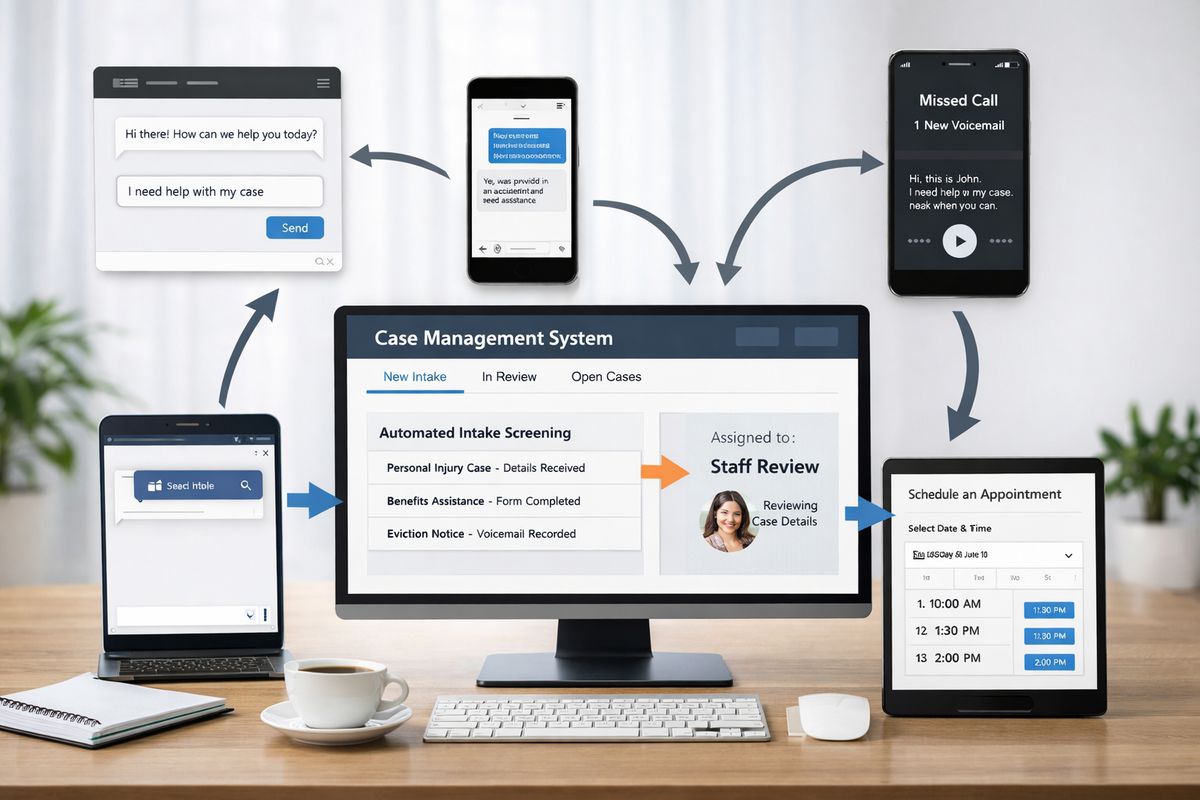
AI intake systems receive inbound contacts across several channels and respond with pre-configured workflows. The software answers chats, texts back missed callers, handles after-hours inquiries, asks qualification questions, offers appointment times, and writes the data into a CRM or case-management platform. In firms with stronger operations, the system also tags urgency, flags potential disqualifiers, and routes by office location or practice type.
According to compliance-focused legal commentators, the technology does not replace legal judgment. It handles information gathering and scheduling. Attorneys and trained staff still decide whether a matter creates a conflict, requires legal analysis, or fits the firm’s acceptance criteria. That distinction is not cosmetic. It is the boundary that separates useful intake automation from unauthorized legal advice risk.
Some providers market the category loosely, which creates confusion. A basic website bot that captures a name and phone number is not the same as full intake. Firms evaluating vendors often compare these tools side by side, but the operating model is different from an AI front desk system built for law practices, especially when omnichannel coverage and CRM syncing are required.
Channels AI Intake Can Cover
The most common touchpoints are website chat, after-hours phone handling, SMS follow-up, web forms, and voicemail response. For firms that rely on mobile-first inquiries, text messaging often drives faster re-engagement than email. For firms with strong local search visibility, after-hours call handling matters more because the lead is already ready to talk.
Bilingual intake also matters in many consumer practices, especially Spanish-language screening for personal injury, immigration, workers’ compensation, and family law. Vendors said firms tend to underestimate how much lead loss comes from language mismatch, especially outside business hours.
Where Automation Stops and Staff Take Over
The handoff points should be explicit. Consultation calls, legal judgment, exception handling, conflict checks, and urgent matters belong with trained humans. If a lead mentions arrest, imminent deportation, an active protective order, a looming filing deadline, or severe injury, the workflow should escalate immediately according to rules set by the firm.
Operators who reported the strongest outcomes said AI performs best as a force multiplier for staff, not as a total replacement. Intake teams still review transcripts, correct bad data, coach the scripts, and catch edge cases. That balance matters because legal matters are not retail transactions. The facts are messy, emotional, and time-sensitive.
The Buying Criteria That Matter Most
For firms hiring an agency or intake partner, the buying decision turns on performance, integration, and risk control. Feature lists are easy to inflate. The harder question is whether the provider can convert more qualified inquiries without creating ethics problems, reporting blind spots, or operational confusion.
The strongest evaluation standard is practical: can the system respond instantly, ask the right questions, route the matter correctly, and produce reporting that ties intake activity to retained cases? If the answer fails at any one of those points, the rest of the sales pitch does not matter much.
Speed, Coverage, and After-Hours Response
According to lead-conversion operators, first-response delay is one of the earliest points of revenue loss. A provider should document response times, overflow rules, weekend coverage, and missed-call text-back speed. Twenty-four-hour availability matters most for high-intent consumer inquiries because the competing firm is often only one search result away.
Coverage also has to include overflow handling during business hours. Many firms assume intake problems happen only at night. In practice, overflow during lunch, court appearances, trial days, and receptionist absences causes just as much loss.
Qualification Logic and Custom Scripting
Practice-area customization separates real intake systems from generic bots. A family law script should not sound like a mass tort screen. A criminal defense inquiry requires urgency handling that differs from bankruptcy. Personal injury matters need question logic around liability, treatment, insurance, and timing.
That is why agencies often begin with the firm’s ideal matter profile and disqualification rules before any software is switched on. When the script reflects how the firm actually accepts or rejects cases, conversion quality rises and staff frustration drops. Generic scripts do the opposite. They create noise, book weak consultations, and miss urgent signals.
CRM and Case-Management Integration
Integration determines whether the intake data remains useful after the first conversation. Systems such as Clio, Lawmatics, Filevine, Litify, HubSpot, and custom CRMs need accurate lead-source attribution, duplicate prevention, appointment syncing, and status updates. Without that, the firm cannot tell which campaigns generated retained matters or whether intake performance improved.
For many buyers, this is where vendor comparisons become real. A polished demo matters less than whether the provider can connect intake actions to the firm’s existing CRM and case workflow. Reporting continuity is the difference between measurable ROI and educated guessing.
Compliance, Privacy, and Risk Controls
Legal buyers should press hard on data handling, SMS consent, call-recording disclosures, retention policies, privilege-sensitive language, and legal-advice boundaries. Vendors can automate the conversation flow, but the firm remains responsible for ethics, supervision, and final acceptance decisions. That point has been repeated by legal operations consultants and bar-focused commentators alike.
A balanced view is necessary here. Good vendors reduce risk by standardizing disclosures, storing transcripts, and enforcing escalation rules. But automation does not transfer liability away from the firm. If the script overpromises, misses a conflict signal, or mishandles protected information, the firm owns that outcome.
Which Law Firms Benefit Most From AI Intake
According to intake consultants, the firms that benefit first are those with enough inquiry volume and enough operational leakage to justify intervention. AI intake creates the fastest gains where prospects expect immediate contact and where repetitive screening determines whether staff time gets wasted.
By contrast, firms with low lead flow, highly bespoke matters, or attorney-led screening from the first interaction often see slower payback. The technology still has value there, but the economics and workflow fit are different.
High-Volume Consumer Practice Areas
Personal injury, employment, immigration, family law, criminal defense, bankruptcy, and plaintiff-side mass tort typically show the clearest early return. These practices deal with urgency, emotional decision-making, and high competition. If intake is slow, inconsistent, or unavailable after hours, the lead goes elsewhere.
Agencies running campaigns designed to attract better-fit prospects often report that traffic quality and intake quality rise together. Stronger leads still need immediate handling. Better marketing without disciplined intake simply moves the leak further down the funnel.
Firms Missing Calls After Hours or On Weekends
This is one of the clearest use cases. If the receptionist leaves at 5 p.m. and the phone keeps ringing, lost opportunity is already documented. AI intake fills that gap by answering, screening, and scheduling while the office is closed.
The reported benefit is not only availability. It is continuity. The caller receives a response in the moment, the firm captures the data, and staff begin the next business day with appointments or prioritized follow-up instead of a vague list of missed messages.
Firms With Strong Lead Flow but Weak Conversion
Firms already spending on SEO, PPC, Local Services Ads, referral partnerships, or local visibility often gain the most from intake optimization. The reason is structural. They already have demand. What they lack is efficient conversion from inquiry to consultation to retained matter.
That is why many agencies frame AI intake as a companion to traffic channels rather than a replacement for them. A firm comparing lead-generation tactics across paid channels should treat intake as the layer that protects the media spend already in motion.

What a 90-Day Implementation Plan Should Include
A competent provider should define what gets delivered in the first quarter and what gets measured. Vague promises about smarter conversations are not enough. Buyers should expect a documented plan tied to systems, scripts, routing, staff process, and outcome reporting.
The implementation plan should also state who owns each step. Some failures blamed on software are really ownership failures. No one reviewed transcripts, no one approved scripts, no one monitored booking quality, and no one connected intake data to signed cases.
Days 1-30: Audit, Scripts, and Systems Setup
The opening phase should include a missed-call audit, review of current intake forms, FAQ gathering, call-flow mapping, escalation rules, and script drafting by practice area. It should also include a plan for CRM integration and a baseline KPI report so post-launch gains can be measured against reality, not memory.
Providers that skip this phase usually launch faster and perform worse. Without an audit, automation simply scales the existing confusion.
Days 31-60: Launch, Routing, and Staff Training
The second phase should include live testing across phone, chat, SMS, and web forms; appointment calendar syncing; routing by office, language, or practice type; and staff training on review procedures. Teams should inspect transcripts and summaries early because weak prompts and unclear escalation logic show up fast once real leads begin interacting.
This is also the point where automated follow-up sequences tied to intake systems should be tested against no-show prevention and reactivation outcomes. Follow-up is not an add-on. It is part of intake performance.
Days 61-90: Optimization and Revenue Reporting
The final phase should refine qualification logic, update disqualification rules, adjust bilingual responses, and analyze appointment outcomes by source and intake path. By day 90, the provider should report retained-case impact, not just handled conversations.
Credible partners also identify what did not work. If a script branch created poor-fit bookings or a weekend flow produced low-value consultations, the report should say so. Good optimization is less about claiming perfection than about removing waste.
Cost, Pricing Models, and ROI Expectations
Price comparisons often start too early. Before a firm can judge cost, it has to know whether it is buying software access, managed intake, implementation support, reporting, optimization, or some combination of all four. Two providers can quote similar monthly numbers while delivering completely different operating value.
According to agencies and vendors, AI intake pricing generally reflects complexity more than raw usage alone. A single-office family law practice with one script is simpler than a multi-location plaintiff firm with bilingual routing, custom CRM logic, and separate intake paths by case type.
Common Pricing Structures
The market typically uses monthly retainers, usage-based pricing tied to calls or conversations, setup fees, per-lead pricing, or hybrid agency-plus-software models. What matters is what is included. Scripting, transcript review, integration work, reporting, optimization, and support change the real cost more than the billing label.
A low base price often excludes the work that drives performance. Buyers comparing proposals should examine implementation scope before reacting to the monthly fee.
When Higher Pricing Is Justified
Higher pricing is justified when the operating environment is more complex. Multi-location firms need routing by geography. Multi-practice firms need different scripts and escalation rules. Spanish-language intake requires separate QA. Custom integrations take real technical work. Firms with tighter compliance demands also need stronger controls and supervision.
That premium makes sense only if reporting remains clear. If a provider charges more while producing fuzzy attribution, the added cost is hard to defend.
How Firms Should Calculate ROI
The proper ROI model starts with leads recovered that would otherwise have been missed, then moves to consultations booked, show rate, signed cases, and revenue per retained matter. This framework connects intake operations to financial outcome. Anything less is partial reporting.
A balancing perspective came from legal marketers who warned that low-cost tools often create tracking gaps. If the firm cannot prove which conversations became consultations and which consultations became cases, ROI becomes a story rather than a number.
Common Buying Mistakes Law Firms Make
The most common buying errors come from treating intake like a minor software purchase. It is not minor. Intake sits between marketing spend and signed revenue. If the wrong system goes in, the firm pays for traffic, then loses the return in the middle.
Another recurring mistake is buying on demo quality instead of workflow fit. Smooth sample conversations mean little if the provider cannot support the firm’s actual intake rules.
Buying a Chatbot Instead of an Intake System
A chatbot handles a narrow website interaction. A true intake system manages calls, texts, forms, routing, scheduling, follow-up, and CRM syncing across channels. The difference matters because most law-firm lead loss happens between channels, not inside one isolated chat box.
Firms evaluating broader AI-based legal marketing systems should separate lead capture tools from intake operations. One creates conversations. The other converts them into retained-case opportunities.
Ignoring Practice-Area Customization
Generic scripts underperform because legal screening is practice-specific. A personal injury case requires different facts, urgency markers, and disqualification rules than an immigration consultation or a criminal defense emergency. If the script does not reflect real intake logic, staff end up redoing the work manually and losing confidence in the system.
This mistake also harms the client experience. Prospective clients can tell when the questions do not fit the matter.
Measuring Activity Instead of Signed Cases
Calls answered, forms completed, and chats handled are operational metrics, not business outcomes. They matter, but only as leading indicators. The meaningful measure is retained-case performance tied back to source and intake path.
According to legal marketing operators, this is where many implementations stall. The system appears busy, management sees higher activity, but no one verifies whether better activity became better revenue.
Questions to Ask Before Hiring an AI Intake Provider or Agency
Decision-makers comparing providers should test for transparency, supervision, and fit. The strongest vendors welcome detailed operational questions because those questions reveal whether the service is built for law firms or adapted from a general sales environment.
A shortlist should be based on proof of process, not only promises of automation. The provider should explain who writes scripts, who reviews conversations, how urgent matters move to staff, and how signed-case reporting works.
Questions About Performance and Reporting
Firms should ask for documented response times, booking rates, qualified-lead rates, show rates, and signed-case attribution by source. They should also ask whether dashboards include transcript review, call recordings where permitted, and full-funnel reporting from first contact to retained matter.
Another useful question is whether the provider can distinguish volume from quality. That answer often reveals operational maturity faster than any demo.
Questions About Supervision, Compliance, and Escalation
Buyers should ask who drafts and approves scripts, who audits conversations, how urgent matters are escalated, how legal-advice boundaries are enforced, and how SMS consent and data retention are handled. They should also ask how conflict-sensitive information is flagged and when a human steps in.
The firms with the fewest surprises usually document these rules before launch, not after the first complaint.
Questions About Fit for the Firm’s Growth Goals
A provider should show practice-area experience, integration depth, multilingual support, location-based routing capability, and the ability to support both demand generation and intake optimization. For firms reviewing agency options, that broader question often overlaps with how to assess a marketing partner’s execution standards.
Fit also includes scale. A system that works for one office can fail across five if routing, supervision, and reporting are not designed for growth.
Frequently Asked Questions
How quickly does AI intake start improving law-firm response times?
Most providers and agencies report that response-time gains appear immediately after launch because the system answers chats, texts back missed calls, and handles after-hours inquiries without delay. Signed-case gains take longer because consultations still need to be booked, attended, and accepted.
Does AI intake replace legal intake staff?
No. The strongest implementations keep trained staff involved in transcript review, exception handling, legal judgment, conflict checks, and urgent escalations. AI handles repetitive screening and scheduling, while staff control the decisions that require human judgment.
What practice areas see the fastest return from AI intake?
High-volume consumer practices usually see the earliest return. Personal injury, immigration, family law, criminal defense, employment, bankruptcy, and plaintiff-side mass tort tend to benefit first because speed and consistent qualification directly affect conversion.
What should a law firm demand in reporting by day 90?
By day 90, the provider should report speed to lead, answer rate, form completion, qualified consultations, show rate, signed cases, and source-level attribution. Lead counts alone are not enough.
What is the biggest buying mistake firms make with AI intake?
The biggest mistake is buying a simple chatbot and treating it as full intake. True intake requires omnichannel coverage, qualification logic, routing, follow-up, scheduling, and CRM or case-management integration.
How should a firm decide if the price is justified?
The firm should compare the price against leads recovered, consultations booked, show rate, signed cases, and revenue per retained matter. A more expensive provider is justified when the system supports complex routing, custom integrations, multilingual intake, and verified reporting.
Where the Decision Usually Becomes Clear
The decision becomes clear when a firm stops asking whether AI intake sounds modern and starts asking whether the provider can prove operational control inside the first 90 days. The strongest partners show scripts, routing logic, escalation rules, integration depth, and retained-case reporting. The weakest rely on surface-level automation claims.
For firms evaluating intake as part of a broader growth system, the useful standard is straightforward: faster response, better screening, cleaner handoff, and verified revenue impact. To review how that standard applies in practice, schedule a call with Attorney Visibility ai for more information.