


Leonardo BartelleEdit Profile
Law firms cannot treat ChatGPT output as finished copy. Teams need a repeatable way to check ChatGPT answers before any legal marketing text, FAQ, intake script, or page draft goes live.
This process sets a review standard. It covers legal risk, factual accuracy, source quality, SEO fit, and brand fit.
What this process covers
To check ChatGPT answers for a law firm means more than spotting typos. It means testing each statement against law, firm facts, ethics rules, and publishing goals.
The scope includes practice area pages, local SEO pages, attorney bios, FAQ content, intake language, blog drafts, ad copy, and internal planning documents. Each content type carries a different level of risk. Each one needs a defined review path.
What the team will need
A review starts with complete input. The team needs the original prompt, the full AI output, the intended use, and the latest firm source material.
The team also needs one owner. That person keeps the review log, assigns checks, and decides when a line stays, changes, or gets cut.
Source documents to gather
The review file should include the firm website, approved attorney bios, office details, service descriptions, consultation terms, jurisdiction rules, and prior approved copy. It should also include any awards, verdict references, review policy language, and bar disclaimer language already in use.
Firm-owned records outrank memory. Public legal sources outrank secondary summaries. That source order keeps the review clean.
Review tools to set
The team needs one annotation document and one fact-check table. It also needs search access for courts, statutes, bar rules, map data, and platform policies.
A plagiarism checker helps screen copied language. Search tools help confirm location terms, court names, and practice details. Teams that publish for AI discovery often pair this review with broader checks on how legal answers get surfaced by AI tools.
Step 1: Set the answer type
The team should classify the output before review starts. Legal information, marketing copy, SEO content, client-facing FAQs, and internal drafts do not need the same review standard.
Classification sets the depth of review. A brainstorming note can move faster than a published injury deadline page.
- Read the full answer once.
- Mark the primary content type.
- Mark any secondary use.
- Note if the draft will be published or used internally.
Checkpoint: the team should be able to describe the output in one line, such as “FAQ draft for Georgia car accident page” or “intake script for family law leads.”
Match the content to its risk level
Risk should be assigned before edits begin. Low-risk content includes neutral internal drafts and topic outlines. Medium-risk content includes service pages and educational blog drafts. High-risk content includes deadline statements, fee claims, result claims, specialization language, and jurisdiction-specific advice.
- Mark low, medium, or high risk.
- Highlight every sentence that could trigger ethics or legal review.
- Route high-risk lines to attorney review later in the process.
Define the publication channel
Channel changes the review standard. A homepage paragraph, a Google Business Profile post, ad copy, and an intake script each carry different exposure and compliance risk.
- Write the planned channel at the top of the review file.
- Note if the draft will appear on a website, ad platform, social platform, email, or internal script.
- Match the review to that channel’s limits and audience.
Step 2: Check the prompt and context
Bad input creates bad output. The team should review the prompt before judging the answer alone.
ChatGPT often repeats assumptions from the prompt in a polished tone. That makes prompt review part of output review.
- Open the original prompt beside the answer.
- Mark missing facts.
- Mark vague instructions.
- Mark claims the prompt treated as true without proof.
Compare the prompt to the firm brief
The prompt should include the firm’s locations, practice scope, audience, and limits. Generic prompts produce generic content. Missing context often leads to false service claims or location errors.
- Compare the prompt to the actual firm brief.
- Add missing practice areas, city targets, and audience details to the review notes.
- Flag any mismatch between the prompt and the firm’s approved positioning.
Teams that want stronger output upstream often refine prompts around content patterns that support AI visibility. That does not remove the need for review.
Flag unsupported prompt claims
Some prompts include facts that no one verified. Common examples include “award-winning,” “top-rated,” “serves all of Texas,” or “specializes in trial work.”
- Underline every factual claim inside the prompt.
- Match each one to a source.
- If no source exists, mark the repeated claim in the answer for revision or removal.
Step 3: Scan for high-risk legal claims
This scan happens before line-by-line edits. The team should first isolate the sentences most likely to create legal or ethics issues.
High-risk claims often appear in ordinary marketing copy. A single sentence about a deadline, guarantee, or fee can change the review path.
- Read the answer once for risk only.
- Highlight statements about outcomes, rights, deadlines, fees, special expertise, and required actions.
- Move those lines into a separate review list.
Check jurisdiction-specific statements
Legal rules change by state and sometimes by county or court. Broad language often hides the wrong jurisdiction.
- Circle every state, city, county, and court reference.
- Verify each legal rule against that jurisdiction.
- Remove national phrasing if the content targets one state or metro.
Check ethics and advertising claims
Bar rules and ad standards should control this review. Testimonials, specialization claims, prior results, and guarantees need close review.
- Compare claims to the applicable bar advertising rules.
- Remove any sentence that implies guaranteed outcomes.
- Rewrite expertise language if the firm cannot support it under local rules.
Check disclaimers and non-advice language
General information should not read like personal legal advice. Required disclaimers should be clear and placed where the channel allows.
- Check whether the draft gives direct legal instructions.
- Add or confirm disclaimer language where needed.
- Make sure the draft separates education from legal advice.
Step 4: Verify facts line by line
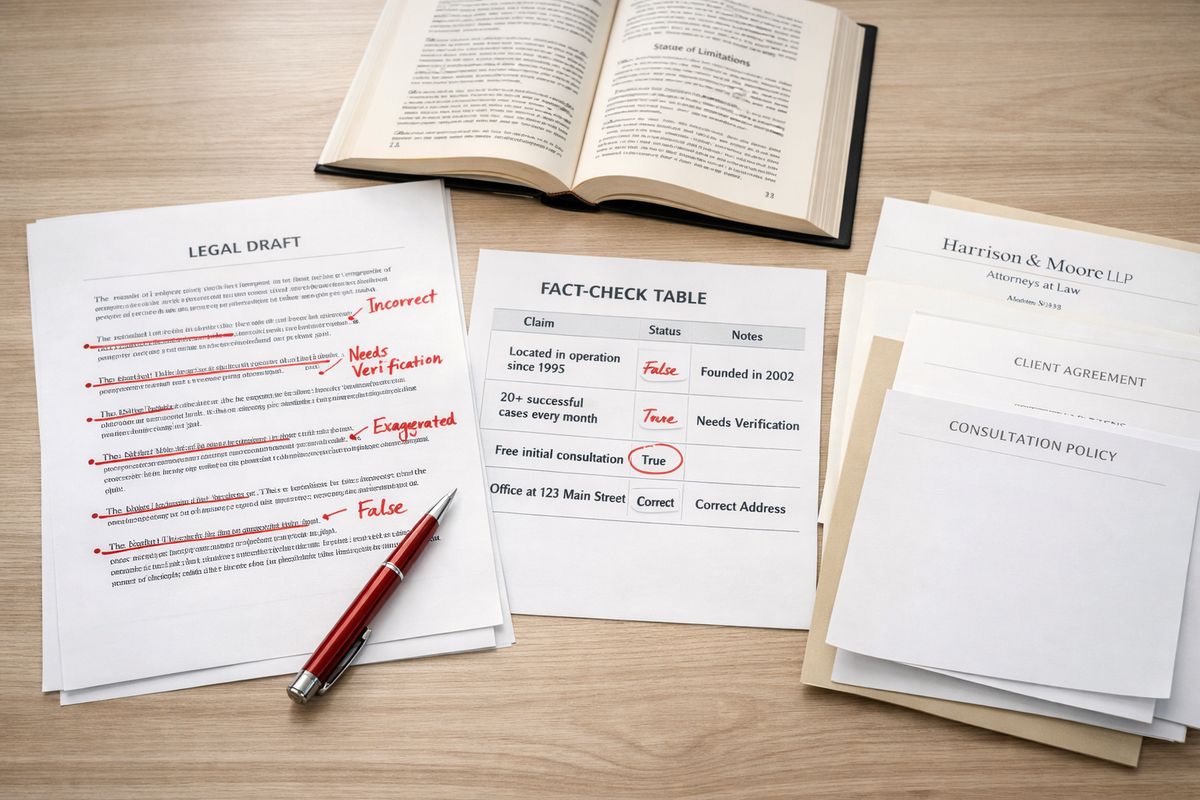
Now the team should run a direct fact check. Each factual statement gets a source, a status, and a fix.
This is the slow part. It is also the part that prevents avoidable errors.
- Break the answer into individual claims.
- Check each claim against a source.
- Mark it verified, revised, or removed.
- Log the result.
Check firm facts
Firm facts fail often. AI may invent office locations, add practice areas, alter years of experience, or state free consultation terms that do not exist.
- Verify office names and addresses.
- Verify attorney names, titles, and bios.
- Verify consultation terms, phone numbers, and case types.
- Verify awards, certifications, and review references.
Attorney bio errors matter for trust and search relevance. That issue overlaps with how professional profile pages shape AI visibility.
Check legal facts
Legal facts need source proof from current authority. Statutes, filing periods, procedural rules, and definitions should never stay based on plausibility alone.
- Verify statutes and deadlines from primary sources.
- Confirm court procedure statements.
- Check that legal concepts are not mixed across states.
- Remove oversimplified rules that hide exceptions.
Check marketing facts
AI often states SEO or platform claims as settled fact. Those claims may be old, generic, or wrong.
- Verify statements about ranking factors.
- Verify ad policy claims.
- Verify search behavior claims.
- Remove unsupported performance promises.
A firm that treats AI search and classic search as the same system will miss important differences. That gap shows up in the comparison between search engines and AI answer tools.
Use a simple fact-check table
A basic table keeps the process accountable. It also speeds later approval.
| Claim | Source | Status | Owner | Fix |
|---|---|---|---|---|
| “The firm has 3 offices” | firm site | Verified | marketing | none |
| “Florida gives 4 years” | state statute | Revised | attorney | update rule |
| “Top-rated trial specialists” | none | Removed | marketing | cut claim |
Checkpoint: every factual statement should have a status. Unmarked lines should not move forward.
Step 5: Check citations and sources
Some ChatGPT answers cite sources. Some do not. Both cases need review.
A named source can still be fake. A real source can still be stretched past what it says.
- List every source the answer mentions.
- Open each one.
- Match each source to the exact claim it supposedly supports.
Confirm that each source exists
Fabricated cases, articles, and organizations remain a known AI failure. OpenAI states that ChatGPT can be helpful but “it’s not always right” and may still make mistakes (help.openai.com).
- Search the exact title or citation.
- Confirm the source is real.
- Delete any fabricated citation from the draft.
Confirm that the source supports the claim
Real sources can be misread. A summary article may discuss an issue without supporting the firm’s specific statement.
- Read the cited section.
- Compare the source language to the draft language.
- Narrow or rewrite claims that overreach.
Prefer primary and firm-owned sources
Primary legal sources should lead. Statutes, court sites, and bar rules outrank secondary articles. Firm records outrank AI-generated wording.
- Replace secondary support when primary support exists.
- Use firm-owned records for service, staff, and office claims.
- Do not cite AI output as proof.
Step 6: Check for hallucinations and hidden errors
Some errors look polished. They still fail review.
Hallucinations often hide in examples, named entities, dates, numbers, and smooth filler language that sounds informed but says little.
- Re-read the answer for plausibility traps.
- Circle names, dates, numbers, quotes, and examples.
- Demand proof for each one.
Flag invented cases, quotes, and statistics
Made-up authority creates high risk. Numbers and quotes should stay only if a source directly supports them.
- Verify every statistic.
- Verify every quote.
- Verify every case name and organization name.
- Cut any item without proof.
Find vague legal language
Vague language creates false confidence. Phrases like “in many cases” or “typically” often hide a weak claim.
- Highlight soft qualifiers.
- Replace them with exact statements if support exists.
- Remove them if support does not exist.
Check internal consistency
Long AI outputs often contradict themselves. One section may mention a 2-year deadline while another says 3 years.
- Compare headings to body text.
- Compare the intro to later sections.
- Check all dates, locations, and service details for consistency.
Step 7: Check for brand and client-fit
Accurate content can still be wrong for the firm. The draft must match the firm’s actual work, tone, and intake goals.
That review matters in practice area copy, local pages, and FAQ sections. It also matters in pages built around defined legal services.
- Compare the draft to approved firm positioning.
- Remove off-target service references.
- Remove examples that attract the wrong matters.
Match practice areas and case types
The draft should reflect what the firm handles now. It should not drift into nearby legal fields that create weak leads.
- Check each service reference against the firm’s intake scope.
- Remove unsupported case examples.
- Add approved examples where needed.
Match tone and intake goals
The copy should sound like the firm. It should also help qualify leads instead of widening the net without control.
- Compare the draft to approved site copy.
- Remove language that overpromises or confuses prospects.
- Tighten intake language around the right matter types.
Match local market details
Local relevance needs more than a city name. Courts, counties, neighborhoods, and service areas must be accurate.
- Verify city and county references.
- Verify court names and local geography.
- Remove generic local phrases repeated across many pages.
Step 8: Check SEO elements without trusting the AI
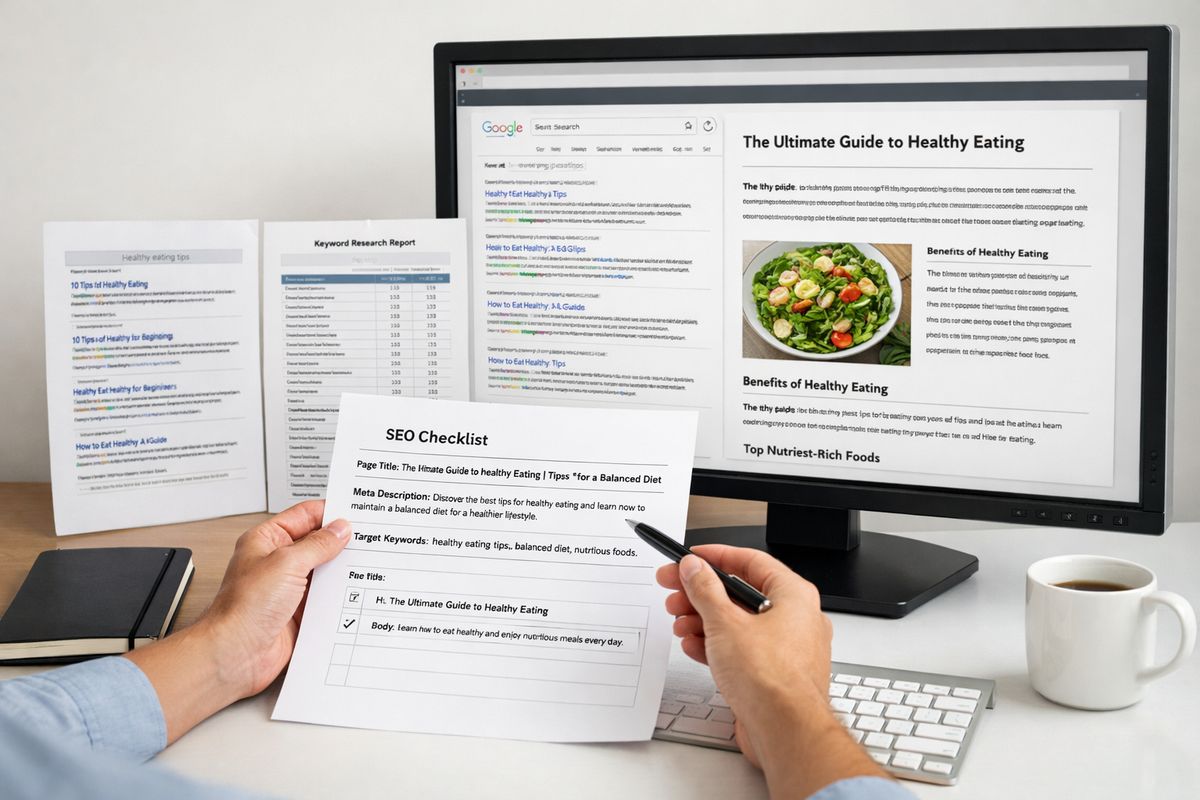
ChatGPT can draft search-oriented copy. It cannot validate search demand, ranking difficulty, or page overlap on its own.
SEO review should focus on usefulness, intent match, and page structure. It should not trust AI confidence.
- Compare the draft to the target query.
- Check the page against existing firm content.
- Review headings, title, and metadata for truth and fit.
Check search intent
A prospect searching “how long after a car accident can someone sue in Illinois” wants a different page than a prospect searching “Chicago injury lawyer consultation.”
- Define the intent.
- Check whether the draft serves that intent.
- Rebuild the structure if the intent and content do not match.
Check keywords and entities
The page should use the right legal and geographic terms. It should not stuff phrases or omit obvious related entities.
- Confirm the target term.
- Add related entities such as court, county, statute type, or case type when relevant.
- Remove repeated phrasing that reads like filler.
Check titles, headings, and metadata
Headings should match the body. Metadata should describe the page without making unsupported claims.
- Read title and heading lines alone.
- Check each line against the body.
- Rewrite any line that promises more than the page proves.
Check for duplicate or thin content
AI drafts often mirror existing site language or common web phrasing. Thin pages weaken performance.
- Compare the draft to current pages.
- Remove repeated sections.
- Add verified local or firm detail.
A larger strategy for showing up in AI-driven search results depends on content quality like this, not on AI output alone.
Step 9: Check originality and risk of reuse
Law firms need distinct copy. Recycled language reduces trust and can blur market position.
Originality review is not only about plagiarism. It also covers stale examples, template phrasing, and generic claims used across many firms.
- Run a similarity scan.
- Compare the draft to leading competitor pages.
- Mark any paragraph that sounds interchangeable.
Run plagiarism and similarity checks
A checker can catch copied passages. Human review still has to judge common AI patterns and near-duplicate structure.
- Scan the full draft.
- Review flagged passages.
- Rewrite any line that tracks too closely to an outside source.
Replace generic examples with firm-specific detail
Firm-approved detail makes the draft distinct. It also makes later approval easier.
- Replace generic examples with real service details.
- Add approved local references.
- Use actual attorney, office, or process facts where allowed.
Step 10: Revise the answer into an approved draft
The checked output now becomes a usable draft. Unsupported claims should be gone. Verified material should read clearly.
Revision is not cleanup only. It is the point where AI text becomes firm text.
- Create a fresh draft version.
- Move over only verified lines.
- Fill gaps with approved human-written content.
- Save notes on every material change.
Cut what cannot be verified
This rule should stay absolute. No proof means no line.
- Delete unsupported claims.
- Delete unsupported numbers.
- Delete unsupported credentials and results.
Rewrite for clarity and precision
Legal marketing copy should use direct language. Short sentences reduce ambiguity.
- Remove vague qualifiers.
- Replace broad claims with exact ones.
- Shorten long AI sentences into clear statements.
Add human review notes
Review notes create accountability. They also reveal prompt problems and recurring AI mistakes.
- Log major edits.
- Record why lines changed.
- Record what source supported the final version.
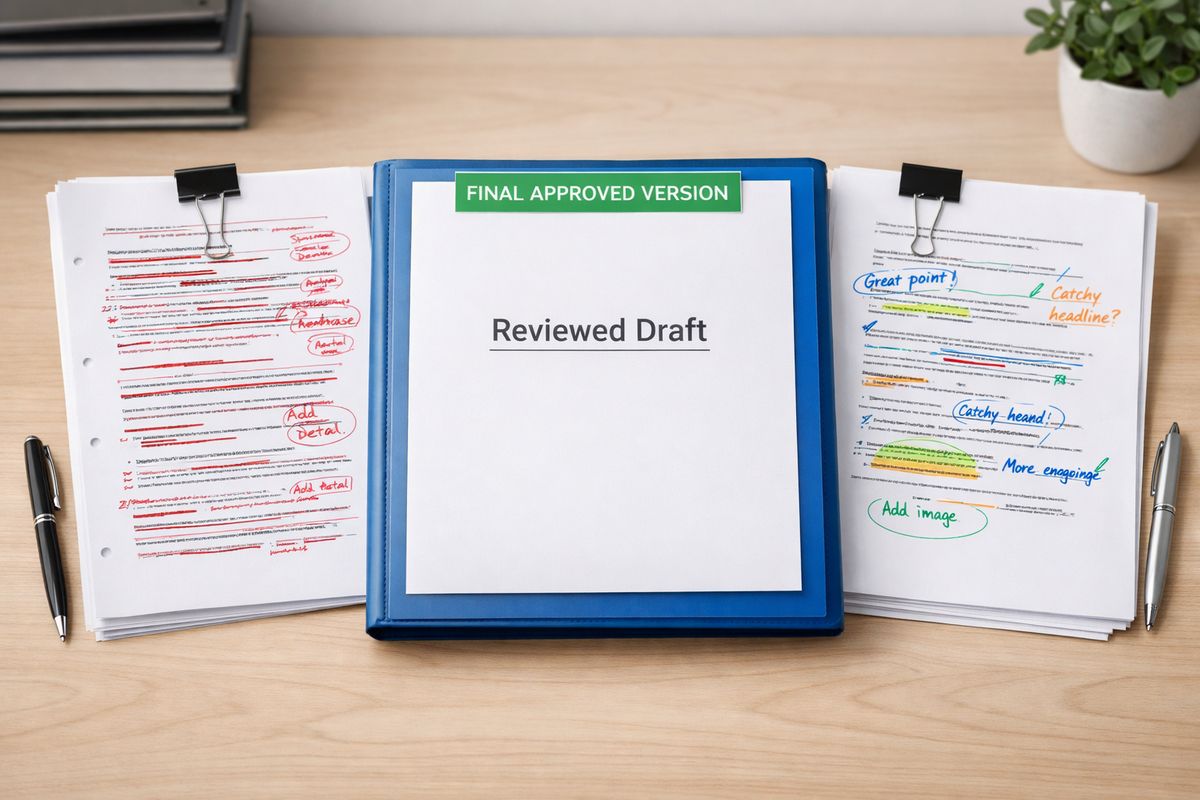
Step 11: Send the draft for legal and marketing review
High-risk content should not publish after one pass. Legal review and marketing review serve different functions.
Attorney review checks legal substance and compliance. Marketing review checks fit, clarity, SEO, and conversion value.
- Send the draft with the review log.
- Route legal issues to an attorney.
- Route content and search issues to marketing.
Assign the right reviewer
Review should match risk and channel. An intake script with legal statements needs a different reviewer than a blog title test.
- Assign legal substance to an attorney.
- Assign SEO and content fit to a marketer.
- Assign final publishing control to one owner.
Use a short approval checklist
A short checklist prevents final-pass misses.
- Facts verified.
- Sources confirmed.
- Ethics checked.
- Brand matched.
- SEO checked.
- Disclaimers present.
Step 12: Build a repeatable QA workflow
One clean review is not enough. The team should turn the process into a standard operating method.
That matters for firms that plan to use AI across blogs, location pages, intake assets, and visibility work tied to tracking how often the firm appears in AI answers.
- Save the checklist.
- Save the fact-check table.
- Save prompt lessons.
- Use the same review path on future drafts.
Create a standard review template
A standard template keeps reviews consistent across people and channels.
- Set sections for prompt, answer type, risk, fact table, edits, and approval.
- Keep the template in one shared location.
- Require its use for every AI-assisted draft.
Set review triggers
Some content needs stricter review by default. New practice areas, legal updates, fee language, and result claims should trigger that higher standard.
- Define trigger topics.
- Tie each trigger to a reviewer level.
- Require attorney review when triggers appear.
Track error patterns
Teams improve when they log repeated failures. Error logs help fix prompts and reduce revision time.
- Record recurring hallucinations.
- Record recurring firm fact errors.
- Record recurring jurisdiction mix-ups.
- Update prompts and templates based on the log.
Troubleshoot common review problems
Some review failures repeat across firms. Each one has a direct fix.
The answer sounds right but has no source
Plausible language is not proof. The team should verify, rewrite, or remove the claim.
- Search for authority.
- If proof exists, cite it.
- If proof does not exist, cut the line.
The answer mixes states or jurisdictions
This error is common in legal drafts. The fix is to isolate one jurisdiction and rebuild the section from local sources.
- Mark all state references.
- Delete mixed rules.
- Rebuild with one jurisdiction at a time.
The answer uses outdated legal or platform information
Old law and old platform guidance create silent errors. Dates should be checked on every authority used.
- Check publication and update dates.
- Replace stale material.
- Reconfirm policy language before publication.
The answer overstates results or expertise
This creates compliance risk. The fix is to remove guarantees, narrow claims, and add required qualifiers or disclaimers.
- Cut guarantees.
- Cut unsupported expertise claims.
- Replace broad superiority language with supported facts.
The team cannot tell who should approve the draft
Approval gaps create publishing risk. Ownership should follow content risk and publication channel.
- Assign one review owner.
- Define attorney-review triggers.
- Define marketing-review triggers.
Expected outcome
A checked ChatGPT answer should be accurate, sourced, firm-specific, and compliant. It should also fit the intended channel and the firm’s intake goals.
The final draft should look less like AI output and more like controlled editorial work. That is the standard.
Next steps
After the first review cycle, the team should turn the process into a standing checklist. Staff should get trained on prompt review, fact logging, and approval triggers.
Prompt quality should improve over time. Error logs should reduce repeat mistakes. Firms that rely on AI-assisted legal marketing need that discipline.
Frequently Asked Questions
How long does it take to check ChatGPT answers for a law firm?
The time depends on risk. A short internal outline may take minutes. A published practice area page with legal claims may take hours.
Who should own the review process?
One owner should control the workflow. That person can assign legal and marketing checks, but one person should hold the file, the log, and the approval status.
Can ChatGPT citations be trusted if they look real?
No. Each source still needs manual confirmation. Fake citations and misread sources remain common failure points.
What parts of a law firm draft create the most risk?
Deadlines, fee terms, results claims, specialization language, and jurisdiction-specific legal statements create the most risk. Those lines need the highest scrutiny.
Is plagiarism the main risk in AI-generated legal marketing content?
No. Factual error, ethics issues, and unsupported legal claims usually create more risk. Originality still matters, but it is not the only review standard.
Should a law firm publish ChatGPT content without attorney review?
High-risk legal content should not publish without attorney review. Low-risk internal drafts may not need that step, but published legal substance usually does.
Law firms that want a formal review process for AI-assisted content should schedule a call with Attorney Visibility ai for more information.